mcsean2163 wrote: » 1. The Irish government has for at least 15 years, that's why we are the third most indebted nation in the world. 2. Me.
Harry Palmr wrote: » Talking about this on Newstalks Taking Stock finance/economics programme. The guest Chris Johns is very much in my corner (or I'm in his!) and railing against the orthodoxy of central bankers, finance ministers and many economists. "Fiscal vigilantes" which is a good term for them. This time it is different, last time we owed other people as we were strung out to the max on "good time borrowing" in a bubble economy. We were doing pretty well before Covid 19 while also saving massive amounts of money (100bn in our clearing banks) this time we owe ourselves, we are on the cusp of a 4th revolution in technology, energy creation & consumption - that's what we build on.
ice.cube wrote: » Out of interest can you explain 'this time we owe ourselves' piece vs owing other people post 2008?
Atlantic Dawn wrote: » They should borrow €50billion more and use it exclusively for majoy infrastucture projects.
Harry Palmr wrote: » Sloppy language on my part, but essentially we the public as collective are not much endebted, whereas we certainly were in 2008. The state has its debt but they can borrow for literally nothing and strink debt through growth.
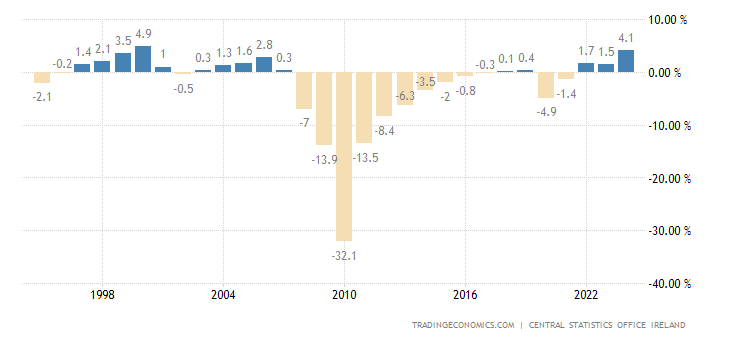
Brussels Sprout wrote: » I was asking in the context of Eurozone countries since that's what your previous post seemed to be on about. If you want to focus only on Ireland - well here were the budget deficits for the past 25 years. After the crash the governments, with the help of the Troika got the public finances back in order gradually over a number of years until eventually the budget was balanced again for the past few years. Seems like the opposite of reckless to me. The Celtic Tiger era spending - yes, absolutely that was reckless. The scenario that we are in this year is more akin to where we were in 2010 though. The financial disaster has happened and now we need to ease our way out of it. It's not possible to get out of this hole without borrowing more money. Trying to do that would do catastrophic harm to the country. It would be similar to a boxer cutting of his leg in order to make weight for a fight.
mcsean2163 wrote: » Set an example by firing the national children's hospital team and then running a criminal investigation of them. Repeat for the housing guy Brendan Kenny. Fire 🔥🔥 and then run the country properly with full accountability and criminal prosecutions for those that cannot do their jobs
Lumen wrote: » This is "man in the pub" logic which doesn't work in reality. Firing people and threatening their successors with "criminal prosecution" will only result in an increase in risk aversion, the end result of which is, perversely, less productivity, more arse covering and greater expense, because procurement will shift towards "derisked" contracts which are always more expensive.
mcsean2163 wrote: » As many have pointed out, the position of always selecting cheapest has failed massively. I'd call it emperor's New clothes logic. Those people were criminally negligent. It's blatantly obvious what should be done to everyone in the private sector and many in the public sector.
mcsean2163 wrote: » I agree re spending now but you ignored my last points, no more level 4/5 lockdown. Get to a surplus position and 60% haircut on bondholders.
Seth Brundle wrote: » If they were criminally negligent as you say, what crimes did they commit?
Brussels Sprout wrote: » The bondholder idea is a complete non-runner. Over 40% of Irish government bonds are owned by residents of the country (mostly the Central Bank). Another third of it is owned by the ECB. There isn't some large collection of 38 year old American Hedge Fund managers who own our debt anymore. All of that debt was refinanced at lower rates which is how the ECB and Central Bank own most of it now. As for the no more lockdown idea - well we can see the finish line of the Pandemic at this stage so it's kind of a moot point. I suspect that we will have one more lockdown period around February. If it's a choice between taking on additional debt to allow that to happen or to run the risk of overwhelming our health service and having thousands of additional deaths on our hands (in the way that USA and many European countries currently are experiencing) then I think it's a no-brainer. No country with our age profile was successfully able to stay open but isolate their older citizens from younger people, so I fail to see the relevance of your comment about under 45s not dying from the virus.
Geuze wrote: » https://johnhcochrane.blogspot.com/2020/12/debt-denial.html Does debt matter?
mcsean2163 wrote: » The crime of losing hundreds of millions through incompetence. People die young and old because the financial cost to save their lives is too much. Literally those decisions are made in hospitals. A lot of lives could have been saved or houses bought if not for the incompetence in children's hospital project. That's criminal negligence IMHO.
mcsean2163 wrote: What's the the figure that causes us to go bust?
mcsean2163 wrote: » Just heard Stephen Donnelly saying we're going to keep spending as long as it takes. Gross national debt at €223 billion now.https://www.ntma.ie/business-areas/funding-and-debt-management/statistics What's the the figure that causes us to go bust?
ice.cube wrote: » Which will eventually see the dollar being removed as the world reserve currency once a suitable alternative comes along. For 2020, yes they brought in around $3.3 trillion but spent $6.6 trillion! The Fed are unable to take their foot of the pedal. Interesting times ahead.
mcsean2163 wrote: » We're already the third most indebted nation per capita in the world. Any thoughts to what would happen if when the debt has to be paid, the interest rates were higher, e.g. 5%. and government revenues were lower.
FreudianSlippers wrote: » There is no such thing as too much debt as long as we can service it.
Arthur Daley wrote: » There is nothing wrong with my bottle of whiskey a day, so long as the old liver can hold up.
Wanderer78 wrote: » ive no idea what your drinking habits have to do about debt, but the poster is absolutely spot on, growing public debt is absolutely fine, provided your economy can indeed continue to service these debts. its common practice globally to continually roll public debts over for extended periods, provided these debts are regularly serviced, without it causing any major negative effects
Wanderer78 wrote: » Countries rarely go bust, as central banks can never run out of money, private debt is the far more dangerous of the two, as we learned the hard way in 08
Arthur Daley wrote: » You know what gets me about all these discussions about debt is that it's a conversation without the creditors ever really playing a part in it. According to a post several posts up, the creditors are largely the Irish citizens, and then various European citizens via the ECB. In particular the creditors are future pensioners, who keep seeing the state default, yes default, on their pensions by pushing the pension age out. Continually pushing the pension age out because you cannot honour your commitments because you've taken on too much debt and too many commitments is a fairly major negative effect to us pensioners.
ELM327 wrote: » Central banks can run out of money especially in the Eurozone. '08-'09 was subprime private debt - which is always problematic if left unchecked. Thankfully the subprime mortgage regime is better regulated now. Plenty of countries have gone bust including some multiple times. The more common practice is to borrow at low interest rates and roll it over ad nauseum until inflation does its job. I believe some WW1 debts were only recently repaid. Now is a good time to borrow, as long as we can afford to service the debt, as interest rates are at historic lows. The only catch to this is that the bond markets must believe in your nation's solvency.
Arthur Daley wrote: » Ok that is interesting. So the main buyers of Government bonds are private (or supposedly private) banks. And they buy this government debt at near zero coupon for what purpose? I mean what is in it for the Banks to keep buying more and more Government debt that doesn't yield much, or anything at all? Also, are these banks in this trade for the long haul. I'm trying to understand why private banks get involved in this, how it generates return to their business. It seems that growing your balance sheet with billions of government debt with little or no return has a finite timeframe from the banks point of view.
Arthur Daley wrote: » Ok that is interesting. So the main buyers of Government bonds are private (or supposedly private) banks. And they buy this government debt at near zero coupon for what purpose? I mean what is in it for the Banks to keep buying more and more Government debt that doesn't yield much, or anything at all? Also, are these banks in this trade for the long haul. I'm trying to understand why private banks get involved in this, how it generates return to their business. It seems that growing your balance sheet with billions of government debt, with little or no return, is a policy with a finite timeframe from the banks point of view. (A bit like my bottle of whiskey a day analogy earlier)