Deleted User wrote: » Im looking forward to going for a spin on that one when it opens. Hmm, might actually head over to Athlone next week for a spin up to Mullingar
Pete_Cavan wrote: » (the alignment is no use as a railway as it was narrow gauge)
ezstreet5 wrote: » It's all 1600 mm and not narrow gauge.
Lord Glentoran wrote: » It’s remarkable how the tactics of some of the most vocal supporters of the greenway option have managed to probably torpedo the very thing that they ridiculed all and sundry to get. As a political campaign it was about the most hamfisted one I have ever encountered. It was like a team thinking that they were playing senior hurling and instead were really playing under sevens rounders with Three Stooges style tactics.
Pete_Cavan wrote: » Sorry it was a light railway which will require a complete rebuild as heavy rail, the cost of which would be astronomical.
Geuze wrote: » Yes, so I think it should be a green-way.
ezstreet5 wrote: » Exactly. Because we all know that absolutely nobody lives along the old railway, so it is obvious that it should become a greenway which would bring huge economic benefits to all of the villages and towns and people living along the old railway.
Muckyboots wrote: » Health, well-being, local heritage protection and investment, community engagement and economic benefit. Don't be under selling it.
Isambard wrote: » it would be correct to say it was a cheaply built line . A Light Railway is another thing altogether.
Pete_Cavan wrote: » No it was built for lighter rolling stock than standard, therefore will have to be rebuilt to accommodate IE trains. It was a light railway at the time but that differs from the modern understanding of the term.
Del.Monte wrote: » And the Mullingar/Sligo line would make a very pretty greenway too. I think the Duke of Wellington would approve as he reckoned railways would only encourage the lower orders to roam aimlessly across the land - away with them. i
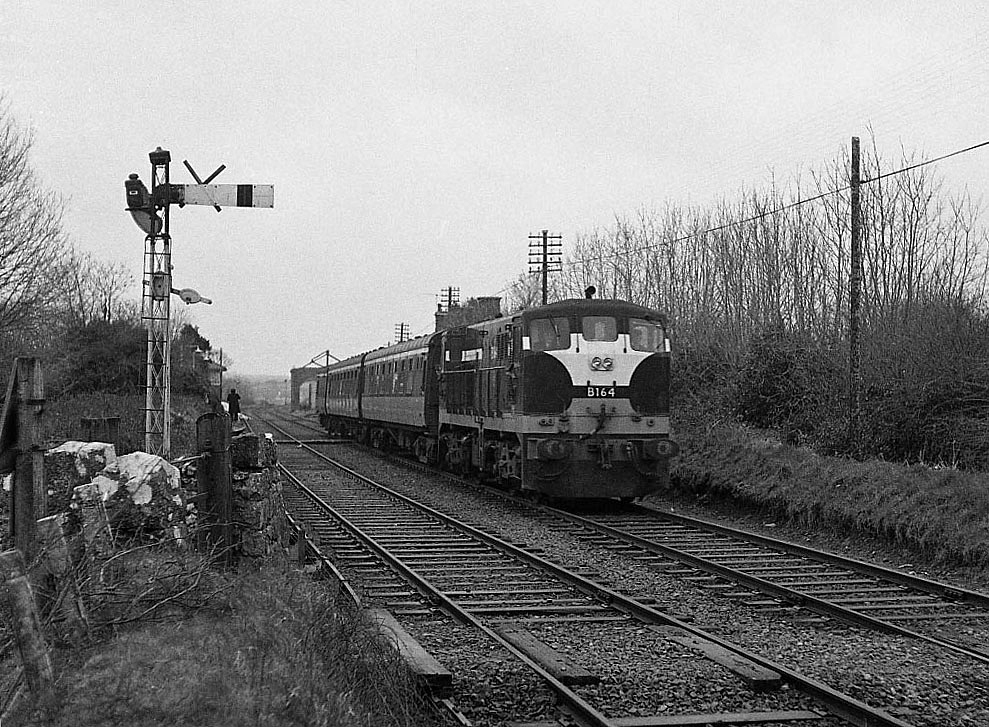
Isambard wrote: » even LIght Railways don't necessarily have lighter rolling stock. Light Railway is a legal term used to denote railways built under different legislation to the normal parliamentary process that set up most railway lines. Knock Special at Claremorris havng come up the Burma Road from Limerick
I understand that there are two main reasons why the cost of the Claremorris Collooney section is very high. Firstly, when it was built in 1891-1892 the section was constructed as a light railway. If it were to be brought into the IE network the formation would have to be rebuilt to the national heavy rail standard. The second relates to the cost of necessary alterations to level crossings, of which there are a total of 290 along the section, two of which alone would cost €24m to create grade separations.
Pete_Cavan wrote: » From the report on which the reopening of Athenry - Ennis was based;https://web.archive.org/web/20060922090156/http://www.transport.ie/upload/general/6645-0.pdf
westtip wrote: » Hilarious LG absolutely hilarious.
ezstreet5 wrote: » At those prices (albeit outdated), the entire line represents a low cost and good value for money.
Pete_Cavan wrote: » With the poor usage on Athenry - Ennis,
ShaneC1600 wrote: » The statement above shows you know very little about the line and its usage pre COVID anyways! You might want to skip on from the fiction area!!
Pete_Cavan wrote: » Athenry - Ennis was estimated at €74.7m, it opened at a cost of €106m five years later, almost 50% uplift. Applying the same to the Athenry - Tuam section, it would have cost €50m 10 years ago. Add in a new bridge over the N63, then 10 years of inflation to get to todays cost, then add another 10 years inflation for when it might actually get built (probably a lot more). If the report which has already been prepared ever gets published, it might give an updated cost estimate. That isn't low cost and certainly isn't good value for an hourly shuttle service (the existing line doesn't have space for direct trains) from a town of 10k people. Low cost and good value for money would be a bus service that provides the same service at greater frequency at a fraction of the cost, if public transport was actually the concern here. Tuam to Claremorris would cost >€100m on top of that. A proper NPV cost analysis would show that kind of money isn't justifiable. With the poor usage on Athenry - Ennis, there is no way the government will be investing such money into more WRC and IE don't want another loss making line anyway.
Pete_Cavan wrote: » Look at the boardings and alightings numbers for Gort, Ardrahan and Craughwell, it certainly is poor usage;https://www.nationaltransport.ie/wp-content/uploads/2019/07/National_Heavy_Rail_2019_FA_ONLINE.pdf Using passenger numbers between Galway and Athenry and Ennis and Limerick to support the case for Athenry - Ennis is fiction, those people had their services before Athenry - Ennis was rebuilt.
Pete_Cavan wrote: » Look at the boardings and alightings numbers for Gort, Ardrahan and Craughwell
ezstreet5 wrote: » Super expensive. That money would be better spent to build 5% of a children's hospital in Dublin, or 10 km of Motorway, or we could extend Covid payments for another 3.5 weeks.
![Photo of [Deleted User]](https://w6.vanillicon.com/v2/62877c35768f143f69acd7bb6cd43f3c.svg)