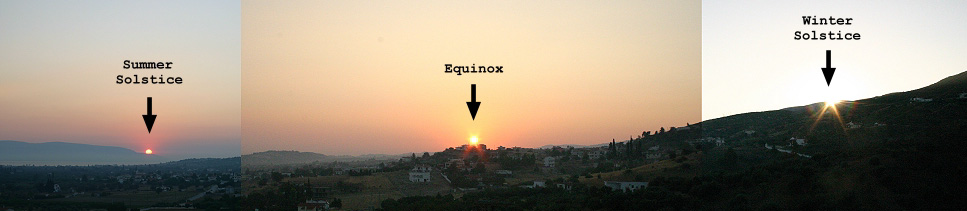
Muahahaha wrote: » Thanks seamus, I must look into it more as it does indeed sound facinating. Have always wondered who was the guy in Stone Age times that came up with the theory that Dec 21 was the shortest day in the year. And how did he feel then when he relaised he would have to wait another full year to confirm his theory. And how really did they pinpoint the exact shortest day compared to all the other short days, I think there is only about three minutes difference in daylight from the 21st to the 22nd so it was a remarkable achievement for them to get that spot on.
Clarence Boddiker wrote: » Which sites are more significant? Are there any major Irish sites that have not had much excavation or any at all?
buried wrote: » 'Queen Meabh's Cairn' atop the summit of Knocknarea in Co.Sligo is definitely one that should be looked at.
EmmetSpiceland wrote: » It’s a nice spot to visit but if you want something “impressive”, and you’re in that neck of the woods, you’d be better off checking out Carrowmore Megalithic Cemetery. Carrowkeel is a bit of trek but would have a passage tomb, Queen Meabh’s yoke is fine for the view, and that, but there’s not a lot going on with it.
buried wrote: » I mean, what is inside the cairn should be looked at by professionals. Even something like radio images of what is in the cairn, or something to that effect. It's strange that there has never been the desire to do so by academics.
Muahahaha wrote: » For me thats always the amazement of Newgrange, the fact that they lined it up to light up on sunrise of the shortest day of the year is remarkable. Anyone know how they did it? I get they were an agrarian society who were conscious of the seasons and daylight but how did they work out what we now know as 21st December as being the shortest day of the year? Has there ever been any evidence of them scraping rocks with lines as a kind of rudimentary calander? Also any evidence of them observing the cycles of the moon?
Bannasidhe wrote: » Absolutely Kelly's interpretation was, and still is, the subject of debate and controversy. My quibble is with the statement 'the OPW used their imagination' as if they just got the lego blocks out and said off you go Paddy, put down the shovel, we're promoting you from culvert digging for the day.
Aint Eazy Being Cheezy wrote: » It is recent. I remember objecting to the planning permission but the fcukers went ahead with it anyway.
Clarence Boddiker wrote: » I found the recent revelations about the incestous relations of people buried at Newgrange and the speculation that they were 'God Kings' to be absolutely fascinating. Especially the discovery that other burials elsewhere (Sligo I think?) were related to the people in Newgrange. Also the fact that a local hill was purportedly known as "the hill of incest" or "the hill of sin" thousands of years later and that the story of the incestuous coupling was recorded in a medieval manuscript, again thousands of years later. (Although I've seen academics of Medieval literature refute the last claim)https://www.sciencemag.org/news/2020/06/dna-ancient-irish-tomb-reveals-incest-and-elite-class-ruled-early-farmers In any case stories like this can lead to flights of the imagination about things like the Tuatha De Dannan!
topper75 wrote: » To what extent would their genes be connected to the average Irish person walking around Meath today? Did they get wiped out?
Edgware wrote: » The same happened in Egypt. Those damm Pharaohs and their brown envelopes got their own way. Bloody pyramids all over the shop
Quantum Erasure wrote: » looking out at the sky this morning I wonder how far science would have advanced if we lived under a permanently cloudy sky, never seeing the sun directly, no stars... Navigation, map making... what would a theory of gravity look like?


![Photo of [Deleted User]](https://w2.vanillicon.com/v2/282101dc2976956f9dfc87f7a2ef2413.svg)