BaZmO* wrote: » This post is the 10,000th post
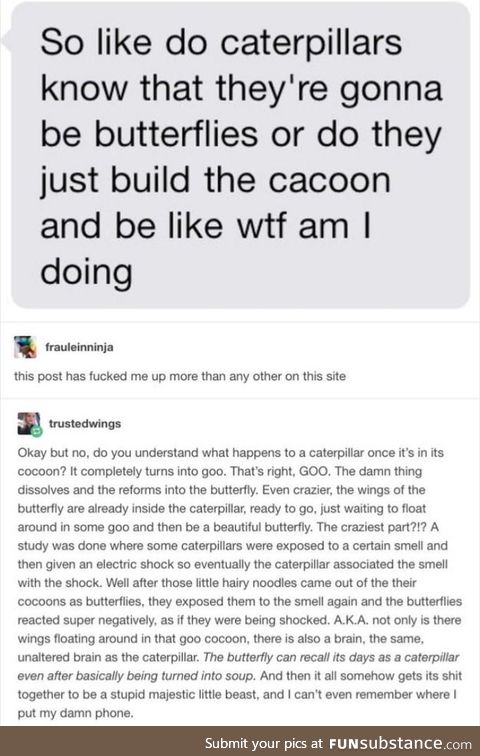
Here's a dangerous, crazy thought from an otherwise sober (and very eminent) biologist, Bernd Heinrich. He's thinking about moths and butterflies, and how they radically change shape as they grow, from little wormy, caterpillar critters to airborne beauties. Why, he wondered, do these flying animals begin their lives as wingless, crawling worms? Baby ducks have wings. Baby bats have wings. Why not baby butterflies? His answer — and I'm quoting him here — knocked me silly. "[T]he radical change that occurs," he says, "does indeed arguably involve death followed by reincarnation."
"In effect, the animal is a chimera, an amalgam of two, where the first one lives and dies ... and then the other emerges." What he's saying is, while a moth appears to be one animal, with a wormy start and a flying finish, it's actually two animals — two in one! We start with a baby caterpillar that lives a full life and then dies, dissolves. There's a pause. Then a new animal, the moth, springs to life, from the same cells, reincarnated.
According to this theory, long, long ago, two very different animals, one destined to be wormy, the other destined to take wing, accidently mated, and somehow their genes learned to live side-by-side in their descendants. But their genes never really integrated. They are sharing a DNA molecule like two folks sharing a car, except half way through the trip, one driver dissolves and up pops his totally different successor. Driver No. 2 emerges from the body of driver No. 1.
BaZmO* wrote: » This came up in an episode of QI years ago (doesn't everything!) and there's still a bit of debate as to whether they are the same creature.Link
Realt Dearg Sec wrote: » This is cool and all, but...Accidentally mated?
Chancer3001 wrote: » trying to remember this fact correctly, so bear with me.... Take a leech, in a lab, have it solve a little maze where there's food at the end. Leech eats the food. Kill that leech. Blend it up. Feed its mushed up body to a 2nd leech. 2nd leech now knows where the food is in the maze. Chemical memory I think it was called That is mental.
Ted_YNWA wrote: » Who the & why the #@?* would even think of that kind of experiment in the first place
Deleted User wrote: » It was probably based on someone trying to disprove tabula rasa?
Ted_YNWA wrote: » you must have to ingest the full sentient being to acquire the knowledge, as I have tried to fly or lay eggs with all the chicken I've eaten.
Memory RNA is a form of RNA that was proposed by James V. McConnell and others in the 1960s as a means of explaining how long-term memories are stored in the brain. The concept behind it was that since RNA encoded information, and since living cells could produce and modify RNA in reaction to external events, it might also be used in neurons to record stimuli.[1][2][3] One experiment that was purported to show a chemical basis for memory involved training planaria (flatworms) to solve an extremely simple "maze", then grinding them up and feeding them to untrained planaria to see if they would be able to learn more quickly. The experiment seemed to show such an effect, but it was later suggested that only sensitization was transferred,[4] or that no transfer occurred and the effect was due to stress hormones in the donor or pheromone trails left on dirty lab glass.[1] Other experiments seem to support the original findings in that some memories may be stored outside the brain.[5][6] Link: https://en.wikipedia.org/wiki/Memory_RNA
Memory transfer has been at the heart of science fiction for decades, but it's becoming more like science fact. A team successfully transplanted memories by transferring a form of genetic information called RNA from one snail into another. The snails were trained to develop a defensive reaction. When the RNA was inserted into snails that had not undergone this process, they behaved just as if they had been sensitised. The research, published in the journal eNeuro, could provide new clues in the search for the physical basis of memory. RNA stands for ribonucleic acid; it's a large molecule involved in various essential roles within biological organisms - including the assembly of proteins and the way that genes are expressed more generally. The scientists gave mild electric shocks to the tails of a species of marine snail called Aplysia californica. After these shocks were administered, the snails' defensive withdrawal reflex - where the snails contract in order to protect themselves from harm - became more pronounced. When the researchers subsequently tapped the snails, they found those that had been given the shocks displayed a defensive contraction lasting about 50 seconds, while those that had not received the shocks contracted for only about one second. The shocked snails had been "sensitised" to the stimulus. Purple ink Scientists extracted RNA from the nervous systems of the snails that received the shocks and injected it into a small number of marine snails that had not been sensitised in this way. The non-sensitised snails injected with the RNA from the shocked animals behaved as if they had themselves received the tail shocks, displaying a defensive contraction of about 40 seconds. They saw a similar effect when they did the same thing to sensory nerve cells being studied in petri dishes. Prof David Glanzman, one of the authors, from the University of California, Los Angeles (UCLA), said the result was "as though we transferred the memory". He also stressed that the snails did not get hurt: "These are marine snails and when they are alarmed they release a beautiful purple ink to hide themselves from predators. So these snails are alarmed and release ink, but they aren't physically damaged by the shocks," he said. Traditionally, long-term memories were thought to be stored at the brain's synapses, the junctions between nerve cells. Each neuron has several thousand synapses. But Prof Glanzman said: "If memories were stored at synapses, there is no way our experiment would have worked." The UCLA professor of integrative biology holds a different view, believing that memories are stored in the nuclei of neurons. The paper might support hints from studies conducted decades ago that RNA was involved in memory. The type of RNA relevant to these findings is believed to regulate a variety functions in the cell involved with the development and disease. The researchers said that the cells and molecular processes in the marine snails are similar to those in humans, despite the fact that the snail has about 20,000 neurons in its central nervous system and humans are thought to have about 100 billion. The researchers see this result as a step towards alleviating the effects of diseases such as Alzheimer's or post traumatic stress disorder (PTSD). When asked if this process would be conducive to the transplant of memories laid down through life experiences, Prof Glanzman was uncertain, but he expressed optimism that the greater understanding of memory storage would lead to a greater opportunity to explore different aspects of memory. Link: https://www.bbc.com/news/science-environment-44111476
peasant wrote: » Which airline is flying the longest domestic flight in the world? Of course, it's ... Air Tahiti Nui Due to Covid-19 restrictions, Air Tahiti Nui on their flight from Tahiti to Paris can not stop in Los Angeles anymore ...so they fly direct. At 15700 km this is now the longest passenger flight in the world. And as Tahiti is French territory it is also the longest domestic flighthttps://www.travelweekly.com.au/article/air-tahiti-nui-breaks-record-worlds-longest-passenger-flight-due-covid-19/
Capt'n Midnight wrote: » You already knew that people in flashy cars are self important. But thanks to science we have a number. The chances of a car yielding to a pedestrian decrease by 3 percent per $1,000 increase in the car's value.
Ipso wrote: » So he was French.
Professor Moriarty wrote: » If the Saxons were bad... Here is Gerald of Wales, having travelled in Ireland in the 12th century, describing the Irish he encountered: The Irish are a rude people, subsisting on the produce of their cattle only, and living themselves like beasts – a people that has not yet departed from the primitive habits of pastoral life. In the common course of things, mankind progresses from the forest to the field, from the field to the town and to the social conditions of citizens; but this nation, holding agricultural labour in contempt, and little coveting the wealth of towns, as well as being exceedingly averse to civil institutions – lead the same life their fathers did in the woods and open pastures, neither willing to abandon their old habits or learn anything new. This people then, is truly barbarous, being not only barbarous in their dress but suffering their hair and beards to grow enormously in an uncouth manner, just like the modern fashion recently introduced; indeed, all their habits are barbarisms. But habits are formed by mutual intercourse; and as these people inhabit a country so remote from the rest of the world and lying at its furthest extremity, forming is it were, another world, and are thus excluded from civilised nations, they learn nothing and practice nothing, but the barbarism in which they are born and bred and which sticks to them like a second nature. Whatever natural gifts they possess are excellent, in whatever requires industry they are worthless"
johndaman66 wrote: » You could probably substitute 21st century for 12th century in that passage and for the very most part it would hold relevant







![Photo of [Deleted User]](https://w1.vanillicon.com/v2/1de30a3af99564ce338f7a27f88f9656.svg)


![Photo of [Deleted User]](https://w7.vanillicon.com/v2/76c148e0517471ca7394feb81f5488ae.svg)


