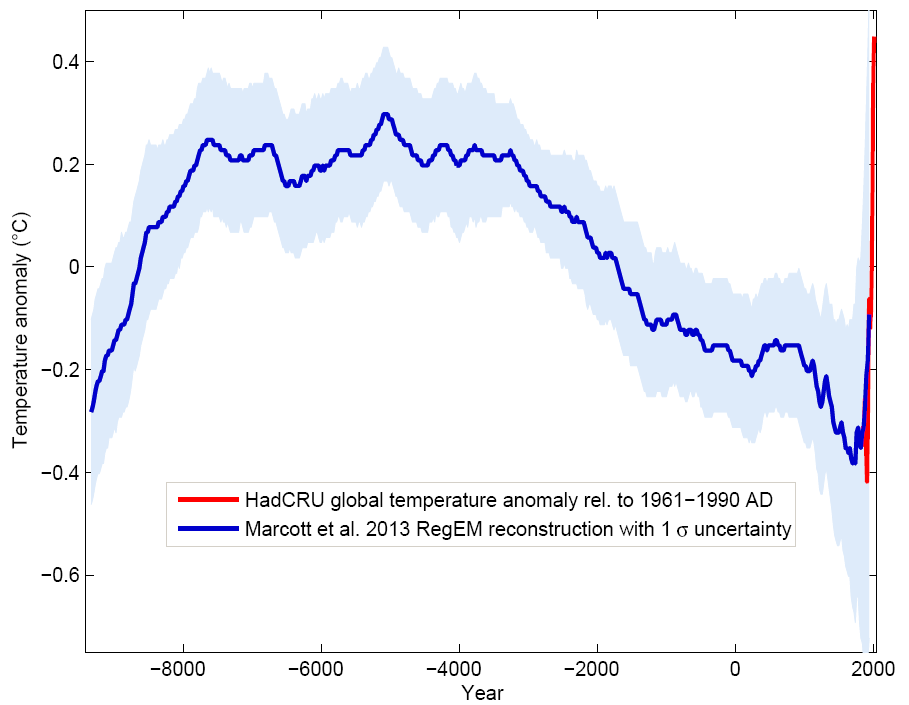
moonage wrote: » CO2 levels got dangerously low in the past and life on Earth was nearly doomed. (At around 150ppm plants can't survive.) CO2 is the gas of life and it's great to see levels so high, resulting in a greening of the planet.
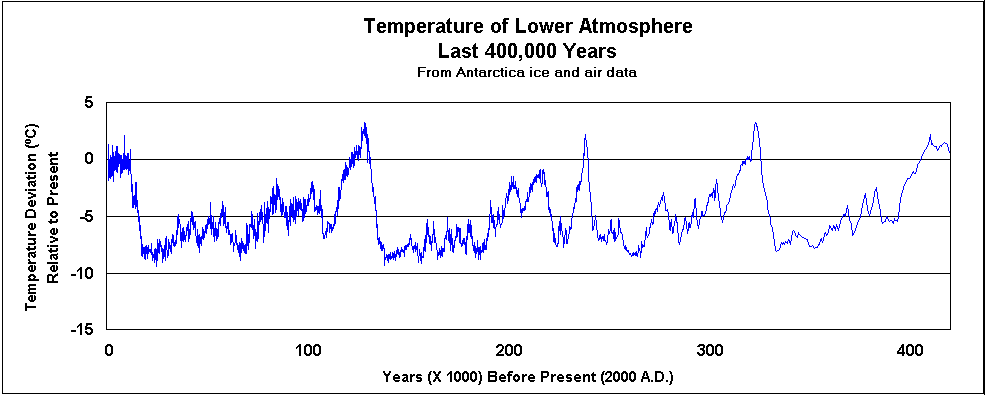
JoeFritzl wrote: » As previously stated, it can be summarized to a sinusoidal graph. It has its peaks and its lows. Its nodes and anti-nodes. Its crests and troughs.
JoeFritzl wrote: » I am actually a member of the Green Party and the reason we never use this as proof is because the ice age was more significant by a magnitude. Ice has been melting for a long time, it's what ice does. We know it's melting at alarming rates but we need to pinpoint what the true cause of this is. It could very well begin to get colder again in the near future. The actual graph we look at these days is the graph of the increase/decrease of ice over time. This is the derivative of ice melted per day over time. We don't have much historical data to compare this with, but it seems to be a sinusoidal and we expect the ice to begin freezing again. Climate change is no longer about global warming and we sort of accept that. We are more about the environment now and trying to prevent litter/clean up our waters and prevent overfishing. It's also very important that we move to greener forms of energy as it's more cost effective long term.
Edgarfrndly wrote: » I think once you understand how humans can affect the planet's climate, the data becomes more important. The sun's energy enters earth, warms the planet and then reflected back out as infrared radiation. The wavelengths between the sun's energy and the energy being reflected back out into space from the earth are different. Greenhouse gases partially trap some infrared radiation, which in turn is reflected back to the planet. This cyclic effect causes the planet to warm. CO2 is an issue because it stays in the atmosphere for a relatively long period of time. So it has an accumulative effect. We know that CO2 is a greenhouse gas. We know that greenhouse gases warm the planet. We know that we are increasing atmospheric CO2, while at the same time chopping down larges areas of forest that would naturally act as a carbon sink. So what you're really looking for is a convincing piece of data to show that the above is false. Which you won't find. If you're looking for visual evidence, you can look at a multitude of satellite images of low-lying islands to see their area loss because of a rise in the oceans, from the warming of the planet. I would also say there's a few misconceptions around climate change. No scientist has ever said the planet's climate doesn't naturally change. What they are saying is that the current rate of change is attributed to human activity because it deviates outside all trends prior to the industrial revolution.
'If you torture the data long enough, it will confess to anything'
Computer Science Student wrote: » I think we all agree that man can have some effect on the climate but I also think that it is quite likely that any effect is pretty close to negligible, especially when you look at graphs that clearly show on a large enough timescale, there is pretty much nothing outlandish going on.
Computer Science Student wrote: » . I would love to discuss it objectively with people who understand that aspect of the debate - and then the debate becomes more of a debate around how the data is being prepared, and not just look at my picture.
JoeFritzl wrote: » I am actually a member of the Green Party
Mattdhg wrote: » I'm an environmental science student, and coming from a rural background my father was always very skeptical at everything I had to say, and would often reply with statements like "How do you know science is real?" or "How do you know all the books are right?"
Computer Science Student wrote: » I think we all agree that man can have some effect on the climate but I also think that it is quite likely that any effect is pretty close to negligible
Chinasea wrote: » Windscreen of your car. 30 years ago if you drove from through the country your windscreen was covered in midgets etc.
alchemist33 wrote: » For After Hours, this thread has actually been an informative and interesting read.
vriesmays wrote: » Do you know what % of the atmosphere is carbon.
Mattdhg wrote: » I'm an environmental science student, and coming from a rural background my father was always very skeptical at everything I had to say, and would often reply with statements like "How do you know science is real?" or "How do you know all the books are right?" So I broke it down in simple terms, effects he sees. I at least got him to acknowledge the biodiversity crisis. When I was a child growing up in the early 2000s there were an incredible amount of moths, butterflies and other insects outside. And foxes, rabbits, hedgehogs and the occasional badger (albeit flattened in the middle of the road). Since my childhood there has been an obvious and dramatic decrease in all these numbers, and he tearfully agreed. He said nearly every night he leaves the window open while he reads the newspaper in his room and he never notices any moths/daddy long legs coming in. He also said as a child growing up here there were frogs that would emerge out of the boggy land, and go everywhere, often making their way into the house. Minnows lived in the water ways and they'd try catch them in jars. He can't remember the last time he ever saw them, and I never saw them here in my life time at all. Sometimes you just need to put reasoning on things people noticed already. Ask ye're auld wans and they'll probably have a similar tale. The problem with climate change is that it's so gradual, its hard to pinpoint to a few specific things. You can say the intense weather events but a bad storm will always come now and again. Historically, the rate at which the earth's temperature is rising is unprecedented, and its very hard to stop the knock on reaction. Higher temp = increased water vapour in ear, which is essentially a greenhouse gas and traps more of the sun's rays. And on and on and on
Ultimanemo wrote: » This is the map of Europe 20,000 to 70,000 years ago most of the UK and most of Ireland were covered with hundreds of metres of snow, global warming is a fact
Computer Science Student wrote: » And if you go back further again, you'll see even more ice. So were humans causing global warming since the ice age or does ice just melt over large periods of time in the history of the planet?




![Photo of [Deleted User]](https://wb.vanillicon.com/v2/bd89cdce15309a6ec2dff928c865017a.svg)


![Photo of [Deleted User]](https://wd.vanillicon.com/v2/d78fd5f5292e11c2974bcd779ad2a2f0.svg)