Silentcorner wrote: » The history of the planet?
Computer Science Student wrote: » I don't want any of the usual hyperbole diagrams or quoting statistics on emissions, greenhouse gases etc. I just want to see that the climate's change in temperature can be shown to be changing in a statistically significant way.
ROAAAR wrote: » I guess the significantly less amount of ice remaining in the north pole compared to 30 years ago.
Duke of Url wrote: » Carbon dioxide (CO2) is an important heat-trapping (greenhouse) gas. The Industrial Age is pumping billions of tons of Co2 into the atmosphere. Trees absorb Co2 and produce oxygen. Fock it. We cut the trees down too. Ice absorbs Co2 also but that sh1ts melting. Rocks absorb Co2 but we’re smashing that crap up too. Co2 has gone nuts in the past 50 years never measured at this quantity in history Again to the first sentence Carbon dioxide (CO2) is an important heat-trapping (greenhouse) gas
Computer Science Student wrote: » I don't want any of the usual hyperbole diagrams or quoting statistics on emissions, greenhouse gases etc.
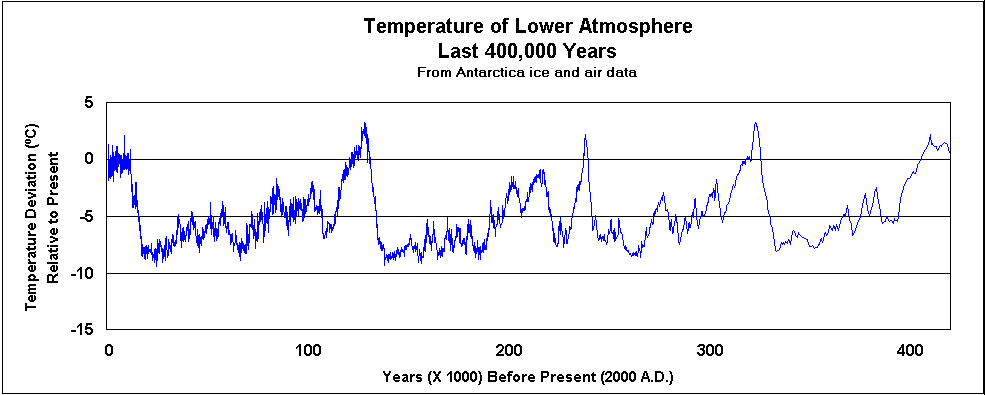
Computer Science Student wrote: » This is an intriguing argument. Would you mind supporting the diagram with a research paper or similar delving into the raw data. Visually it definitely is statistically significant, but I would like to see how the data was prepared to get there.
Fr_Dougal wrote: » The end of the first ice age.
In a geological sense, we are still in an ice age as there is still ice in Antarctica and Greenland. The Antarctic ice sheet is roughly 35 million years old, and the Greenland one is roughly 1.5 million years old. Before 35 million years ago there were no ice sheets at all. We have to go back to the Permian period some 270 millions years back to find another period on Earth with significant ice volumes.
Computer Science Student wrote: » https://www.johnenglander.net/wp/wp-content/uploads/2011/11/CO2%20550my%20Extinction%20Chart%20from%20Ward.jpg
Would you mind supporting the diagram with a research paper or similar delving into the raw data. Visually it definitely is statistically significant, but I would like to see how the data was prepared to get there.
Duke of Url wrote: »
[Deleted User] wrote: » This. If you want to see a runaway greenhouse gas effect, check out venus.
"a 'runaway greenhouse effect'—analogous to [that of] Venus—appears to have virtually no chance of being induced by anthropogenic activities."
Deleted User wrote: » So, no complicated facts or data, just a nice word picture for you, . Do you want us to sing you a lullaby about climate change ?


![Photo of [Deleted User]](https://w4.vanillicon.com/v2/4781b34abcdc100dc96f5c22e41cff29.svg)
![Photo of [Deleted User]](https://wb.vanillicon.com/v2/bd89cdce15309a6ec2dff928c865017a.svg)




![Photo of [Deleted User]](https://we.vanillicon.com/v2/e050b53be62f0ae2404c620976170938.svg)