Franz Von Peppercorn II wrote: » I on the other hand think that any intelligent alien would have something like pythagoras‘ theorem in their mathematical belt.
Fourier wrote: » Do you mean this to say mathematics is "true out there" independent of minds or just that aliens will probably think and use concepts of space etc like we do. The latter I can see, the former I find hard to square with things like Godel's theorem.
Franz Von Peppercorn II wrote: » Of course they’ll probably just make me a sex slave. But I won’t be eaten.
Fourier wrote: » Bernard d'Espagnat was a French physicist who thought about this sort of stuff. If there were aliens who could just grasp the things we can't, could they communicate it to us. Does our non-analytical side sometimes grasp stuff genuinely not captured by the analytic side, i.e. maybe there is some "truth" captured by finding a sunset beautiful that mathematics doesn't. Once you open the door of mathematics and science not having access to the "truth" you naturally open these questions. Hard to know.
Fourier wrote: » In light of Godel's theorem and other results very few people today in mathematics are Platonists, i.e. believe mathematics exists "outside of space and time" and view that as being as silly as saying "English exists outside of space and time". The vast majority take the view riffmongous and Wibbs expressed above, i.e. that it is simply a language.
Perla Full Urination wrote: » Gödel himself was a mathematical platonist, and did not see platonism as incompatible with his incompleteness theorem. He certainly did not view it as "silly."
Franz Von Peppercorn II wrote: » I don’t know much about Gödel, however what I am saying is that if I am am ever caught by aliens who look like they are going to eat me, and working on the assumption that they won’t eat intelligent animals, I’ll write something like Pythagoras’ theorem in the dust. A right angled triangle with 5 dots beside the hypotenuse and 3 and 4 dots as appropriate on the other sides. They’ll say: “ it knows ziggüërts algorithm. We can’t eat it”
Fourier wrote: » Probably not in my opinion. In my opinion even scientifically there often isn't an absolute truth, though in most cases this doesn't matter or is a technicality.
Fourier wrote: » He was originally. Not toward the end of his life and this was largely as a result of his theorem and work following from it like that of Paul Cohen's. This is directly confirmed in correspondences especially around 1952 onward.
Perla Full Urination wrote: » Can you indicate which letters written by Gödel back that up? It's my understanding that saw his incompleteness theorem as supporting mathematical platonism rather than undermining it.
Quaker Fellowship Princeton Collection Box 8 wrote: In mathematics, [the] question is to find out what we have perhaps unconsciously created.
Complete works of Kurt Gö wrote: » The method for the foundation of knowledge is then psychoanalysis.
Fourier wrote: » Two fairly straight forward examples
It would be more accurate to say he was mostly Platonist about some areas of mathematics, but not all.
The more important point is that the majority of the mathematical community today is not Platonist...
Perla Full Urination wrote: » Those examples don't actually contradict the Platonist position. The debate over Gödel is whether his views constituted a "strong" or "weak" Platonism — but there's little support for the belief that he actually ever rejected mathematical Platonism.
Perla Full Urination wrote: » So Platonist mathematics do exist?
So you claim, but mathematicians such as Reuben Hersh believe otherwise, and I don't believe there's any clear evidence for asserting what "the majority of the mathematical community" believes on the subject.
In any case, pointing to a majority belief is a clear instance of the argumentum ad populum logical fallacy of the form "Most people believe x, therefore x is true."
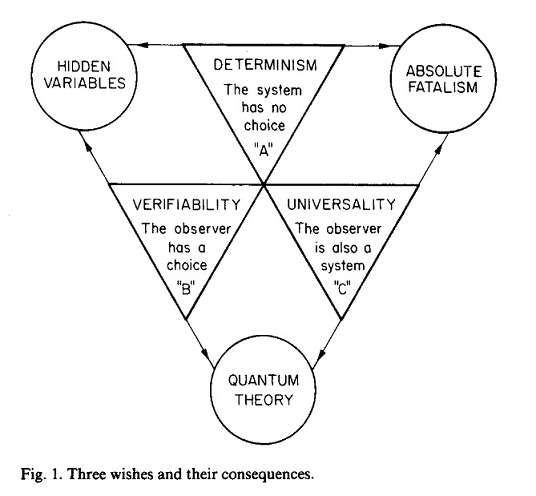
sbsquarepants wrote: » But would you not be inclined to think that maybe that QM is just not the right tool to describe whatever the absolute base reality is? ... I just can't wrap my head around the idea that there wouldn't actually need to be one hidden somewhere
Schrodinger wrote: Quantum Mechanics forbids statements about the what really exists, statements about the object. It deals only with the object-subject relation
riffmongous wrote: » Hm I can use mathematics to make theories that I know are not true in our universe, even though they are rigourous








![Photo of [Deleted User]](https://wd.vanillicon.com/v2/dcc54fc0153c491ede3e66aef098573d.svg)