LXFlyer wrote: » I am NOT backtracking. Unless high capacity underground north/south and east/west rail solutions are in place (Metrolink and DART Underground) then there is no way you can move buses out from the city centre area. There's also a hell of a difference between continuing to use existing tram lines (which the vast majority of other cities have) and putting in brand new tram lines along shared space that doesn't offer any particular speed improvement. I really don't see that happening at all. Re College Green there were two lanes in each direction. Now there is one in each direction. That's the problem. The appallingly designed two way cycle lane takes up one of those lanes - the revised layout to facilitate LUAS with wider lanes and the larger island removed the other. Re the 54a - I was responding directly to your point. What other route (apart from the 49) starts on Pearse Street? The 49 is only two buses an hour as well.
LXFlyer wrote: » I think that you'll find that the prime objection to the original plans was the enforced changing to get to/from the city centre. I was thinking more of the distance from Clanbrassil Street/Patrick Street. You could conceivably be doubling people's walking distances from the existing routes if they are heading eastward. That does become an issue here.
Last Stop wrote: » Great more anecdotal evidence. A single busy point in the city doesn’t mean it’s efficient. Again it’s 10% modal share so extremely low compared to other modes despite the coverage (almost everyone has access to a bike and there are a significant number of routes where people can cycle safely)
Last Stop wrote: » You’re speed argument is all relative. It’s 5km from the dodder bridge to college green. Even at an average speed of 15kmph that would give a journey time of 20 minute. Keep in mind that between Harold’s cross and Christchurch it would not be sharing with cars so can get up to 35kmph like it does on other streets like Harcourt for example. So a delay of 1-2 minutes isn’t going to effect things massively when you consider how busy the Luas green line is on journeys over 20 minutes (past milltown approx. then I see no issue with with the speed. If you look at cities like Manchester, Edinburgh and Nottingham they have developed tram networks recently in a bid to reduce congestion’s. These are the examples we should be looking at as they are a comparable size to Dublin. The fact that bigger cities maintain tram lines further highlights their credentials
Last Stop wrote: » So what about keeping line F and running A via Kevin st? My point being there is alternatives to college green even though I don’t agree with the full closure either
Last Stop wrote: » The addition of the gap between the road and the footpath increasing the number of crossing for pedestrians is not in the Dutch model. The curves in the Dutch model are far less severe than those proposed in this example. You also missed my last point?
Last Stop wrote: » Is agree the current road is substandard as it was designed before DMURS was published but why as part of an upgrade should be not design the road to DMURS completely rather than just bring it “more in line”. DMURS was developed in the interest of ensuring all road users are safe. If we are not using to full effect which it looks like here then it’s unsafe. Your signalling proposal ignores the nucleus of my point in that the n11 mainline gets more green time that the side roads. How long do your propose to hold the filter lanes for? On a number of the n11 junctions the traffic back up past the filter lanes (hence their presence). If you hold them longer you hold the mainline causing gridlock. I’m not too fussed about extra green time for pedestrians as I am of the opinion that it is adequate currently and if it needs changing it is a relatively simple measure. There is a significant number of people on here who jump at those who criticise Busconnects. I don’t agree with NIMBYISM but I have raised some serious issues here which no one has been able to address and even point here is effectively a defence of the NTA who got in wrong in the first phase and are now playing catch up.
Last Stop wrote: » Buses are more efficient than cyclists and trams more than buses
Last Stop wrote: » 7-10 is low? If I got 10% in an exam I wouldn’t be happy and thinking great room for improvement. The modal share is the same despite their being only 2 tram lines. Everyone can access a bike?
Last Stop wrote: » Define a “little bit more mixed”? As in similar to the hill at Christchurch or a gentle incline? How does cycling modal split fare in the more mixed areas as all the evidence presented in Amsterdam and Utrecht is based on areas in Holland itself correct? So based on that my point is valid. Throwing in ebikes as a solution is a token gesture.
Last Stop wrote: » But the point is you can’t build half a tram line but you can build half a cycle lane... therefore it is easier to stop funding despite only certain parts being build which leads to the whole network collapsing. Adding a tram line now and another in 20 years still helps significantly where as adding 1km of cycle lane now and another in 20 years won’t encourage people to cycle.
Last Stop wrote: » Again point me to figures on the return on investment in particular passenger numbers or reduction in traffic when a cycle lane is provided. Surely that’s available for some schemes?
Last Stop wrote: » It’s a reason people use. An excuse yes but it’s a reason why people don’t cycle. I’m not denying the main issue but my point was a list reasons why we won’t be like the Dutch and this is a valid reason.
Last Stop wrote: » I have not suggested closing access to any streets etc. Or reducing the width of a significant amount of roads which would be required to install cycle lanes. This comes down to catchment areas. A tram serves an area 1km around the stop. To be served by a cycle network you effectively need a cycle lane on every street.
Last Stop wrote: » Don’t care where it ranks, it’s a reason. If you’re suggesting adapting then your adding to the cost of cycling infrastructure. I know the vast majority of places will definitely not pay for such facilities out of their own pocket unless it becomes law.
Last Stop wrote: » My point is some people can’t drive or cycle and therefore rely on public transport. Investment in trams accommodates everyone equally. The catchment area of a tram is significant (around 1km) so I don’t see your point here. Developing a tram network would serve a significant proportion of the city. More people on trams is also a bento the country? With investment in a tram network and redesigned bus network, there would be a significant increase in public transport use. 50% is ambitious but there is far better chance of getting 50% of using public transport than using bikes even if just based on the fact that there is a percentage of people who physically can’t cycle. A 50% modal split on cycling would be extremely difficult. The GDA plans 2000km of cycle lanes to maintain 10%. How many more would be required to reach 50%. At this stage the costs are surely favouring trams. Even a doubling of modal share to 20% would put a massive strain on even the best parts the cycling infrastructure such as the grand canal cycleway and the Drury st bike park. 50% public transport on the other hand could be achieved
Bambi wrote: » Massively inefficient given the low usage to space allocated, basically handing road space over to a small group of very vocal hobbyists. Emphasis should be on mass public transit in peak hours rather than private transit like bicycles and cars
Last Stop wrote: » I’ve said it’s not feasible. Doesn’t answer my question as to why not other country has done it? Surely the Germans would have tried if it was that easy?
Last Stop wrote: » Again show me where there is a change of level at the junction. I’m not arguing with the segregation of cyclists of course thats beneficial. I’m arguing against doing this to the detriment of pedestrians. You still haven’t explained why there needs to be a gap between the road and the cycle lane unlike how the Dutch design their junctions
Last Stop wrote: » Sending a link to a pro cycling website with no link to any reports or similar really doesn’t help your case. The UK report says between 2:1 and 35:1.... would that’s vague. A Luas line has a cost benefit ratio of 4:1 typically so if any of the proposed cycle lanes are around the 2:1 mark then Luas is a better alternative as I have said all along.
donvito99 wrote: » How does the person on a bicycle get to the top of the queue when a person in their car has to join from the back? There is no inbound cycle lane. A bicycle barely 2 feet wide is inherently efficient for this reason. That 10% share is remarkable given that Dublin's infrastructure is wholly inadequate despite what you may think.
LXFlyer wrote: » Again you are moving the A spine further away from the city centre as it approaches it, before looping back, discommoding more people than you are facilitating by virtue of a longer route. Using Parliament Street is critical in my view if you are to reduce bus use on College Green - without it I just don't see how any plan that avoids College Green will be an improvement or similar to what we have now. It minimises the length of any diversion. DCC turned use of Parliament Street down on environmental grounds - given that the network won't start to change until 2021, it is reasonable to say that by the time the George's Street routes get redesigned, that all of the routes that would use it could by then be operated fully by hybrid vehicles.
LXFlyer wrote: » The tram networks in those cities outside the city centre are not on-street by and large. They're segregated. Edinburgh's trams beyond Haymarket are fully segregated. Most of Metrolink in Manchester is on former railway lines or are segregated outside the city centre. Harold's Cross-Christchurch isn't a problem area currently as traffic flows reasonably quickly - the problems are further south where the roads are narrower and you have pinch points.
monument wrote: » That's outright misinformation. There isn't a significant number of routes where people can cycle safely. Also: Errr... no, almost everybody in Dublin do not have access to a bicycles fit for commuting or normal daily use.
Last Stop wrote: » You don’t need to buy any specific equipment to use public transport.
Last Stop wrote: » My point being there are alternatives to college green although college green is still the best option Reducing the number of buses is even more critical. I cannot see us having fully hybrid vehicles by 2021. They won’t even have the 600 they ordered built by then and these will only be phased in to replace older stock.
Last Stop wrote: » From Haymarket to York place in Edinburgh is 2.6km. From Terenure to Harold’s cross is 2km. While I appreciate it wouldn’t be fully segregated from Harold’s cross to Christchurch as you said yourself this isn’t a problem area so speed isn’t an issue. A speed of 30kmph on this section would mean that you could be slower through Terenure and still get to college green in 20 minutes. I like how you left out the Nottingham trams which have a significant amount of on street shared running too even outside the city centre...
Last Stop wrote: » There are a significant number of routes that have full cycle lanes on them with more planned in the near future separate to Busconnects.
Last Stop wrote: » Surely your second point brings into question your point about costs. If everyone has to go any buy a bike it’s a significant cost burden which should be included in the cost benefit analysis. You don’t need to buy any specific equipment to use public transport.
Last Stop wrote: » Around 10% is the norm around the world so nothing remarkable about Dublin.
Last Stop wrote: » If it’s so efficient at 2ft then why are we building lanes up to 10ft wide?
LXFlyer wrote: » So what? I’ve not been to Nottingham. But I have been to both Manchester and Edinburgh. I commented upon what I know about. It doesn’t change my view that laying brand new tramlines along shared road space isn’t a good idea. Haymarket to York Place is in the city centre. It is nothing like Terenure to Harold’s Cross. We are talking chalk and cheese here. The disruption that would be involved on a key artery to divert utilities and lay down tracks all for what? A slow tram no faster than the buses that already operate there. This isn’t even remotely going to happen. Whether you like it or not, you’re stuck with buses for the foreseeable future.
Last Stop wrote: » Well I would suggest you look at what Nottingham has done to that shared space running does work. Busconnects is doing this in 16 corridors for Christ sake. Buses aren’t currently segregated from Harold’s cross all the way to Christchurch and again from Terenure to the dodder. If you’re suggesting that you can’t get from the dodder to college green in 20 minutes by bus then you’re living in fantasy land
monument wrote: » The more you type the more clueless you seem about cycling... are you for real? What are "full cycle lanes"? How many times do I have to say that there is not a single segregated cycle route from city to suburbs in Dublin? Cost of a bicycle and on-going costs is significantly cheaper than the cost of public transport. Just a reminder that after 1.5 billion euro later, Luas has the around the same or a bit lower modal share. You claimed a while ago in this thread to be a qualified civil engineer and now you're asking why cycle lanes should be wider than 1 metre? What lane in Dublin has been built or is planned to be built "up to 10ft wide" that isn't two-way? Every time I think you have shown the extent of how little you know about cycling, you start typing again. Given your posts here, if you're still working as a civil engineer, please tell me nobody is letting you near cycling projects.
donvito99 wrote: » How is a tram faster than a bus?
Last Stop wrote: » Less stops, faster acceleration, greater priority to name but a few reasons.
monument wrote: » What space allocated? In Dublin there's a tiny amount of space allocated to cycling -- usually it's substandard, only the space left over after space is given to other modes, and not segregated and often blocked by motorists. You saying it is not feasible without any reason to back that up does makes your point very weak. As for "if it was that easy" -- who said it was easy? It's been said to you many times it's hard but just because something is hard is not a reason why not to do it. I just said it in what you were replying to! And some German cities have been trying to do it with different levels of success. As in my other reply -- you don't seem to know how the Dutch design their junctions. And you're again using pedestrians to argue against life-saving segregation. Cherry-picking the lower end of a scale in one reference point on the page I sent If you want to do more cherry-picking, there's loads more links to read under "further reading" header on that page, including:6,500 early deaths prevented annually in NL due to cycling levels — Universiteit UtrechtThe cost-effectiveness of bike lanes in New York City -- BMJ 'The Value of Cycling’ -- UK DoT You might have found the further reading links if you were not just focused on taking pot shots at cycling.
Last Stop wrote: » There are sections of the N11, rock road all the way out to howth including Clontarf and Sutton where people can fully commute with bike lanes. E.g Clontarf to east point business park as a single example. Not everyone works in the city centre and lives in the suburbs.
Last Stop wrote: » Again your point about Luas ignores the relative size of the system - 2 lines vs the possibility that people can in theory cycle from any part of the city.
Last Stop wrote: » Once again you’re twisting my words. Someone suggested how efficient Rathmines was with 2ft and I asked why we are building wide lanes if 2ft is sufficient. Do cyclists not get sarcasm?https://www.cyclemanual.ie/manual/thebasics/width/ And for the record depending on the road conditions the national cycle manual advises cycle lanes in excess of 3m. As an example on the n11 at Colaiste Eoin, the manual advises 0.65 (beside a wall) + 1.25 (single file + overtaking) + 0.75 (beside a road) + 0.25 (uphill) + 0.25 (around schools) = 3.15m or over 10ft so I actually overestimated. Based on this I would appreciate if you withdrew your challenge of my professional credentials.
Last Stop wrote: » I’ve given your a list of reasons why cycling will never be as popular here as in the Netherlands.
Last Stop wrote: » My suggestion that it is easy is that you are saying that with the investment here, cycling numbers would skyrocket to Utrecht type levels when in reality they won’t because it requires so much more than that and in Ireland we simply do not have the political will power to make it happen making it unfeasible.
Last Stop wrote: » So even following the Dutch model doesn’t guarantee success? That’s a significant risk to be betting €2bn on. At least with trams you know what you get.
Last Stop wrote: » Yet again you’ve failed to explain to me why there is a gap between the cycle lane and the road. Explain that and I’ll appreciate the design. But until that point I remain of the view that it is an unsafe design for pedestrians and cyclists.
Last Stop wrote: » It’s such a broad range I didn’t have much choice. Again all the articles refer to public health but do little to address the biggest issue when it comes to transport in Dublin which is congestion. Of course we all know the reason for this is that cycling does little to reduce congestion.
Last Stop wrote: » I’m not taking pot shots at cyclists. If I wanted to do that I could have gone down the running red light route but I didn’t. Instead I made an argument as to why trams would reduce congestion more than cycle lanes.
monument wrote: » You're digging so much you need something bigger than a shovel. A JCB might be too small too. With you, it's fallacy or straw man one after another. Your argument goes from a "significant number of routes that have full cycle lanes" to there "are sections of". Goal posts are quickly changing. And you really cannot be getting uppity re professional credentials when you keep acting the fool to score points -- in other replies you have (rightly) said cycle networks are needed, not just single routes, but now you're saying parts of routes are good enough. All of this just to score points. You're more intelligent than this. All you're doing here is trying to point score when you really aren't doing any of your arguments for trams over buses any favors by being so illogical on cycling. What, just like there's the possibility that people can in theory be pushed into trams Tokyo-style to fit more in at peak times? Because that's comparable to your claim that "possibility that people can in theory" when we have already talked about danger putting people off etc. Stop insulting your own intelligence by continuing to try to claim 1.5 billion in investment in trams the same as the disjointed state of the cycle network. Again: Not a single full city to suburbs route in Dublin. Nobody is twisting your words. You are nitpicking, being facetious, trying to score points... I think you're the one who need have a think about what you are posting. It would be fantastic if we're building 3m wide unidirectional cycle tracks anywhere -- but that was your claim. Mentioning the National Cycle Manual now is shifting the goalposts. You said they were being built. In any case if a cycle route is wider at points for good reason, that's quite different than the normal width of the route. What you are claiming to be reasons are actually fallacies -- your ones and more of them at https://cyclingfallacies.com/ -- as I've already done, I can added Irish context if you need. Your suggestion is to keep saying that I am saying it is easy when I am not saying it is easy? Do you actually think you are being clever here? With you, it's fallacy or straw man one after another. Where is the €2bn being risked on cycling? What are you trying to say here? The Government will have to sign off on a cycle network as one project with a figure you came up with and nothing to support it? Now, this is a problem for you. For a number of posts you have said that the design is not like Dutch junction designs (when it clearly is), and now you want me to explain it to you. Is this another attempt at a joke of yours? You have failed to explain what you mean by "reduce congestion" -- some people take that as meaning speed up cars and others take it as to reduce the number of cars. That's just trying to be clever (putting across convoluted fallacies) vs opening being an idiot (red light fallacies etc, which you clearly where not doing). But your version of trying to be smart is also not working out well.
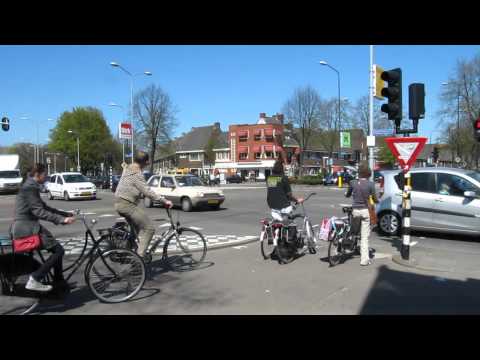
CatInABox wrote: » Was it this video by any chance? https://www.youtube.com/watch?v=5HDN9fUlqU8 Because this video shows multiple examples of the type of junction that the NTA has designed in use, and it's hard to believe that you've actually watched the video at all, or took anything from it on board , to be honest. It makes it look like you wanted the screenshot to prove your point, but didn't like the what the rest of the video was saying because it completely and utterly undermines your point, so you didn't include the link to the video.
Last Stop wrote: » Funnily enough no it wasn’t that one but this one
CatInABox wrote: » Haha, even in that video, they literally say this is standard design for dutch junctions, and change the image to a design that includes pedestrian traffic islands. It's at the two minute mark. Here's an image of it, it's the one on the right: To be honest, I'm willing to take the Dutch at their word on these designs, and I'm not much of a cyclist at all, so I'm open to correction on these by anyone with more authority on it, but this design would allow cyclists to turn left without waiting for the lights, and would also reduce conflict between pedestrians, cars, and cyclists. I know that you keep banging on about the fact that pedestrians will have to cross a cycleway to get to the traffic island, but surely you can see that it's easier for pedestrians to cross a cycleway than it is to cross a road? It's not the same level of danger at all. It's why the Dutch also use floating bus stops all over the place as well. The Dutch have 50 years worth of knowledge and data that shows this is the safest way, so as I said, I'm content to take their word on it. Also, the Dutch cyclists don't have priority over pedestrians, so I don't know where you're getting that from?