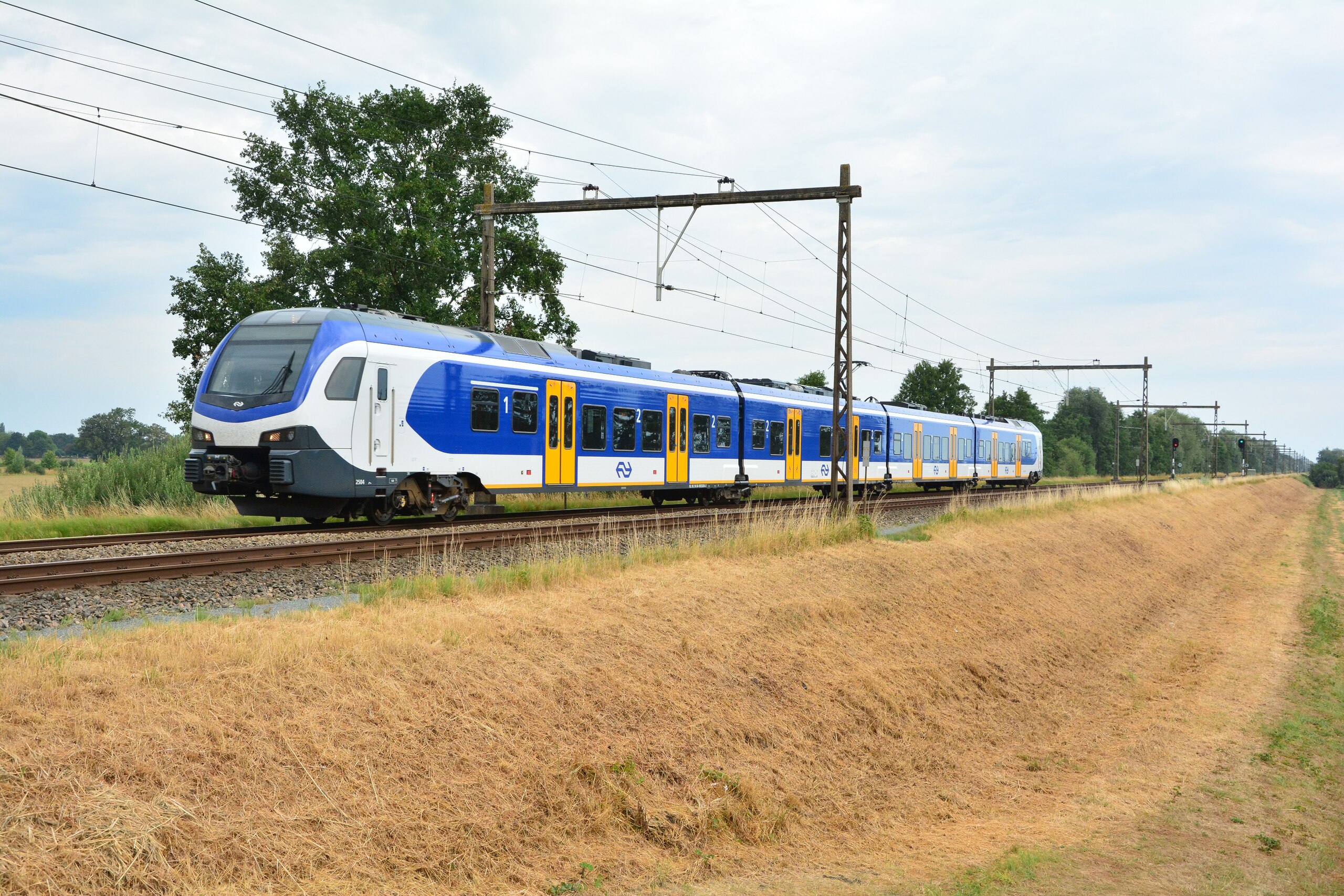
Sam Russell wrote: » That woul be 30 km or so. What would that cost? I suppose, putting up O/H cable would be a must.
bk wrote: » Those Stadler FLIRT trains actually have a corridor going through the middle of the "powerpack" section that allows passengers pass from one side to the other. These sections actually contain four relatively small (for a train) Diesel engines, two on each side of the corridor. Nice design and would allow for redundancy (e.g. one engine fails, the train can still continue).https://www.railwaymagazine.co.uk/5519/first-view-of-swiss-built-bi-mode-units-for-greater-anglia/ Check out this pic:https://pbs.twimg.com/media/DcQq8KlX0AAmtEf.jpg And here is a diagram of a regular 4 carriage layout. See the pass through section in the middle: You do have a point about the length. An 8 carriage train would require two "powerpack" sections as they call them, looks like they would take up about the space of 2/3rds of one carriage. One option if the platforms aren't long enough to handle that, is to start of with 7 carriages + 2 "powerpacks" and once they go all electric and they remove the two powerpack sections, they can add in an 8th carriage. High speed rail to Cork would require billions, just electrification a lot less. But then if you aren't doing HSR, there isn't much point to electrifying a service like Cork to Dublin. Electrification is most useful for HSR or for services that stop frequently like DART. The service to Cork would gain very little from just electrification. Great to hear that there is finally some progress on DART electrification.
LeinsterDub wrote: » I heard somewhere it too low to electrify part of the reason they need hybrids.
cgcsb wrote: » It'll mean closing of some lanes of the N4, CPO of some back gardens in Ballyer and a few bridges demolished and reconstructed. No doubt it will be disruptive, hence why it's been left until now. I think there's a change of tack coming in how these projects are done. Between BusConnects, Metrolink and DART expansion more less everyone in the city will see some disruption, a sort of even spread if you will. This removes the whole, 'what about my estate Joe' mentality because pretty much everyone is giving up something, the only people who seem to have a major issue with it are the socialists of Terenure/Ranelagh.
bk wrote: » Those Stadler FLIRT trains actually have a corridor going through the middle of the "powerpack" section that allows passengers pass from one side to the other. These sections actually contain four relatively small (for a train) Diesel engines, two on each side of the corridor. Nice design and would allow for redundancy (e.g. one engine fails, the train can still continue).https://www.railwaymagazine.co.uk/5519/first-view-of-swiss-built-bi-mode-units-for-greater-anglia/ Check out this pic:https://pbs.twimg.com/media/DcQq8KlX0AAmtEf.jpg And here is a diagram of a regular 4 carriage layout. See the pass through section in the middle: You do have a point about the length. An 8 carriage train would require two "powerpack" sections as they call them, looks like they would take up about the space of 2/3rds of one carriage. One option if the platforms aren't long enough to handle that, is to start of with 7 carriages + 2 "powerpacks" and once they go all electric and they remove the two powerpack sections, they can add in an 8th carriage.
Sam Russell wrote: » Those trains look more interesting the more one looks. They have fewer bogies than Dart trains, which makes change of guage slightly less of an issue. The power pack would cut down noise for passengers, and instead of diesel motors, it could house battery packs. Looks like a future path for the design. It only needs to be made driverless and IR have a winner. Hope they are considered.
loyatemu wrote: » only 4 doors per train isn't great.
Sam Russell wrote: » Yes, I noticed that, but it gives more seating. If they are used for longer commuter type distances, it might be OK.
loyatemu wrote: » you've still got to board people in the city centre stations. Just from experience of the 22Ks on commuter service, lack of doors is a real issue.
bk wrote: » I'd say the above train could easily be spec'd to have more doors if required. The above spec is just one example, of a particular spec for a particular service. A big selling point of this train is that it is a modular design for different needs. Here is an example of one (all electric) with two doors per carriage in the Netherlands: I agree, the more I think about this design, at least on paper, it seems like an excellent design. The reason IR went for DMU's, is reliability. One engine can fail and a DMU can continue on, unlike a classic push-pull. Since reliability is vital on very busy lines, where you have trains every few minutes. A train breaking down causes mayhem to multiple trains and tens of thousands of people. But the downside of DMU's is that you have an engine in each carriage, which is noisy and causes vibrations and leads to a less pleasant passenger experience. These "powerpacks" are sort of the best of both worlds. You have the redundancy of four engines, so if one fails, you can still continue, just like a DMU, but the engines are out of the carriages, so should be less noise and vibrations for passengers. Great, sounds like the best of both worlds. Also it can have some great maintenance advantages. Depending on how easy it is to change "powerpacks", you could have some spare powerpacks, so that if there is a failure of one of the engines, just swap out the faulty unit for maintenance and put the train straight back into service with a new powerpack. With the traditional design, you would lose a whole passenger carriage when an engine needed maintenance. This design should allow the carriages to get more usage. Also in future, as battery tech matures (or hydrogen) you could swap out the Diesel "powerpack" for a battery/hydrogen one, for non electrified sections of track. It seems like a really nice design.
Sam Russell wrote: » Unless it is part of the design, I cannot see how swapping the power packs would be an easy job. Remember there is only one bogey between carriages. That means the power pack would need to be lifted out of the train by crane and a new one craned in. Not impossible, but not easy unless designed in from the beginning.
On 23 April 2015 the Netherlands' railway operator Nederlandse Spoorwegen announced that it was ordering 58 Stadler FLIRT EMUs, comprising 25 four-car units and 33 three-car units, to be delivered by the end of 2016.[54][55] The very short delivery deadline (20 months), to meet capacity needs, allowed NS to invoke 'urgency mode' provisions in EU procurement rules and place the order without tendering.
end of the road wrote: » powerpacks likely could have bogies if it is requested they do so. i would also think that train sets as a whole could have conventional bogies if that is also requested.
Sam Russell wrote: » Wouldn't that require a whole new design?
end of the road wrote: » i don't know. i guess it will depend on where any other equipment under the cars is placed?
Sam Russell wrote: » Surely if you have two bogies, the articulation is between coaches. With a single bogie design, the articulation is between the bogie and each of the coaches. That is a totally different design principle.
Sam Russell wrote: » It would be difficult to combine the articulation of a double bogie with passengers passing from coach to coach. Also, such a modification would introduce two extra bogies.
Sam Russell wrote: » Using a crane would not be a show stopper of itself.
DoctorPan wrote: » If anyone has attended Peter Smyth's talks to Engineers Ireland last year or this year, he did speak about those designs and he was very impressed with the design of them and ability to convert to pure EMUs once wires have gone up fully. However with the experience of the 800/802s in the UK, the appeal of Bi-modal DEMUs has diminished in the CME's eyes. BEMUs is what he's pushing for as the first order as part of DART expansion, 4 or 8 fixed piece sets.
bk wrote: » BEMU's as in Battery EMU's? While cool, that would be quiet radical and perhaps risky. It is pretty new technology and there aren't many major examples out there actually in service. Though I do see lots of orders for this sort of design to start coming on stream in 2019. So maybe it is finally here. Though that would raise the question, will they even bother to fully electrify these lines? You only need to partly electrify them to charge the trains.
DoctorPan wrote: » Peter Smyth's thought process outlined last Tuesday night for battery EMUs is thus: he can't and doesn't want to buy new diesel stock, and EMUs are cheaper to run compared to DMUs. What he orders has to last 40 years minimum as the NTA does not open the chequebook for new stock often, so what he orders has to be future proof and he can't wait for OHLE to go up in 2025 when these are meant to arrive in 2023. His plan once the wires are up is to pull them into Inchicore and remove the batteries and have them be pure EMUs. These are also to feature a first for DART stock, toilets! 1 per each 4 piece sets
bk wrote: » And then there is the question, if it works, why bother with electrification? I know the batteries need to be replaced every 10 years or so, but that might still be cheaper then putting up the OHLE. BTW I assume they will at least put OHLE in the stations to charge the batteries when stopped.
DoctorPan wrote: » Regarding why bother with electrification when we have BEMUs is Cork/Belfast/Limerick/Galway services. He hopes that money will be forthcoming to allow Cork and Belfast be under the wires by 2035 and new locos to replace the 201s coming on stream at the same time.
bk wrote: » I And I'd worry if the battery works, that the NTA/TII/DoT will just say great, job done so and not bother with the electrification work. Source, working in IT, we will put this temporary solution in place, 30 years later it is still there and now a business critical system that no one has a clue about. Seen it happen dozens of times.