terrydel wrote: » you clearly have never driven one
rubadub wrote: » I also imagine that many bicycle helmet wearers who call people stupid or mad not to wear one would also likely still cycle home if theirs was lost/nicked, esp. if the only alternative was to walk many miles. I also reckon they would slow down and be more risk averse in general -as they are doing something they obviously usually consider utterly crazy and reckless. Some might walk of course but I really think that would be a minority, they could roll along at a brisk walking pace.
ChrisJ84 wrote: » An interesting wrinkle to this debate, for me anyway, is the fact that I feel safer on the bike when I'm wearing a helmet. I'd class myself as a fairly cautious cyclist, so I don't think wearing the helmet makes me more reckless.
People behave differently while wearing a helmet
People behave differently while NOT wearing a helmet
terrydel wrote: » Motorcyclists do not put a helmet on and change the way they ride, if you think otherwise then you clearly have never driven one, spent time with bikers or understand the culture.
magicbastarder wrote: » i'm quite sure they don't make a conscious decision to alter their behaviour, but no-one is saying they do.
rubadub wrote: » I would say some do, my uncle had some high power bikes and I remember him saying he would only go fast if wearing his leathers, following that mentality I would have guessed he would limit his speed even more if he had no helmet at all. As per my previous post I would certainly consciously drive slower on a motorbike if I had no helmet.
terrydel wrote: » Well I know loads of guys with high powered bikes, myself included, and we will all drive the very same regardless of leathers/helmets, leathers and helmets dont change any of us to veer towards taking greater risks.
In one experimental study, adults accustomed to wearing helmets cycled more slowly without a helmet, but no difference in helmeted and unhelmeted cycling speed was found for cyclists who do not usually wear helmets.
5. CONCLUSIONS Our results show increased cycling speed and decreased risk perception in a helmet‐on compared to a helmet‐off condition among cyclists used to wearing helmets, a finding that is in line with the theory of risk compensation. However, for those cyclists not used to helmets there were no differences in either risk or behavior between the helmet‐off and helmet‐on conditions.
There is probably no safer riding attire than a one-piece leather racing suit. But if wearing one on public roads pushes you to ride at speeds that are dangerous for you and others, then you’re undercutting the effectiveness of wearing leathers to begin with. When I slip into a race suit, I can feel a change in myself. A proper fitting suit transforms my posture, my confidence and attitude. Zipped up, a set of leathers prevents me from standing completely upright, my shoulders are pushed forward and my arms hang in front of me – giving me the aggressive stance of a motorcycle racer. The internal pads of the suit bulk up my otherwise skinny frame and the hardened sliders on my shoulders, elbows and knees make me feel impervious to the blur of asphalt whizzing beneath my motorcycle as it approaches and exceeds 100 mph. For me, the protection that a race suit offers also provides equal parts confidence. By numbing the effects of fear, leathers allow me to push a little further toward my personal limits. Which is wonderful on the racetrack, but no so much on the open road. It’s because of this change in my riding that I do not wear race leathers on the road, and maybe you shouldn't either.
rubadub wrote: » This "biker" admits he changes with a leather suit.https://www.rideapart.com/articles/253429/why-wearing-racing-leathers-on-public-roads-may-be-a-bad-idea/
terrydel wrote: » I'm not saying you are 100% right or wrong either.
terrydel wrote: » My issue is simply the notion that people take bigger risks when they don a helmet.
rubadub wrote: » this is just getting ridiculous, it was clear to my you thought I was 100% wrong when saying this very definite statement.again you keep going on the defensive as I reckon you think this is a negative thing to do... My experience is that people who consider safety equipment that they regularly use, and consider to be benefical, will take more care if they are doing the same tasks without the equipment at hand. In most cases it would be absurd not to take more care.
rubadub wrote: » You must know plenty of incredibly stupid people, depending on your age then likely yourself and very likely your parents.
rubadub wrote: » I think people get hugely defensive when it is suggested they take greater risks or are "reckless". This is why I was turning the thing around as people might not mind admitting they might be more cautious.
rubadub wrote: » The fact you say you feel safer on the bike with a helmet would lead me to presume you feel less safe without one, would this be the case? and if you were forced to cycle without one would you be more cautious at all? go slower etc? or would you behave the exact same?
terrydel wrote: » You can find evidence to back up any opinion you like on either side of an argument, we all can
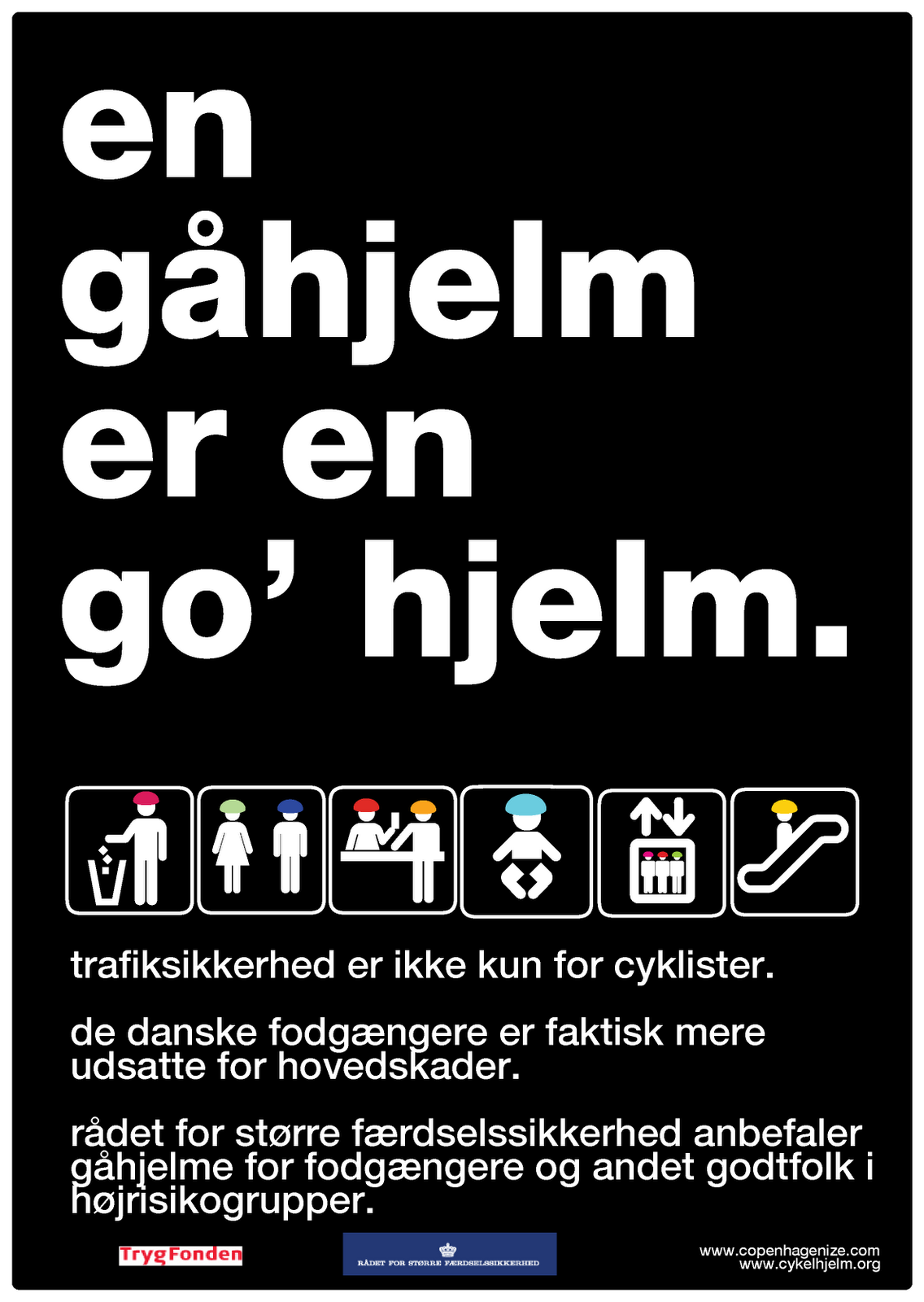
This Danish campaign poster reads: "A walking helmet is a good helmet" "Traffic safety isn't just for cyclists. The pedestrians of Denmark actually have a higher risk of head injury. The Danish Road Safety Council recommends walking helmets for pedestrians and other good folk in high risk groups." The slogan is catchy in Danish since it kind of rhymes. All in all it's a brilliant project. Let's save some lives. The new walking helmets will be available in the Danish Cyclists Union's [Dansk cyklist forbund] shop. Although, as the Danish Cyclists' Union, the Road Safety Council and Trygfonden have been quick to point out: "A bike helmet is a fine substitute for walking helmets, so there's no need to take it off when you get off your bike. Keep it on throughout the day for maximum safety."
The Centre has been evaluating the concept of a protective headband for car occupants. In about 44 percent of cases of occupant head injury, a protective headband, such as the one illustrated, would have provided some benefit. One estimate has put the potential benefit of such a device (in terms of reduced societal Harm) as high as $380 million, compared with $123 million for padding the upper interior of the car. This benefit derives from the fact that in a crash, the head strikes objects other than those that could be padded inside the car.
The Swedish brands have teamed up for what they claim is a "world-first" series of crash tests that will assess the impact on cycle helmets in collisions with cars – and, by comparing the results with those of existing regulations regarding pedestrian head protection, will enable them “to make a direct comparison between wearing a helmet and not wearing a helmet.”
Could Volvo and POC end the helmet debate?
Grassey wrote: » I'd be surprised if the end result wasn't favouring elwearing helmets... Simply because the study is being done by a company that makes its money by selling helmets... Working with a car company whose safety feature a while back was high vis paint for cyclists.
Chips Lovell wrote: » Turkeys never vote for Christmas