BaZmO* wrote: » This post is the 10,000th post
BaZmO* wrote: » Yes. It’s one of the the reasons why you have lobbies in hotels, because the lobby breaks the air from rushing in once a door is open to the outside. Or using revolving doors also stops this from happening. The venturi effect is essentially the velocity increasing due to constriction. The pressure drops but the velocity increases. It also applies to fluid dynamics.
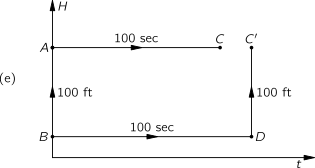
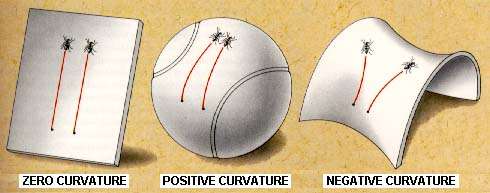
Fourier wrote: » So gravity must be from spacetime curving and not a force.
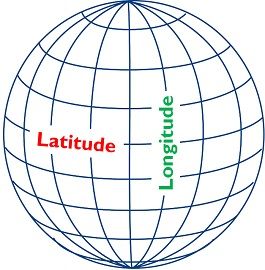
New Home wrote: » Think about latitude and longitude lines on a globe: they don't form perfect squares. I think it's something like that, anyway.
Chancer3001 wrote: » But that's cos the sphere gets "fatter" towards the equator. Surely if you walked 1000 miles in each direction youd 100% end up back where you started?
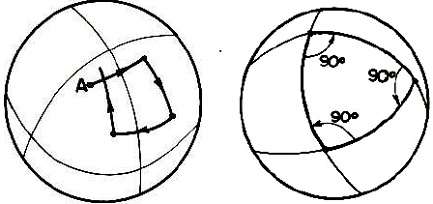
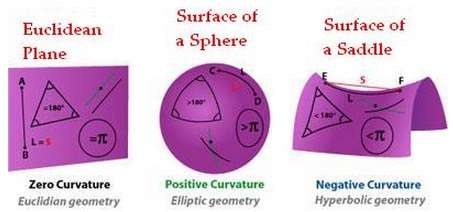
Chancer3001 wrote: » Ah jaysus. This is confusing stuff. Apparently a triangle on a sphere can have three 90degree angles.I was always taught the angles in a trianhle add up to 180degrees.
Chancer3001 wrote: » Ah jaysus. This is confusing stuff. Apparently a triangle on a sphere can have three 90degree angles. I was always taught the angles in a trianhle add up to 180degrees.
seagull wrote: » Is it still a triangle if it's not on a flat surface?
Fourier wrote: » It's actually because the Earth gets fatter toward the equator that walking 100 miles in each direction doesn't have you end up back where you started. I'll put up a bit more of an explanation later today.
Sephiroth_dude wrote: » Sections of the Autobahn in Germany have no speed limit.
Capt'n Midnight wrote: » It's hotter at the equator , so things expand ?
Quazzie wrote: » I know as I was just driving 250km/h on it two weeks ago :P
Esel wrote: » The mountain whose summit is furthest from the centre of the earth is Chimborazo in Mexico.https://en.m.wikipedia.org/wiki/Chimborazo
Nixonbot wrote: » Ecuador is not Mexico :pac: The main reason for this is that the Earth bulges at the equator, giving it an extra 20km or so of distance to the centre compared to the poles.
Deleted User wrote: » There is a big building just off the M1 at Donabate, you can see one elevation of it as you're driving into the village, it even has its own wind turbine for power generation This is the Tesco distribution centre for Ireland. All goods are shipped to Dublin port, brought there and then loaded up for distribution to the 150-odd Tescos around the country, including all the NI stores.https://www.google.ie/maps/@53.4781389,-6.199248,3a,24.5y,39.42h,90.1t/data=!3m6!1e1!3m4!1sEq3Rwv6uO5nio6LnaeBTPg!2e0!7i13312!8i6656 It looks big, even from that point which is about 1.5km away. And it IS big. Huge, in fact. It has a footprint of over 80,000 sq. metres, which is impressive on it's own. But the fact that it is essentially one big rectangular cube means it has a volume that is even more impressive: over 1.5 million cubic metres. To put that in context, it is the 10th biggest building, by volume, in the world. In. The. World. It was number 9 until the Finnish entry at number 8 was completed last year. Edit: forgot the Wikipedia linkhttps://en.wikipedia.org/wiki/List_of_largest_buildings
Sleepy wrote: » I pass the Tesco Distribution Centre every day. Our Zombie apocalypse plan involves raiding it before heading out to Lambay







![Photo of [Deleted User]](https://w7.vanillicon.com/v2/76c148e0517471ca7394feb81f5488ae.svg)

![Photo of [Deleted User]](https://w5.vanillicon.com/v2/5d64887c9bc6ef1c014eb33422ffcd89.svg)

![Photo of [Deleted User]](https://w2.vanillicon.com/v2/240e12baadbef0248a8a694618b3009d.svg)


![Photo of [Deleted User]](https://wb.vanillicon.com/v2/bb1b435feca4d036f6db42bb67252c40.svg)