DublinWriter wrote: » Multiple sources here:http://georgewashington.blogspot.com/2005/12/why-was-there-molten-metal-under.html
An engineer stated in the September 3, 2002 issue of The Structural Engineer, "They showed us many fascinating slides ranging from molten metal, which was still red hot weeks after the event."
According to a member of New York Air National Guard's 109th Air Wing, who was at Ground Zero from September 22 to October 6, "One fireman told us...
A reporter with rare access to the debris at ground zero "descended deep below street level to areas where underground fires still burned and steel flowed in molten streams."
According to a worker involved with the organizing of demolition, excavation and debris removal operations at ground zero, "Underground it was still so hot that molten metal dripped down the sides of the wall from Building 6."
weisses wrote: » another video .... sorry from 1.55 in https://www.youtube.com/watch?v=xysnVixh1sY
Overheal wrote: » Did you catch the name of the two emergency crew that claimed there was liquid molten steel? The most interesting part of the clip was that “lava rock” of fused debris, but that’s not at face value hard evidence of thermite or even clarity that it was indeed molten steel. Also the mention of things spontaneously combusting when re-exposed to oxygen (like you see sometimes when you pull a hot coal etc back out from under a bunch of ash/soot. Both of those things just corroborate it was real hot down there.
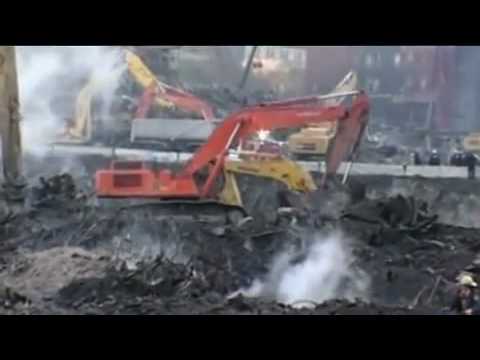
Extremely high temperatures were evident before and during the destruction of the World Trade Center Twin Towers and at Ground Zero. Seven minutes before the destruction of the South Tower, a flow of molten metal appeared, accompanied by several smaller flows, as documented by the National Institute of Standards and Technology (NIST). The material’s glowing color showed that its temperature was close to “white hot” at the very beginning of the flow and “yellow-orange” further down. Iron-rich spheres in the WTC dust are additional proof of temperatures above the melting point of iron. Pyroclastic-like, rapidly expanding dust clouds after the destruction of the Towers can also be explained only by the expansion of hot gases. An excavating machine at Ground Zero lifts debris dripping with molten metal The high-temperature phenomena at Ground Zero are documented by various sources: Bechtel engineers, responsible for safety at Ground Zero, wrote in the Journal of the American Society of Safety Engineers: “The debris pile at Ground Zero was always tremendously hot. Thermal measurements taken by helicopter each day showed underground temperatures ranging from 400ºF to more than 2,800ºF.” The fact that high-temperature phenomena were an important issue at Ground Zero is underscored by the large number of thermal images acquired: images by SPOT, MTI, AVIRIS/NASA, "Twin Otter"/U.S. Army, and at least 25 images by EarthData, taken between Sept. 16 and Oct. 25. In addition, temperature measurements by helicopter were taken each day, and the firefighters used onsite sensors too. Many witnesses, including rescue personnel and firefighters working on the piles, described the phenomenon of “molten steel.” Terms used in witness statements are, for example, “molten steel,” beams “dripping from molten steel,” “molten steel … like you’re in a foundry. Like lava, from a volcano.” A photograph taken on September 27 by a Ground Zero worker shows an excavating machine lifting debris from the WTC wreckage dripping yellow/orange molten metal. WTC clean-up workers and 9/11 artifacts architect Bart Voorsanger, in the PBS video “Relics from the Rubble,” described what must have been several tons of “fused element of steel ... molten steel and concrete and all of these things …all fused by the heat,” weighing several tons each. These foreign objects came to be known as “meteorites.” The heat at Ground Zero was not only extreme, it was also persistent, as proven not only by witness statements and a photograph by LiRo Group / Engineering of orange-red glowing steel as late as October 21, but also by thermal images taken by NASA and EarthData satellites. The EarthData thermal images also show that the “hot spots” remained at the same locations. The phenomenon did not “move” across the site, like one would expect from fire as it consumes the fuel available in any one location. University of California professor Abolhassan Astaneh-Asl, the first structural engineer given access to the WTC steel at Fresh Kills Landfill notes, “I saw melting of girders at the World Trade Center.” Astaneh also “describes the connections [between supporting columns] as being smoothly warped: ‘If you remember the Salvador Dalí paintings with the clocks that are kind of melted – it’s kind of like that. That could only happen if you get steel yellow hot or white hot – perhaps around 2,000 degrees.’”. Iron workers at the site pointed out that huge columns that were bent into horseshoe shapes - without the flanges showing any cracks or buckling. They cited, "It takes thousands of degrees to bend steel like this". FEMA documents in their Appendix C of its May 2002 WTC Building Performance Assessment Team study, for sample 1, “evidence of a severe high temperature corrosion attack on the steel, including oxidation and sulfidation with subsequent intergranular melting.” A “sulfur-rich liquid” containing “primarily iron, oxygen, and sulfur” “penetrated” into the steel. The extremely high temperatures contradict the official story. Office and hydrocarbon fires burning in open air (~500° to 1,500° F) cannot reach temperatures in the range that iron or structural steel melts (2,700° F). This was even acknowledged by NIST’s Co-Project Leader, John Gross, in the same public talk where he stated regarding the phenomena of molten steel, “I know of absolutely nobody, no eyewitnesses that said so, nobody that’s produced it.” Yet there is abundant proof of the molten metal, which subsequent tests reveal to be iron, in the debris piles. Furthermore, NIST itself performed extensive fire tests to establish the temperatures reached by the WTC office and jet fuel fires. The temperatures established are far below the temperatures required to produce all of the above phenomena – which occurred both before and during the destruction and at Ground Zero. The steel problem was “solved” by NIST by excluding most of the steel from being systematically examined for failure modes and heat excursions. The steel collected by the Port Authority, which has been stored in Hangar 17 at JFK Airport, was not included in the investigation except for 12 pieces. Of the 236 pieces that NIST possessed, many were excluded based on the circular argument that only columns from impact and fire floors were of interest in the investigation. Thus, NIST avoided having to discuss 51 of its 55 core columns. Sample 1 from FEMA’s Appendix C was also excluded. In addition, NIST developed a new method of “visual examination” that it then substituted in place of the systematically used tool. NIST’s “paint cracking” method has the following “advantages”: paint cracks can be produced not only by high temperature excursions, but also by “corrosion”/ “environmental degradation” and by plastic deformation; many columns had no paint left for examination, Moreover, by relying on a method that requires microscopic examination, NIST was able to ignore pieces that were obviously heat-affected but had come from non-fire floors. A contractor’s report that employed common visual examination was “reviewed”: NIST contrasted the contractor’s results with their newly developed method and their fire exposure observations, and by employing again a circular argument. NIST’s steel “examination” shows that its “working hypothesis” was in fact its premise, and that NIST gone to great lengths to maintain this premise. Some want to cite “natural thermite reactions” for the high-temperature phenomena: airplane aluminum must have reacted with rust. This possibility can be ruled out based on the findings of a study that was conducted in 2002 at the Colorado School of Mines for the Minerals Management Service. Officially, the study, whose lead author is a close research associate of T. W. Siewert of NIST, is about thermite-sparking in offshore environments. But due to a very odd study design the question about the feasibility of natural thermite reactions in the WTC is answered too. The authors established the ignition temperatures for rust, dehydrated rust and iron-oxide-based thermite reactions. The necessary temperatures are so high that one can conclude that thermite reactions between airplane aluminum and rust (some rust was on beams according to documents), dehydrated rust (rust dehydrates in fire) or iron oxide (iron oxide was part of the primary paint) were not feasible in the WTC. Also tested was what happens when aluminum impacts rust at very high velocity, so, interestingly, even the possibility that the impacting airplanes caused natural thermite reactions can be ruled out.
weisses wrote: » I posted one ....you choose to ignore it
could you address the question below ?https://www.boards.ie/vbulletin/showpost.php?p=109660027&postcount=2591
weisses wrote: » The thing is that there are witnesses claiming they saw molten metal either dripping or running and yet the lead guy from NIST is stating the complete opposite ... he even claimed there were no witnesses
More on the melted steel
DublinWriter wrote: » Hard to imagine how burning jet fuel and office furniture could even generate heat in excess of 300C.
Then we're also left with the thorny and well-documented issue of the pools of molten steel still extant at ground zero three months later.
The Nal wrote: » We're kind of getting the cart before the horse here. All of this is totally irrelevant unless theres a plausible theory on how "they" rigged the buildings. All 3 of them. Is there one? Because "elevator maintenance" isn't it. Only then can we talk about controlled demolitions, fires burning for days etc
Dohnjoe wrote: » This obsession with "molten steel" is a (snide and deliberate) attempt to "catch out" the NIST and deflect from basic issues such as 4 buildings on the day collapsing or partially collapsing due to plane strikes, debris damage, and crucially fire effects on steel
Dohnjoe wrote: » Fire weakens steel. At over 600 degrees C steel has lost half it's strength Temps in WTC 1 reached 1000 C. Unprotected steel in those temperatures reduces to 10% of it's strength That has nothing to do with "molten steel"
Overheal wrote: » I don’t have a link for the eutectic iron-sulfur mix, but it’s melting temp is 950 C. Aluminum was not identified in the sample collected by FEMA. As previously mentioned aluminum is melted at 660 C. There was plenty used in the exoskeleton of the building. There is nothing about any of the alleged testimony that actually confirms that rubble crews witnessed molten steel and not molten aluminum or other molten metals with lower melting points. Do you have a link for that 1990s fire study you just mentioned?
Cheerful Spring wrote: » https://www.bregroup.com/wp-content/uploads/2017/01/BRE-Cardington-Steel-Framed-Building-Fire-Tests-SM.pdf FEMA said there was a liquid of Iron (it then cooled). They confirmed this phenomenon. The rubble crews were finding this molten liquid in a hot rubble pile, it had no time to cool.
Overheal wrote: » We’ve been forwards and backwards about the “liquefied” metal sample FEMA reported on. Rubble crews may or may not have found molten metal - they didn’t confirm its chemical makeup. It could have very easily been molten/liquid aluminum which flows colder than steel.
Cheerful Spring wrote: » In isolation with no supporting structure, the steel can lose strength at 600c.
Overheal wrote: » Yeah, neither of the two tests ran in this paper are very relatable at all. The building uses concrete columns and brick walls. And the fuel for these fires was timber. They don’t actually simulate the combustion of office materials. They don’t simulate a fire accelerated by jet fuel. They don’t simulate steel with total or partial fireproofing: I would imagine a steel beam that is 90% covered in asbestos say, would have an entry point for heat but no real exit point. And these timber fires weren’t sustained for a long period of time either, only 40 minutes for peak burn and 80 minutes to ember off. These were also two independent burn tests in isolated sections of the building - WTC 1 and WTC 2 experienced fire in a very broad swathe from where each plane smashed into the building and exploded. WTC 7 experiences multiple ignition points as well. But hey you still observe incredible damage to the structure, if it had been a more real simulation the structure might have failed. I do certainly see where the steel yielded and sagged under the test parameters - bearing in mind, these floors aren’t at their maximum design load. The building wasn’t overloaded with airliner debris, nor did it experience seismic events. Had it burned longer or the floors been loaded less conservatively, it’s totally reasonable to expect this test structure would have failed. We could probably rebuild the same structure and actually furnish it like an office, spray jet fuel everywhere, simulate the extra weight of aircraft debris and light it up and expect to see a failure.
Overheal wrote: » Or it just proves 8 people are really good at not getting caught planting enough explosives over the course of one weekend to take down 3 skyscrapers :rolleyes:
Dohnjoe wrote: » And also really good at evading the largest criminal inquiry in FBI history, at one point it's estimated that one out of every two FBI agents was working on the 911 case

![Photo of [Deleted User]](https://w8.vanillicon.com/v2/867a9f20e705add43a3ada2e4f4480cc.svg)