SeanW wrote: » On the day the bypass opens, the existing N6, which is all 4 lane in one form or another, should have the two kerbside lanes become an express bus corridor. If it works, then over time it could be upgrade to a GLuas. The entire length and then West onto the Seamus Quirke Road. The distinction would be absolute. Need to get through Galway? Use the bypass. Need to go into Galway? Maybe try the bus and P&R, because accommodating traffic is no longer the priority.
L1011 wrote: » The quin bridge. The elephant in the room in all the crayons attempts
Ruhanna wrote: » How can there be space on the Quincentenary Bridge for thousands of single-occupant cars yet no space for multi-occupant buses transporting a much larger number of people per square metre?
marno21 wrote: » This is reality, not an ideal vision.Removing a lane on the Quincentenary Bridge for buses would result in civil unrest.Political considerations have to be taken into account here.If it was that easy COLOR="Red"]politically[/COLOR it would have been done.
marno21 wrote: » This is reality, not an ideal vision. Removing a lane on the Quincentenary Bridge for buses would result in civil unrest. Political considerations have to be taken into account here. If it was that easy it would have been done.
Ruhanna wrote: » There are variations on BRT. Galway is not a metropolis after all (despite the grandiloquence of the City Council's failed Smarter Travel Plan, which referred to the "metropolitan area" of Galway, as if our small European town was Curitiba or Jakarta. The real issue is that Galway needs an orbital public transport service for commuters, and to crowbar commuters out of their comfy cars will require both carrot and stick. The carrot is a fast, reliable, efficient and comfortable service that whisks commuters to their destination without delay and with the minimum of hassle. That means high quality conveyances, high frequency at peak times and a high standard of facilities (eg stops that are more akin to stations). The stick will have to be a range of restrictions on car use, which is why building a cross-town motorway for car commuters will undermine the development of modern public transport in Galway for a generation (until the N6GCRR inevitable ends up the way the M50 is now). At the moment, the City Council contemptuously leaves bus passengers standing in the rain and mud waiting for infrequent buses that don't arrive on time and take stupidly circuitous routes to places commuters don't want to go to. If you live in Knocknacarra and work in Parkmore or Ballybrit, you just want to get on the bus and go straight to work. Why would you have any interest in going through Eyre Square, just because the bus driver's union says you have to and because we're not allowed to do anything with transport that will upset the triumvirate of motorists, mandarins and merchants?
what_traffic wrote: » Remove a lane? You are putting the cart before the ass in your reality. Start with a City Orbital bus service over the Quincentenary Bridge first. Once frequency and usage increases on it - then the Civil unrest/ political consideration could be flipped the other way towards the more efficient modes.
serfboard wrote: » You obviously don't know what BRT is, and that's fair enough - you're not interested in it. BRT is a completely different way of thinking about Bus Transport. Yes, the mode of transport is a bus, but to say that it's the same thing is like comparing a steam train with a TGV - they're essentially the same, but there's also a world of difference.
Zzippy wrote: » There would be no incentive to use such a service if it's stuck in the same traffic as the drivers/potential users are in. There has to be a perceptible advantage to public transport for it to become popular.
Paraphrase of President Reagan wrote: The question is not an easy one, but it is simple.
Ruhanna wrote: » Finally we're getting to the core of the issue. For the past 25 years in Galway (and ten years in the Roads forum on Boards?) we've had people insisting that the "only solution" to traffic and transport problems is to build a new highway.
Geometry is universal, immutable and unarguable.
That's why the real obstacle is not one of roads/traffic engineering, but of politics.
Ruhanna wrote: » Precedent is the most obvious, because we've been here already. The existing N6 was planned as a ring road around the city, but the Council ruined it by giving "planning" permission for large traffic-generating developments all around it, including huge areas of surface car parking. All low density, massively wasteful of valuable urban real estate and hugely damaging to the viability of public transport.
The M50 is another example of the way we use bypasses in Ireland. Need we go into details?
Additional precedents include other towns and cities that were bypassed and which subsequently saw a rise in the total number of car trips and in modal share for driving.
If that is an incorrect assessment, can you name any bypassed town in Ireland that has experienced a decreased modal share for driving and an increased modal share for public transport, cycling and walking? If there is one it would be good to know, because it would make an interesting and informative study.
PR is either (a) the promotion of the long-demanded "bypass" (now called a ring road or expressway) on the basis that it will make more development possible, or (b) promotion of development on the basis of its proximity to the proposed new road.
They're not building railways with the same speed and enthusiasm, so the result in almost all cases is car-dependent sprawl.
What are motorways for but to make more driving more easy?
SeanW wrote: » An great American president, Ronald Reagan once said (of the fear of the Soviet bomb, but the principle applies to many problems)
what_traffic wrote: » What was so great about him? Always picture the McDonald's Fast Food Clown whenever I read Ronald Reagan's name in text. Am a kid of the 80's
Zzippy wrote: There would be no incentive to use such a service if it's stuck in the same traffic as the drivers/potential users are in. There has to be a perceptible advantage to public transport for it to become popular.
Ruhanna wrote: That's why the real obstacle is not one of roads/traffic engineering, but of politics.
SeanW wrote: Not enough public transport, especially in the main cities. Dublin in particular has been starved of investment in public transport, it should have a full network of trams, at least one Metro line, DART Underground and so on. And it should have had them 10 years ago. What's here now is a sick joke. It's the same problem in the smaller cities, Cork at least should have its own Luas by now, maybe Galway and Limerick as well.
McGiver wrote: » This. That's exactly it. Imho Ireland had missed the train during the Tiger years. It should have massively invested in public transport but didn't. Now, It's difficult to catch up with the rest of the Europe if you are 15-20 years behind and also government which is ideologically opposed to the concept of public transport, simultaneously running a "small" state budget for investment whilst running "big" state enabling billions of tax evasion/breaks for MNCs.
Deleted User wrote: » Also, luas for the other cities is not going to happen for the next 20 years (Cork), 30 (Limerick) and 40 (Galway) and nor should it. Buses, pedestrian and cycling infrastructure will be the priorities in those cities for the foreseeable future and rightly so
Deleted User wrote: » The state spent billions on national infrastructure i.e. Motorways, ports, airports etc. The bubble burst before it could fully invest in city infrastructure with the 2 luas lines being the main extent of that
what_traffic wrote: » Agree re Galway, not sure about 40 years, but any GLUAS corridor would want much higher density than exists anywhere in the City at the moment.
McGiver wrote: » Yes and no. At the moment probably not, but you could look at it from long term perspective.
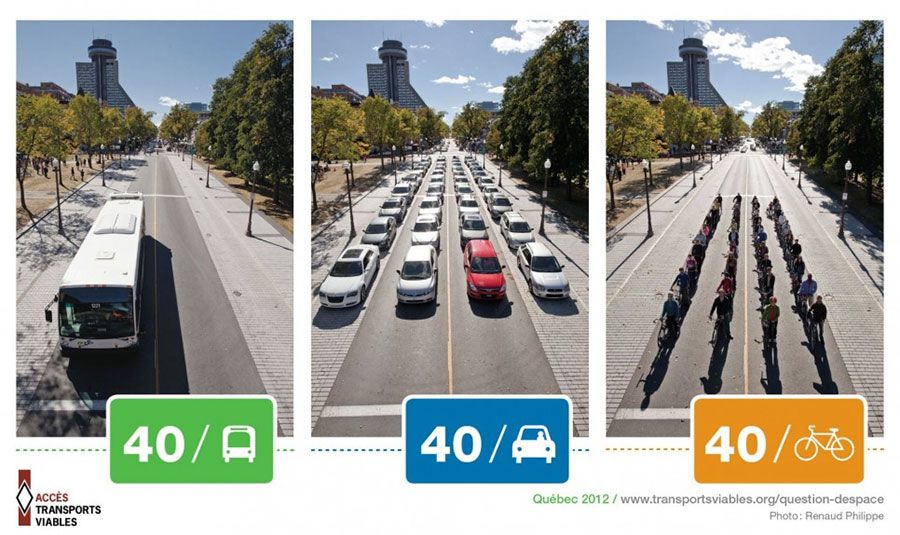
Ruhanna wrote: »
SeanW wrote: » I've seen variations of this image a lot on this thread and I have to wonder. If a fellow is in Oughterard and he needs to get to somewhere in Roscommon (for example) how should he do this? According to this image - in the context in which it is presented - he should drive along the N59 to the junction with the L5381 (where the 50kph speed limit begins), stop, get out of the car, take out the bicycle, put the car on his back, cycle through Galway city streets with the car on his back, and plonk the car back down on the road where the N6 is no longer a stroad to continue his journey. This is obviously ridiculous, but to say that the bicycle/bus is the ONLY solution to problems in a city where all the long distance roads are stroads, where short haul commuter traffic is mixed in with national traffic, is specious at best. To be sure, it is not possible or even desirable for everyone to commute to work door-to-door by car. that's what big cities have Metros, trams, cycle lanes etc. No-one here is suggesting that everyone should drive everywhere, even in Galway though it is barely a city. What is being suggested however is that 1) The existing N roads in Galway city are stroads and 2) that means access problems between the county West of the Corrib and the rest of the country. Since Galway City is playing host to key through-routes, the question should not be "should there be a bypass" but rather "how to ensure the bypass is not mis-used" and remains - to the greatest extent possible - an easy way to get from the rest of the country to Spiddal, towns on the N59 etc. And I for one have given suggestions on how to do that - starting with concrete measures to turn the former stroads into streets. Repurpose traffic lanes into bus lanes to facilitate express public transport, lower speed limits etc to create a more pleasant atmosphere and capture value in the spaces, maybe accompanied by turning traffic lanes into on-street parking if it will help bring patronage to street-side shops. Preferably all of this should be accompanied by some better planning where people can still have houses, just not all over the place. And this can work, because for all the bashing of the M50 it mostly does it's job, Dublin still has a very vibrant core with dense office development, shopping districts (often pedestrianised) etc in the city centre, and very well used (actually maxed out) public transport coming into the city from all the hinterlands. Dublin needs more public transport mainly, as do most of the cities to a lesser extent, long distance travel nationwide needs more motorways and bypasses. And yes, in cases where a city needs PT but is also an impediment to national/through traffic, it needs roads and public transport, both.
Sam Russell wrote: » The image is to demonstrate the PT and cycling is very efficient use of road space.
It is always possible to come up with examples of how a particular solution does not suit a particular situation.
Car is quicker in nearly all circumstances because you leave when you are ready, and generally you can travel as fast as a bus would if it took you from your start point to your end point.
However, that does not work if buses are using a bus lane and you cannot and there is heavy congestion. If bus lanes were available for all trunk routes, and buses provided an adequate service, then only a fool would sit in a car stopped by congestion for a 50 min journey when the bus can do it in 20 mins.
For a journey where bus is not an alternative, then obviously a car is necessary.
However, a bike or walking is certainly an option for short a journey. For example, children should walk or cycle to school and not travel by armoured 4wd SUV children carriers for the 2 km journey to school.
Galway made a huge mistake by building roundabouts on major routes that cause gridlock, and they are now removing. That surely is a reason to rethink the plans of such a local authority that has demonstrated at so many levels just how poor they are at road planning.
Why are there no buses crossing the Quincentenial Bridge? Maybe there is a question to ask before a new bridge for cars is built.
SeanW wrote: A large part of the problem with the Irish school run is the lack of centralised schools. In the United States, each municipality has a municipal school system and a place in it is guaranteed to any child resident in the municipality. They then follow that up with a local school bus system.
SeanW wrote: » Which is something that has been disputed by precisely nobody. What is disputed is how that applies to people traveling long distances between remote places. The kind of stuff you need roads and cars for. As to the idea that better public transport should be done instead of a bypass, that's a way of thinking I'd be more partial to if there had actually been a bypass built in the first place. As in, with an unbroken median dual carriageway, end-to-end with only grade separated junctions at key road junctions, like the Athlone or Mullingar bypasses. Then it would be appropriate to ask why so much city traffic was on the bypass and what could be done to shift some of it off. But that didn't happen, someone decided back in the 80s I guess, to have a new bridge very close to the centre of a growing city, access to which would require one navigate a number of at-grade junctions and even a detour for East-West traffic up and down the Headford Road on a North-South axis. In short, the 4 lane section of N6 there was probably intended to be a stroad from Day 1, with little money around to fix things properly in the late 20th century they probably decided to try to solve two problems in one, on the cheap. Something that we've also seen in other places, like Carrick on Shannon. Possible perhaps, but it's very easy when there is a section of road that long distance travelers unsuited to long distance travel and which they must share with local traffic. I just picked Oughterard and "somewere in Co. Roscommon" out of thin air. But you could just as well throw a dart at a map of Western Co. Galway, and another at any point in Ireland East of the Corrib River, and you would have the same problem. Anyone traveling between those two points has to travel through Galway City Stroads. It hurts everyone that this occurs because such users have no business in the city (and are thus slowed down immensely in their journey - even if they are doing it outside of peak hours) and should not be part of its traffic, nevertheless they must do so and contribute to the traffic problems of a city they'd rather not be in. It makes no sense at all. Except in cities, where you cannot do this because if everyone tried to, the traffic would just break down altogether. That's why cities have public transport, and that's why I've called for more. Again, you're re-iterating a point that was disputed by 12 groups of nobody. What is being disputed is that problems with PT is the only aspect of this that needs attention. Do whatever you like with buses, bicycles, whatever you're having yourself, it makes no difference because long distance traffic will still be forced through city streets. If anything, if you reduce the motorist carrying capacity of the stroads to rebalance them towards local users on buses, bicycles etc without providing an alternative road for the long distance drivers, you just make things worse for the long distance user. It makes no sense at all. Yes. Like virtually every single journey not involving the city but requiring a crossing of the Corrib. A large part of the problem with the Irish school run is the lack of centralised schools. In the United States, each municipality has a municipal school system and a place in it is guaranteed to any child resident in the municipality. They then follow that up with a local school bus system. Here in Ireland, there are a random smattering of schools here and there and there are no guarantees of a school place to anyone. You just apply everywhere and if you're lucky, there is a place somewhere for your kid, so they go to whichever school that happened to be, even it is 10 miles away past a bunch of other schools that were "full". So you end up with a completely dis-jointed, unplanned "school run" that tends more likely than it should to involve private cars. There's little use blaming the private motorist for that aspect of it. Structural reform of education would accomplish a lot more than telling people "you're the problem because you drive your child to some random school that just happened to accept your application". The whole thing was a mistake, but there are good reasons it might have appeared to make sense at the time. The Quincentennial Bridge and presumably the stroads leading to it were built starting in 1984 when A) the country was broke and 9 years before the National Roads Authority took some central control of road planning in 1993 (The NRA was subsumed into TII in 2015). Also, 1984 was more than 30 years ago. First of all, even those looking to turn Galway into a mini Los Angeles are not trying to build something "for cars" because cars don't drive themselves for no reason. People use cars to get from place to place, thusly, a new bridge as you describe it would be for people using their cars. Not the cars themselves. As to why the current QB does not have lots of buses, good question. Maybe most public transport users want to get into the city? Maybe there's a lot going on the city centre? Perhaps the workplaces near the current N6 are out-of-town corporate parks that are not pedestrian (thus public transport) friendly? Maybe it's because the people on the buses would get stuck in the same traffic as the people in the cars? And to fix that you'd have to take a massive gamble by putting bus lanes on the QB, which if the desired modal shift did not happen, would turn 2 hour commutes into 4 hour commutes? Or maybe the transport planners are lazy and missing an obvious trick? I don't know. A better question is why some people want to continue forcing long distance traffic onto badly planned city stroads that everyone would be better off if they avoided?


![Photo of [Deleted User]](https://w6.vanillicon.com/v2/62877c35768f143f69acd7bb6cd43f3c.svg)
