Carry wrote: » Well, it's like with men: Give them the choice of a burger or a sexual encounter - most will glance shortly at the burger and head for the sex
Carry wrote: » The perfume contains civet, a musk, that's being "harvested" from the perineal or anal glands of the animal called civet,
Capt'n Midnight wrote: » A slightly more ethical use for the rear end of a civet is in the production of Kopi luwak coffee. And you don't even have to put the coffee beans in the front end as the civets will do that themselves.
pleas advice wrote: » ah, don't go changing topics when i was just about to ask how do you explain the Casimir effect or Hawking Radiation...
Arnold Neumaier wrote: Nothing goes on; the vacuum is completely inert.
Big Nasty wrote: » My wife is from Mayo and spent a bit of time in the bog during the summer. She swears blind there's lizzards in the bogs in Co Mayo.
Nixonbot wrote: » Viviparous probably. Our only native lizard.
mzungu wrote: » Gorillas can catch human colds and other illnesses. This is why you are advised not to go viewing them (can usually be done in the Uganda, Rwanda, and DRC ) if you are feeling in any way ill.
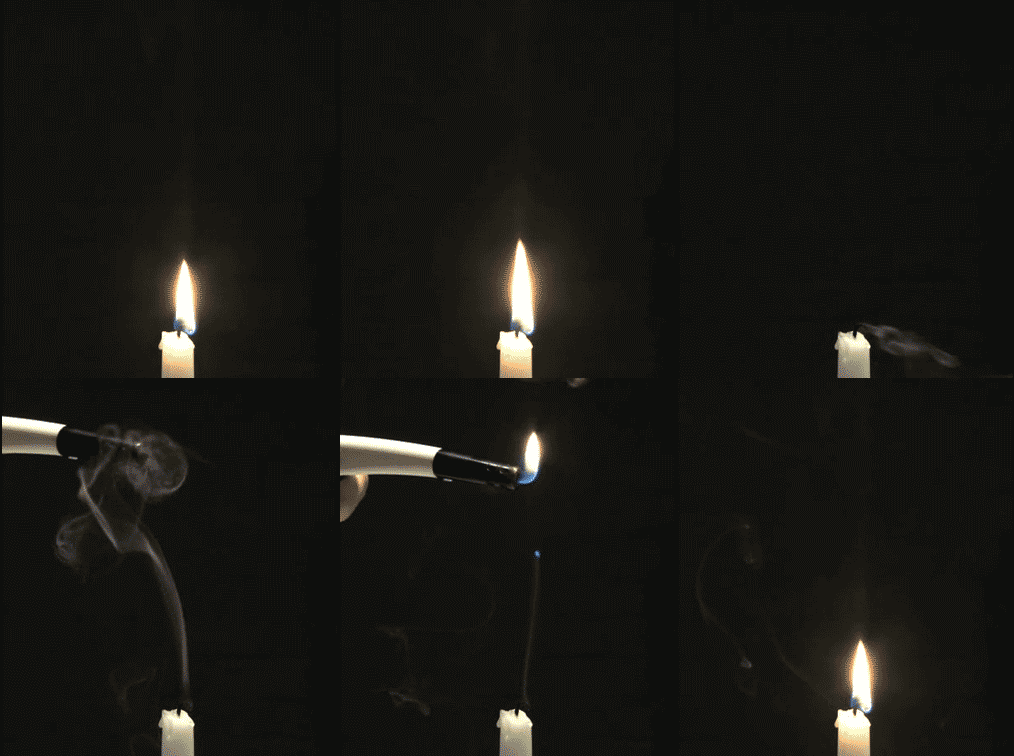
retalivity wrote: » Something I found out today, and forgive me if it is common knowledge, but its news to me goddammit! Candles: How do they work? I always thought that the wick burned, and the viscous wax stopped it from burning too quickly. That's it - I didn't wonder why it didn't just go out instead of waiting for the next bit of wick to become available. SO in a candle, the wax is actually the fuel....lighting the wick causes the surface wax to melt, which in turn is forced up through the wick due to the capillary effect, from here, it vaporizes and keeps the candle burning - which i turn causes more wax to melt......... Its not something i ever put much thought into, and after reading about what actually happens, i feel silly for not understanding physically what actually happens when you light a candle. Nowadays candles are mainly made from parrafin wax, in olden times, they were made from rendered beef fat, which stank to high heaven as they burned, but hey, light. The rich lads had beeswax candles to see in the dark without their sense of smell getting violated.
New Home wrote: » If I'm not mistaken, it's the gas produced that burns.
KevRossi wrote: » The route crosses Spain, France, Germany, Poland Belarus, Russia, Kazakhstan and China ... The train passes through 4 different gauges: Chinese, Russian, European and Standard and requires either changing bogies or sometimes moving containers from one train to another.
Water John wrote: » Some materials go direct from solid to gas. Wood burned in a gasification unit does that.
Capt'n Midnight wrote: » It's not quite that simple. Gasification is a chemical process rather than a physical one. It's a mixture of destructive distillation and partial combustion. During distillation Tar, turpentines, water, sap and other liquids boil off as normal. Leaving behind charcoal which is mostly carbon. If you are doing it right most of this carbon partially oxidises to carbon monoxide. Colourless, odourless, extremely toxic and flammable but it burns to form carbon dioxide completing the combustion. Depending on how you do the gasification you could also inject steam or water into the red hot charcoal. This splits the hydrogen and oxygen in the water, so you get Hydrogen, Carbon Monoxide and Carbon dioxide as Synthesis gas. You could then use the Water-gas shift reaction and more water to get more hydrogen and less carbon monoxide. Water goes directly from solid to gas, if the temperature is below freezing. So you get ice mummies in mountains. If the pressure is below 611 Pa you don't even get liquid water.