Sam Dazzling Numerology wrote: » If Ireland? Sure more food and medicines/pharma are sent out to the UK, (and elsewhere) than are brought in. They have a population x14 times bigger to feed, but landmass (with max farming availabilty) maybe only x2.8 greater. One thing that can forsee going up in price for Ire is fuel. Also machinery and tech/electronic/niche products as they're the main imports.
imokyrok wrote: » Medication on a whole will probably be ok. I'll have to check if all mine are made in Ireland. Short to medium term supply chain disruption in a 'just in time' world may be very problematic if all goods from the continent have to be rerouted and/or if trade with Britain becomes stagnated while crisis deals are worked out after a Hard Brexit. We are a net importer for foodstuffs. https://www.agriland.ie/farming-news/ireland-has-been-net-importer-of-food-since-2000-un-data-reveals/ Are there any Irish journalists examining the potential fallout I wonder akin to this chap ?https://www.agriland.ie/farming-news/ireland-has-been-net-importer-of-food-since-2000-un-data-reveals/ I saw another very alarming article on the impact on just the agri sector in the UK but of course I can't find it now.
my3cents wrote: » My question is just how much stuff that we take for granted comes to us via a UK border either sea or land. If there is no free flow of goods then just how much freight which comes by sea from the UK is going to get tied up in customs before it arrives here? Just look at companies like Aldi and Lidl, they obviously don't fly all their stock over from the UK or Europe so some of it must come through UK ports but how much?
imokyrok wrote: » It's not how such matters work out when the dust settles that bothers me. It is the weeks and months immediately following a no deal Brexit. If we were a country in the middle of the continent then our disruption would be minimal but we aren't. I'm thinking if by xmas a no deal Brexit is looking likely then some minimal preparations at least are in order. Basics like pasta, rice, flour, tinned tomatoes, tuna, vegetable oil, tea, coffee, basic cleaning supplies, toilet roll. Keeping the petrol tank full.
Graces7 wrote: » This idea is my norm each year. Just now stocking up on basics ready for winter as we can get cut off easily . I have good supplies already and am adding extras each week. Please do not forget pets.. Wondering if this year vegetables eg carrots will be in short supply with the heatwave?
imokyrok wrote: » I think the EU is engaged in assisting us with ferry transportation that by passes the UK. That is going to be essential on an on going basis and will require considerable investment from the EU. I read something about it a while back. I haven't been able to locate a good central resource for all things Brexit on Ireland. It's all focused on the border with little real analysis by economics journalists. Maybe someone can point me in the direction of a good source?
touts wrote: » Unfortunately in reality to maintain the levels of capacity they would need 8-10 times the number of ferries (a fast ferry can go over and back to the UK up to 4 times a day to get to the continent is a two day return trip at best). None of the ferries on the calm Irish Sea route can be moved to a rough North Atlantic Route and it takes years to design, order, build, test and deliver a ferry. We are basically stuck with the customs nightmare that is the UK landbrdge for the better part of a decade.
Tabnabs wrote: » Ferries are regularly chopped and changed to different routes and trading areas. Many of the ships in the Irish Sea have worked in the North Sea and vice versa. If the weather is horrendous, then nobody ventures out, no matter what sea area you are in. It's as much the manoeuvring on and off the berth in high winds where damage can be sustained as they high seas during the crossing. In fact, once Irish Ferries get their new pair, the existing ferry Ulysses will change to a Ireland - France route. Shipping companies are commercial beasts, they will follow the money.
touts wrote: » Perhaps but the route is much much longer. We would still need far more ferries to maintain the same level of capacity and they just aren't available. And the money won't be there for them to divert ferries to serve the tiny Irish market.
The MV Celine - LNG ready to allow for future running on gas - is the newest vessel to join the shipping line, Compagnie Luxembourgeoise d’Navigation (CLdN), which specialises in short sea RoRo cargo. At 234m in length - longer than two football pitches - it is the largest short sea roll-on/roll-off vessel in the world. With a capacity of 8,000 lane-metres, it represents the next generation of super ferries servicing Dublin Port, providing additional capacity for customers trading with Continental Europe via the ports of Zeebrugge and Rotterdam.
“Yesterday, from early morning till well after midday, cortege after cortege reached Glasnevin Cemetery, sometimes as many as three corpse-laden hearses being seen proceeding up Sackville Street at the same time. Close on 40 orders for interment were issued at the Cemeteries’ Office yesterday, and, inclusive of the remains brought for burial on the previous day, which had been temporarily placed in the vaults overnight, there were close on one hundred bodies for sepulchre.” This is how the The Irish Times of October 31st, 1918 described the effects of the Spanish flu epidemic – 100 years ago this month. Globally the influenza virus killed an estimated 50 million people. And yet the disease was not considered especially lethal. As Ida Milne, in her recently published book Stacking Coffins notes: “International statisticians and historians often use a death rate of 2.5 per cent of those who actually caught the disease (case fatality rate) to estimate morbidity. Applying this rate to the official estimation of Irish influenza dead, 20,057 would give a morbidity of approximately 800,000, or about one fifth of the island’s population at the time.” An article in The Irish Times on October 31st, 1918. An article in The Irish Times on October 31st, 1918. Whatever it may have lacked in lethality, the 1918 flu made up for in virulence. Could we see one fifth of the population struck down with influenza ever again? Dr Michael Osterholm, director of the Centre for Infectious Disease Research and Policy at the University of Minnesota, thinks so. In a recent conversation piece in the Journal of the American Medical Association, he was asked if improvements in vaccine development and sanitation mean another pandemic on the scale of the 1918 flu is avoidable? “I would say that we are much more vulnerable today to a catastrophic influenza pandemic than we were in 1918. That may seem counterintuitive, but today there are about 7.6 billion people on Earth, more than 3 times the population in 1918. When we talk about less crowded living conditions today, that is true for part of the world. But for the vast majority of the world it’s worse.” “We now have influenza vaccines that we didn’t have in 1918, but their effectiveness is limited. In the 2009 influenza pandemic, which fortunately was mild, that vaccine was roughly 50 to 55 per cent effective. More importantly, less than one per cent of the world’s population had access to the vaccine in the first six to 12 months of the pandemic because of our inability to quickly make a largely egg-based product. In the future, vaccines still are going to have only a limited impact.” Flu vaccine With a universal flu vaccine that could be given every 10 years in the pipeline, surely Osterholm is being overly pessimistic? “Unfortunately we’re a long way away even though there’s a lot of hype today that it’s just around the corner...We think there’s reasons to believe we can find a combination vaccine that would be much more effective. But I would say we’re at least five to eight years off...” He thinks more money and effort is required– a universal flu vaccine “could do more for the world’s public health than we even did with the eradication of smallpox, and it would surely have a major impact economically in terms of taking off the table future pandemics”. Meanwhile, its the annual influenza vaccine season. The World Health Organisation has chosen its three strains of virus for this year’s shot. It has updated the influenza B component to take account of last year’s prominent strain. The two influenza A elements remain the same. A calculated gamble by WHO every year, the lead in time to manufacture means we will always be vulnerable, as happened last year, to the emergence of a different strain of the virus as the flu season progresses. But even if this happens, having the vaccine will lessen the severity of flu infection.
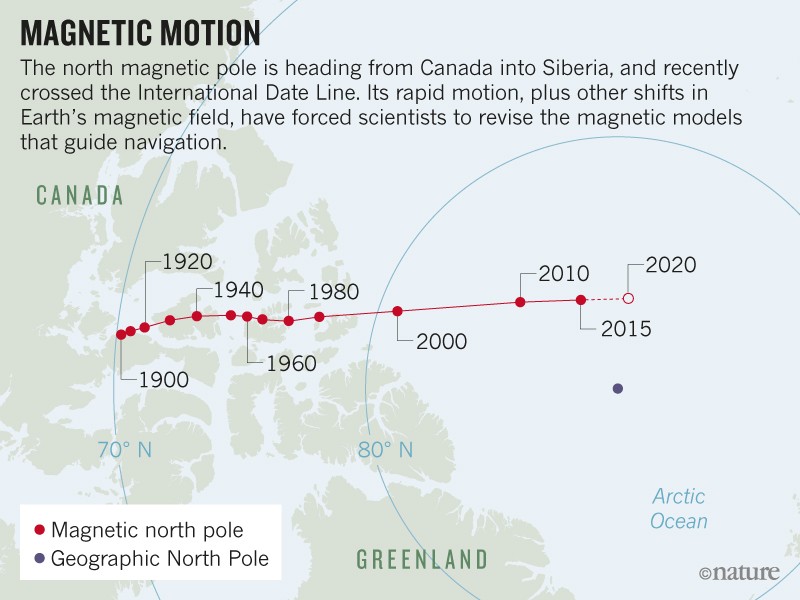
Something strange is going on at the top of the world. Earth’s north magnetic pole has been skittering away from Canada and towards Siberia, driven by liquid iron sloshing within the planet’s core. The magnetic pole is moving so quickly that it has forced the world’s geomagnetism experts into a rare move. On 15 January, they are set to update the World Magnetic Model, which describes the planet’s magnetic field and underlies all modern navigation, from the systems that steer ships at sea to Google Maps on smartphones. The most recent version of the model came out in 2015 and was supposed to last until 2020 — but the magnetic field is changing so rapidly that researchers have to fix the model now. “The error is increasing all the time,” says Arnaud Chulliat, a geomagnetist at the University of Colorado Boulder and the National Oceanic and Atmospheric Administration’s (NOAA’s) National Centers for Environmental Information. The problem lies partly with the moving pole and partly with other shifts deep within the planet. Liquid churning in Earth’s core generates most of the magnetic field, which varies over time as the deep flows change. In 2016, for instance, part of the magnetic field temporarily accelerated deep under northern South America and the eastern Pacific Ocean. Satellites such as the European Space Agency’s Swarm mission tracked the shift. By early 2018, the World Magnetic Model was in trouble. Researchers from NOAA and the British Geological Survey in Edinburgh had been doing their annual check of how well the model was capturing all the variations in Earth’s magnetic field. They realized that it was so inaccurate that it was about to exceed the acceptable limit for navigational errors. Wandering pole “That was an interesting situation we found ourselves in,” says Chulliat. “What’s happening?” The answer is twofold, he reported last month at a meeting of the American Geophysical Union in Washington DC. First, that 2016 geomagnetic pulse beneath South America came at the worst possible time, just after the 2015 update to the World Magnetic Model. This meant that the magnetic field had lurched just after the latest update, in ways that planners had not anticipated. Source: World Data Center for Geomagnetism/Kyoto Univ. Second, the motion of the north magnetic pole made the problem worse. The pole wanders in unpredictable ways that have fascinated explorers and scientists since James Clark Ross first measured it in 1831 in the Canadian Arctic. In the mid-1990s it picked up speed, from around 15 kilometres per year to around 55 kilometres per year. By 2001, it had entered the Arctic Ocean — where, in 2007, a team including Chulliat landed an aeroplane on the sea ice in an attempt to locate the pole. In 2018, the pole crossed the International Date Line into the Eastern Hemisphere. It is currently making a beeline for Siberia. The geometry of Earth’s magnetic field magnifies the model’s errors in places where the field is changing quickly, such as the North Pole. “The fact that the pole is going fast makes this region more prone to large errors,” says Chulliat. To fix the World Magnetic Model, he and his colleagues fed it three years of recent data, which included the 2016 geomagnetic pulse. The new version should remain accurate, he says, until the next regularly scheduled update in 2020. Core questions In the meantime, scientists are working to understand why the magnetic field is changing so dramatically. Geomagnetic pulses, like the one that happened in 2016, might be traced back to ‘hydromagnetic’ waves arising from deep in the core1. And the fast motion of the north magnetic pole could be linked to a high-speed jet of liquid iron beneath Canada2. The jet seems to be smearing out and weakening the magnetic field beneath Canada, Phil Livermore, a geomagnetist at the University of Leeds, UK, said at the American Geophysical Union meeting. And that means that Canada is essentially losing a magnetic tug-of-war with Siberia. “The location of the north magnetic pole appears to be governed by two large-scale patches of magnetic field, one beneath Canada and one beneath Siberia,” Livermore says. “The Siberian patch is winning the competition.” Which means that the world’s geomagnetists will have a lot to keep them busy for the foreseeable future.
my3cents wrote: » I've never seen a shelter that didn't have more ventilation than was needed. Stoves used in closed up tents can create a lot of CO but afaik there are no reports of it actually killing anyone. Once you are using wood as a fuel the smoke will drive you out of any shelter long before the CO get you.
morebabies wrote: » Any ideas for heating a semi permanent shelter?
sheesh wrote: » a wood burning stove that they use in hot tenting would do the job and they pack up to a reasonable size. it is unlikely that brexit would cause that level of hardship especially if the last recession did not cause it. Don't get me wrong a hard brext could lead to a bad recession if it restricts our sales to the british market the food industry is a big employer here.
The risk of nuclear weapons being used is at its highest since World War II, a senior United Nations security expert said, calling it an "urgent" issue that the world should take more seriously. Renata Dwan, director of the UN Institute for Disarmament Research (UNIDIR), said all states with nuclear weapons have nuclear modernisation programmes under way and the arms control landscape is changing, partly due to strategic competition between China and the United States. Traditional arms control arrangements are also being eroded by the emergence of new types of war, with increasing prevalence of armed groups and private sector forces and new technologies that blurred the line between offence and defence, she told reporters in Geneva. With disarmament talks stalemated for the past two decades, 122 countries have signed a treaty to ban nuclear weapons, partly out of frustration and partly out of a recognition of the risks, she said. "I think that it is genuinely a call to recognise, and this has been somewhat missing in the media coverage of the issues, that the risks of nuclear war are particularly high now," she said. "And the risks of the use of nuclear weapons, for some of the factors I pointed out, are higher now than at any time since World War II." The nuclear ban treaty, officially called the Treaty for the Prohibition of Nuclear Weapons, was backed by the International Campaign to Abolish Nuclear Weapons (ICAN), which won the Nobel Peace Prize in 2017. The treaty has so far gathered 23 of the 50 ratifications that it needs to come into force, including South Africa, Austria, Thailand, Vietnam and Mexico. It is strongly opposed by the United States, Russia, and other states with nuclear arms. Cuba also ratified the treaty in 2018, 56 years after the Cuban missile crisis, a 13-day Cold War face-off between Moscow and Washington that marked the closest the world had ever come to nuclear war. Ms Dwan said the world should not ignore the danger of nuclear weapons. "How we think about that, and how we act on that risk and the management of that risk, seems to me a pretty significant and urgent question that isn't reflected fully in the (UN) Security Council," she said. Meanwhile, Tehran claimed yesterday that the United States and its supporters do not dare attack Iran because of its "spirit of resistance". Tensions have spiked between Iran and the United States after Washington sent more military forces to the Middle East, including an aircraft carrier, B-52 bombers and Patriot missiles, in a show of force against what US officials claim are Iranian threats to its troops and interests in the region. "If the criminal America and its Western and regional allies don't dare carry out a face-to-face military attack against our country, it is because of the spirit of resistance and sacrifice of the people and youth," Major General Gholamali Rashid said, according to the Fars news agency. In a Twitter message addressed to US Secretary of State Mike Pompeo yesterday, an adviser to Iranian President Hassan Rouhani said the American military deployment to the region was a deliberate provocation. "You @SecPompeo do not bring warships to our region and call it deterrence. That's called provocation. It compels Iran to illustrate its own deterrence, which you call provocation. You see the cycle?," the adviser, Hesameddin Ashena, tweeted in English. Irish Independent