VW 1 wrote: » Quoted to tell you my OCD loves that you took that pic with the odometer at 150000. I've a photo on my phone of my clock at 98765km. And the trip computer 432.1 Spent ages waiting for the right moment to set it all up, the gf gave me an exasperated roll eyes when I explained why.
runawaybishop wrote: » Some cars do, most do not. It's an urban myth .
mzungu wrote: » If there was a hole going straight through the earth and you jumped in, it would take about 42 mins to reach the other side.
Capt'n Midnight wrote: » Jaguar solved this problem a long time ago on the XJ-S. The fuel cap is on the right. And there's another one on the left.
Mountainsandh wrote: » "Worry not, mother, look thou yonder at the little arrow on the pump, thence be your tank." (I think the car was a Honda)
(Claude Francois was hugely successful and famous, and died young, electrocuting himself in the bath as he attempted to fix a light fitting that had gone wonky).
Wibbs wrote: » Oh and see those white wall tyres? Tyre rubber was actually white, or close to it back in the day before modern plastics, they added black pigment to make tyres black.
ARNOLD J RIMMER wrote: » 11 days that never happened in Britain. Nothing whatsoever happened in British history between 3 and 13 September 1752. The British Calendar Act of 1751 proclaimed that in Britain (and Americn Colonies) Thursday 3 September 1752 should become Thursday 14 September 1752 In 1752 Britain decided to abandon the Julian calendar in favour of the Gregorian. By doing so, 3 September instantly became 14 September - and as a result, nothing whatsoever happened in British history between 3 and 13 September 1752.
sbsquarepants wrote: » First the disclaimer: Fourier - don't ask me any questions, i'll plead the 5th, but please do feel free to correct me! A new technique to measure (well to extrapolate) the pressure inside a proton has lead to an astronomically high measurement, actually in the region of an order of magnitude higher than the pressure inside a neutron star (the densest object known) or 10 to the 30 times standard atmospheric pressure.(For fear of embarrassing myself, I won't even pretend to understand how exactly "they" have arrived at this measurement.) Now something a bit more my level - here's a video of a tardigrade taking a crap.:D
Wibbs wrote: » More likely because you needed two fuel holes for quick access to keep the thing running for any length of time. Not quite a joke either. I knew someone who had the series three E-Type with the V12. You could actually watch the fuel gauge slowly but perceptively drop on tickover. :eek: That engine was a beautifully engineered petrol leak, with added noise.
Greybottle wrote: » This is a triumphal arch built for the visit of Queen Victoria in 1900. It was on Leeson St bridge, was made of wood and demolished some time later.
M5 wrote: » Here’s a bit of Cup trivia you may not know. In 1962, NASA launched a small, spherical communications satellite called Telstar that ended up altering the look of the balls used in the World Cup. Telstar was the first active communications satellite and the first commercial payload in space. By sending television signals, telephone calls, and fax images from space, the 3-foot-long satellite kicked off a whole new era in telecommunications—and soccer ball design. There’s a direct line between the distinctive black and white patterning of Telstar’s hull and solar panels and the Adidas ball used as the official ball of the 1970 World Cup in Mexico and the 1974 World Cup in West Germany. While earlier generations of soccer balls were brown and did not show up well on television
JRant wrote: » There's only one creature on the planet that defies death.
sbsquarepants wrote: » First the disclaimer: Fourier - don't ask me any questions, i'll plead the 5th, but please do feel free to correct me! A new technique to measure (well to extrapolate) the pressure inside a proton has lead to an astronomically high measurement, actually in the region of an order of magnitude higher than the pressure inside a neutron star (the densest object known) or 10 to the 30 times standard atmospheric pressure.
Electrons show up as particles only under particular circumstances; e.g., in detectors such as Geiger counters.
We don't think glass doesn't occupy space because it is transparent for light, or that only the bones of our bodies occupy space because the remainder is transparent for X-rays
Fourier wrote: » So to respond to this and some related info, it's a handy jumping point to explain atoms. The Thomas Jefferson National Accelerator Facility managed to use electromagnetic fields to measure the pressure within a proton. Previously people thought you'd have to use gravitational fields to do this (gravity responds directly to pressure, electromagnetism doesn't), but the group found a way around this. (Any more detail is too much for a forum post) Quantum Theory is broken into two main branches:Quantum Mechanics, which deals with situations were particles are moving slowly and don't decay or combine Quantum Field Theory, which basically deals with every situation. However it is very difficult to work with. There's a quantum field theory to handle each of the three forces, the one for the strong nuclear force being called Quantum Chromodynamics (QCD for short). This handles everything to do with what goes on in atomic nuclei. QCD predicts massive internal pressure inside a proton, which has been confirmed by this experiment. The pressure in a proton is over ten times that on a Neutron star. Or 1,000,000,000,000,000,000,000,000,000,000 times atmospheric pressure. That's in every proton in your body. So now that we have confirmation of this, the best way to think of* a proton is basically a ball of paste that starts off fluid like near the center and gets more viscous the further from the center you go, until it becomes solid at a certain point (the edge of the proton). At the point where it becomes solid, the pressure within the paste is ten times that of a neutron star. There are also three knots in the fluid/places where the fluid is twisted at the center (we'd call them quarks). Neutrons are the same. The internal flow of the paste is incredibly complicated, a supercomputer can't fully manage it.Or simpler, a proton is like a toffee ball with a molten toffee center. There are three swirls within the creamy center, these are the quarks. They're more patterns in the proton than things in and of themselves In helium then you'd have two protons and two neutrons, being four "paste balls" like this. It's never really clear when one ends and another begins though as tubes of paste connect each of them (we see these tubes as pion particles). Then sitting on top of this is an electrically charged fluid, much more smooth and fine than the paste within the proton (like oil versus toffee). This fluid is the two electrons. We tend to think of it as two particles because it tends to leave two small marks in equipment like a Geiger counter. As Arnold Neumaier, professor of physics in Vienna says: He uses the more accurate term "electronic fluid".Other atoms are then the same, just with more toffee balls and more electronic fluid on top of them.Again all of this is with the proviso that Quantum Theory just says "this is a handy way to think of an atom", it doesn't say if an atom is really anything like this. All this fluid stuff is most likely just like the flashing lights from my boardgame analogy earlier. It's what we tend to see, but it could be just a shadow or aftereffect of the real thing.Note: It's a myth that an atom is mostly empty space. Coming from pre-quantum physics. The electronic fluid fills the atom from the nucleus all the way out to the edge. It comes from measuring the size of stuff with a Geiger counter or similar, but that's just one way of measuring this stuff, again to quote Arnold Neumaier: So number 7 in this list from the Guardian is just false: https://www.theguardian.com/science/2013/jan/27/20-human-body-facts-science *by this I mean the best thing you can picture in your head from what we know
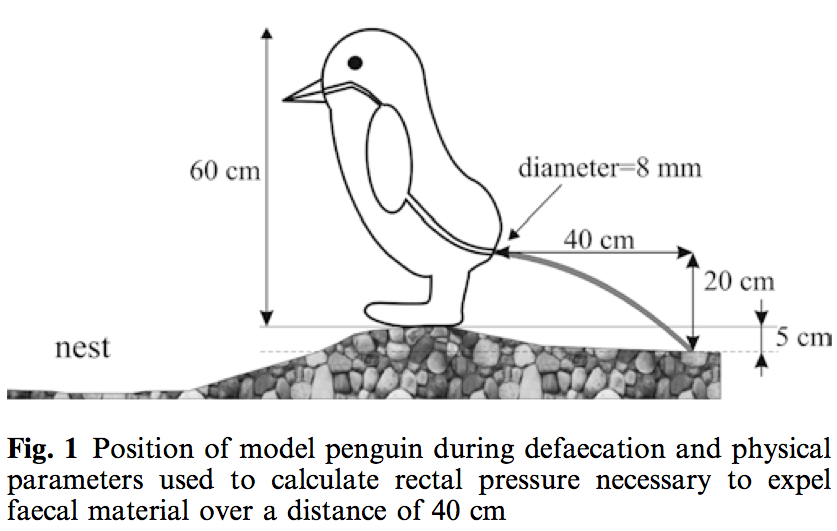
Fourier wrote: » I'll respond to this but I see your tardigrade and raise you a penguin:
evolving_doors wrote: » Is that from the Applied Maths exam?