Akrasia wrote: » you've obviously not been reading my posts then. I don't want people to believe my point of view, I want people to believe the science, and I don't want people peddling conspiracy theories instead of the accepting the science behind global warming. I was pushed to resort to the kind of language as above with Dense because he engages in hit and run arguments using misrepresentation and conflating words and meanings to generate a warped version of events. I was going to define these terms for him, but I knew he would ignore it, so the only hope I had of getting him to acknowledge the meaning of these terms was to get him to define them himself, or at least think about the definitions privately and realise he's been getting mixed up.
Not surprisingly, the maps show a giant blob of superheated rock about 60 miles beneath Mount Sidley, the last of a chain of volcanic mountains in Marie Byrd Land at one end of the transect. More surprisingly, they reveal hot rock beneath the Bentley Subglacial Trench, a deep basin at the other end of the transect. The Bentley Subglacial Trench is part of the West Antarctic Rift System and hot rock beneath the region indicates that this part of the rift system was active quite recently.
Mr Bumble wrote: » Note the first thing you say in response is another statement of certainty - that I haven't been reading your posts. I have. So you're wrong about that. Fancy that! That's the problem I have with just about everything you post. You go on, with great certainty again, to tell me that another poster is "mixed up". This is a discussion, with differing views. If it's not that, it's a lecture and in this case, with a finger that never stops wagging.
dense wrote: »
Akrasia wrote: » I'm perfectly willing to admit when I'm wrong if someone points out a mistake I have made or refutes a point with a solid argument. I've been wrong plenty of times in the past and will be wrong again in the future, and I might be wrong today. I do acknowledge that my last few posts have been dismissive, and I should definitely avoid that tone, but it was out of frustration rather than any sense of superiority. I take a lot of time to research my posts on this topic. And when I go to the effort of checking someone's sources and I discover that they say nothing like what it's claimed they say, over and over again, and rather than defend the original point, that poster just makes another wild claim with yet more dodgy sources, its just a pattern of behaviour that I felt needed a different kind of response. Rather than waste my time checking his sources, I wanted him to have to defend his understanding of what these sources are saying in his own words.
dense wrote: Anyone reading the last few pages of the thread anyone can see you're getting snarky because you've refused to explain what economic and political system the socialist eco activists riding the global warming scam actually want to replace capitalism with.
Akrasia wrote: » This is a thread in a science forum about the science of climate change Dense, your 'socialist' nonsense is off topic here.
Akrasia wrote: » There are 3 broad areas for discussion relating to climate change and these are broken down by the IPCC into the 3 working groups, Firstly the physical science, working group 1, is it happening, and secondly, WG2, Impacts, Adaptation, and Vulnerability, what will it's effects be.
Here we provide several lines of palaeo-oceanographic evidence that Labrador Sea deep convection and the AMOC have been anomalously weak over the past 150 years or so (since the end of the Little Ice Age, LIA, approximately AD 1850) compared with the preceding 1,500 years. Our palaeoclimate reconstructions indicate that the transition occurred either as a predominantly abrupt shift towards the end of the LIA, or as a more gradual, continued decline over the past 150 yearshttps://www.nature.com/articles/s41586-018-0007-4
Here we provide evidence for a weakening of the AMOC by about 3 ± 1 sverdrups (around 15 per cent) since the mid-twentieth century. This weakening is revealed by a characteristic spatial and seasonal sea-surface temperature ‘fingerprint’—consisting of a pattern of cooling in the subpolar Atlantic Ocean and warming in the Gulf Stream region—and is calibrated through an ensemble of model simulations from the CMIP5 project. We find this fingerprint both in a high-resolution climate model in response to increasing atmospheric carbon dioxide concentrations, and in the temperature trends observed since the late nineteenth century.https://www.nature.com/articles/s41586-018-0006-5
Akrasia wrote: » Getting back to the science and away from the nonsense above 2 new studies released this week in Nature both show that the AMOC (gulf stream) has decreased by 15% since the middle of the 20th Century and is now likely to be at it's weakest strength in at least 1k years (at least 1.6k years according to one of the studies) The studies both took different methodologies and while there are some areas of disagreement, the authors of both studies conclude that this is yet another fingerprint of climate change The high resolution climate models predict a very similar pattern of change to what we have been witnessing.
Gaoth Laidir wrote: » So the weakening started 150 years ago. It can't be due to aghg so.
For now, the timing of the AMOC decline remains a source of intrigue.
Akrasia wrote: » It doesn't mean it can't be aghg, it means that there might be another underlying natural mechanism. We can't know where the AMOC strength would be today if it wasn't for the warming caused by human influence. These studies both show that the AMOC is down at least 15% and is the lowest in over a thousand years. It fits with the AGW hypothesis. If there is another mechanism that better explains this, it needs to a robust theory accompanied with supporting evidence.
With this new technique, Willis was able to calculate changes in the northward-flowing part of the circulation at about 41 degrees latitude, roughly between New York and northern Portugal. Combining satellite and float measurements, he found no change in the strength of the circulation overturning from 2002 to 2009. Looking further back with satellite altimeter data alone before the float data were available, Willis found evidence that the circulation had sped up about 20 percent from 1993 to 2009. This is the longest direct record of variability in the Atlantic overturning to date and the only one at high latitudes. The latest climate models predict the overturning circulation will slow down as greenhouse gases warm the planet and melting ice adds freshwater to the ocean. "Warm, freshwater is lighter and sinks less readily than cold, salty water," Willis explained. For now, however, there are no signs of a slowdown in the circulation. "The changes we're seeing in overturning strength are probably part of a natural cycle," said Willis. "The slight increase in overturning since 1993 coincides with a decades-long natural pattern of Atlantic heating and cooling." If or when the overturning circulation slows, the results are unlikely to be dramatic.
Gaoth Laidir wrote: » You can't have it both ways. The decline started decades before the start of the rise in temperature trend around 1890 (and that rise was not aghc-related). So yes, something big was already happening for nearly a century before the recent warming post 1970, and it was indeed natural. It started when CO2 was still well below 300 ppm.
Akrasia wrote: » Here are the researchers themselves discussing their research
Gaoth Laidir wrote: » And in that he says that the sst pattern change emerged around 1870, i.e. it preceded the warming by about 20 years. What happened in the last 50 years is up for debate, as is its significance, given the lack of historical context. Just don't attribute a slow down in the AMOC to aghc.
Akrasia wrote: » You say the last 50 years is up for debate but definitely not agw?
Gaoth Laidir wrote: » No, I'm not saying that. I'm saying that if something starts to happen a century before agw really kicks in then it can't be attributed to agw. Whether or not agw subsequently prolonged it/made it worse/better in the last 50 years is only secondary. But the quote "agw has caused the AMOC to slow down" is a little misleading as it implies it was the cause of the start of it. It's the same with the start of the pre-1900 warming. Not anthropogenic in nature but still widely quoted as being the start of the human fingerprint.
M.T. Cranium wrote: » Meanwhile, three warm days since the middle of November ...
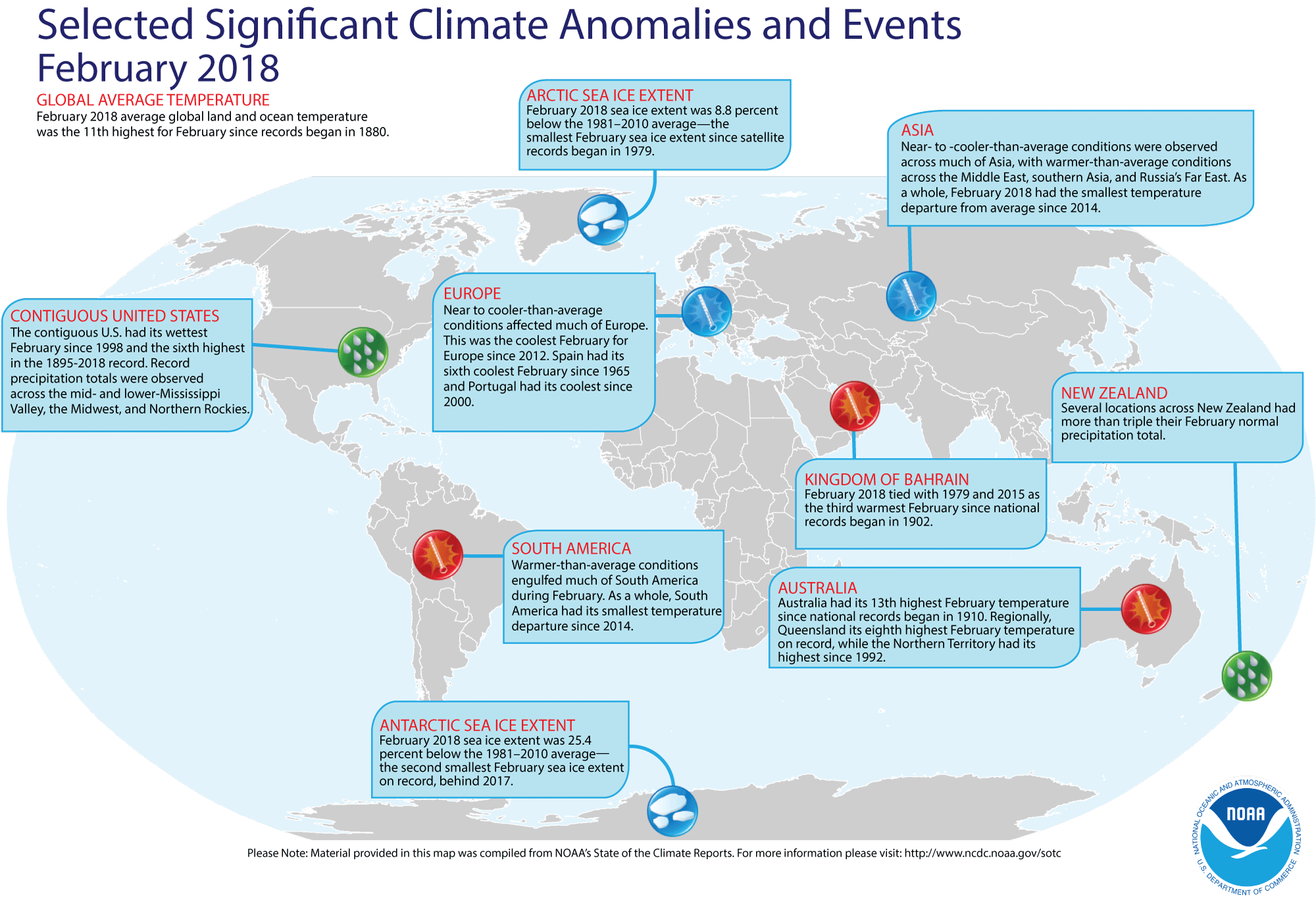
Akrasia wrote: » Globally February was 5th or 6th warmest February on record according to NASA and NOAA
Akrasia wrote: » That's true. For Ireland. Globally February was 5th or 6th warmest February on record according to NASA and NOAA