NIMAN wrote: » We had compulsory Irish when we got to 1st year in grammar school in Derry in 1980. It was compulsory for 1st and 2nd year, optional after that. Only a handful out of each class kept it on to 'O' Level, most couldn't wait to drop it.
jm08 wrote: » Has that not more to do with how the subjects are more specialised after GCSE and most people only do 3 A Levels?
Junkyard Tom wrote: » Fionn1952 wrote: » New poster here myself ... how much time did you spend living in the North You're a 'new poster' yet you're asking me how much time I spent in the north? How do you know I spent any time there at all?
Fionn1952 wrote: » New poster here myself ... how much time did you spend living in the North
Fionn1952 wrote: » The question was directed at "Blanch", the last person on the quote tree, not you.
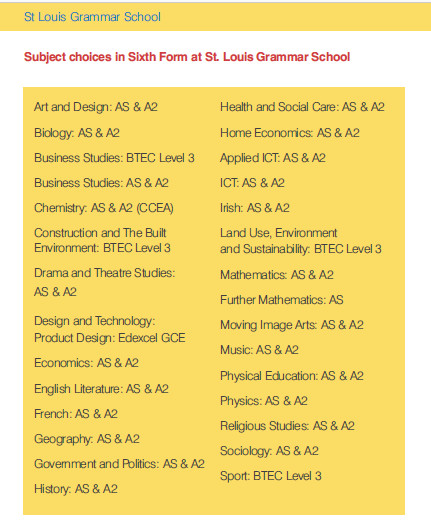
jm08 wrote: » I agree. I see that the top 11 performing schools in NI (based on A level results) are all catholic schools that have Irish in their curriculum. Learning Irish doesn't seem to hold them back.
Sean Rafferty, head of St Louis Grammar in Ballymena wrote: "If you take a look at the top 11 schools they are all faith-based, and I think that says it all."
Phoebas wrote: » That's a bit of a crude correlation. That list was based off GCSE and A-Level results - is Irish even an A-Level exam? I don't think anyone involved in the study or the schools involved have cited Irish being on offer as any part of their success. What was cited is the fact that they are all faith based.
Phoebas wrote: » That's a bit of a crude correlation. That list was based off GCSE and A-Level results - is Irish even an A-Level exam?
jm08 wrote: » The point I was trying to make is that despite investment in Irish in catholic schools, it hasn't prevented them from being high achievers.
jm08 wrote: » In fact, the point could be made that learning Irish from a young age has made it easier for them to pick up other languages. The problem for English speaking countries is that there is no huge need to learn another language because they will get by on English only. Learning another language also gives you insight into other nationalities and their culture and how their thought process works. Irish is a beautiful descriptive language. If we lost the language, we lose part of our heritage. For instance, the name Dublin is meaningless if you don't know where it came from (dubh linn=blackpool) in comparison to London which there are many theories (such as place owned by Londinios).
recedite wrote: » So NI schools can and do teach Irish to A level standard. The British state funds Irish language broadcasting. Anybody who wants to learn and speak the language can do so freely. Is it really a major inconvenience to shinners that they can't demand to have a court case heard as gaeilge? State-funded translators provided for everybody, despite that fact that all involved would be back speaking English again in the pub afterwards. Wouldn't it just be a pointless waste of public money? Jobs for the boys/cousins.
recedite wrote: » Is it really a major inconvenience to shinners that they can't demand to have a court case heard as gaeilge? State-funded translators provided for everybody, despite that fact that all involved would be back speaking English again in the pub afterwards. Wouldn't it just be a pointless waste of public money? Jobs for the boys/cousins.
FrancieBrady wrote: » You can make that type of case about anything that is not important to you.
recedite wrote: » People's freedom is important to me. I'm not seeing any infringement on peoples freedom to speak Irish in NI. And there is also some state financial support. In contrast, the RoI has a compulsory Irish policy in all state funded schools.That is an infringement on people's freedom.
FrancieBrady wrote: » It isn't about 'freedom to speak it'. How silly to be taking that stance.
recedite wrote: » What exactly is the nature of the oppression against NI Gaeilgeoirs then?
recedite wrote: » Whats with all the negative vibes? If there's a legitimate grievance, surely you can just say it here? Apparently the proposed Language Act was a bit of a secret, but involved duplicate signposts, court cases as gaeilge and a commissioner to do something. Perhaps he/she would decree that a whole bunch of govt. publications needs to be translated into Irish? Pretty much what happens in Dublin and Brussels already; create a whole lot of very expensive translations that nobody ever reads.
FrancieBrady wrote: » I love the way people with obvious issues with our language are deciding whether it has value for money or not.
recedite wrote: » Whats with all the negative vibes? If there's a legitimate grievance, surely you can just say it here? Apparently the proposed Language Act was a bit of a secret, but involved duplicate signposts, court cases as gaeilge and a commissioner to do something.Perhaps he/she would decree that a whole bunch of govt. publications needs to be translated into Irish? Pretty much what happens in Dublin and Brussels already; create a whole lot of very expensive translations that nobody ever reads.
Irish is the third most popular language subject (after French and Spanish) at post-primary level in English-medium schools. In the school year 2012/13, there were 2,078 pupils entries for GCSE Irish and 309 entries for A level Irish (the figures for other languages are: GCSE French 6250; Spanish 3,568; and GCSE German 1,017; A-Level French 550, Spanish 513 and German 125). The numbers of pupils studying languages has dropped since the requirement to study at least one language to GCSE was dropped from the curriculum. Diarmuid Mac Giolla Chríost (2000), in his research is this area, has estimated that there are 40,000 to 45,000 ‘functional Irish speakers, with some 13 to 15,000 people with 'fluency in the full range of language skills. You can read his paper at http://cain.ulst.ac.uk/issues/language/ macgiollachriost00.htm. Research by the renowned sociolinguist Pádraig Ó Riagáin estimates that 1-2% of the population of Northern Ireland claim to be completely fluent (16, 179 - 32, 358 people) (Fortnight March 2007: pg. 12).
jm08 wrote: » And perhaps not. The wording of the St. Andrews Agreement: - The Government will introduce an Irish Language Act reflecting on the experience of Wales and Ireland and work with the incoming Executive to enhance and protect the development of the Irish language. - The Government firmly believes in the need to enhance and develop the Ulster Scots language, heritage and culture and will support the incoming Executive in taking this forward. -- Problem is the language is actually attacked by some unionists (mainly DUP) and needs protection from them.
FrancieBrady wrote: » I also love how a 'constitutional nationalist' is backing the belligerent never never unionist position here while all the other nationalist parties (and for a while the DUP) want an ILA.
jm08 wrote: » And perhaps not. The wording of the St. Andrews Agreement: - The Government will introduce an Irish Language Act reflecting on the experience of Wales and Ireland and work with the incoming Executive to enhance and protect the development of the Irish language. - The Government firmly believes in the need to enhance and develop the Ulster Scots language, heritage and culture and will support the incoming Executive in taking this forward.
jm08 wrote: » Problem is the language is actually attacked by some unionists (mainly DUP) and needs protection from them.
blanch152 wrote: » https://www.rte.ie/news/politics/2018/0219/941725-varadkar-sinn-fein-stormont/ If anything shows the impotence of SF up, outside of Stormont, outside of Westminister and outside of Government here, it is the sight of Mary-Lou on her way into Government Building as a supplicant to Leo and Simon seeking their help in resolving the North's problems that they are unable to fix themselves.
recedite wrote: » Well what is the experience of Wales and Ireland? a) Compulsory Irish or Welsh in schools. In Wales the age for this instruction has been increasing. Since 1999 it goes on until GCSEs. IMO this is a bad idea in Wales and Republic of Ireland, and a terrible idea if anyone tried to copy it in N.Ireland.