Oneiric 3 wrote: » No running away warming, but isn't warming still warming at the end of the day? Is the rate of warming of greater interest/concern than the overall trend that indicates a steady and unrelenting warming? Genuine question.
“In the last 30 years we’ve really moved into exceptional territory,” Gavin Schmidt, director of Nasa’s Goddard Institute for Space Studies, said. “It’s unprecedented in 1,000 years. There’s no period that has the trend seen in the 20th century in terms of the inclination (of temperatures).”
Gaoth Laidir wrote: » Yes, warming is warming, but the rate of warming is the primary area of concern and the one that gets quoted the most. Quotes such as:https://www.theguardian.com/environment/2016/aug/30/nasa-climate-change-warning-earth-temperature-warming
ABC101 wrote: » Well, just one observation I have to offer. Is there not a phenomenon of Latent Heat of Vaporisation? Take 1 lt of water, heat it to 100 degrees by adding heat. Despite continuing to add more heat, the temperature does not increase, until all the water is converted to steam. After this point is reached, the addition of more heat will raise the temperature. So I wonder... could the same phenomenon be happening with Planet Earth. Heat is being added all the time, but temperature is not raising much. There are reports of ice melting at the N.Pole, Greenland ice sheets receding, Swiss glaciers and so on, not sure what is going on in Argentina etc So IMO.... we do require to be careful, that just because the temperature is not rising much (or not as fast as one would expect) it could be because there is this phenomenon at work?
Gaoth Laidir wrote: » Water has a very high heat capacity so a lot of energy goes into raising its temperature. As such it can act as a heat sink and store excess heat, like what you say. This is a known factor in the global climate energy budget.
As water warms it releases stored CO2, just like a bottle of coke loses its CO2 as it goes flat over time. This leads to a positive feedback, with temperature further increasing, releasing more CO2, and so on. It's been modelled over and over but the atmospheric response in the form of global atmospheric temperatures doesn't seem to be keeping pace with the less pessimistic forecasts (RPC4.5).
Akrasia wrote: » It is known, but widely overlooked when the vast majority of people refer almost exclusively to atmospheric heat content and talk of the 'pause' and 'hiatus' demonstrate this well. All the talk of global temperatures not rising completely ignored the rise in ocean heat content, and as you yourself say below, warmer water can hold less co2 so rising ocean temperatures now could just be a stop gap before we see a large increase in the rate of atmospheric warming. Again, at this point, the RCP 4.5 scenario is barely distinguishable from RCP 8.5, they start to diverge in the middle of the next decade so your claims that we're on track for an optimistic outcome is a bit disingenuous.
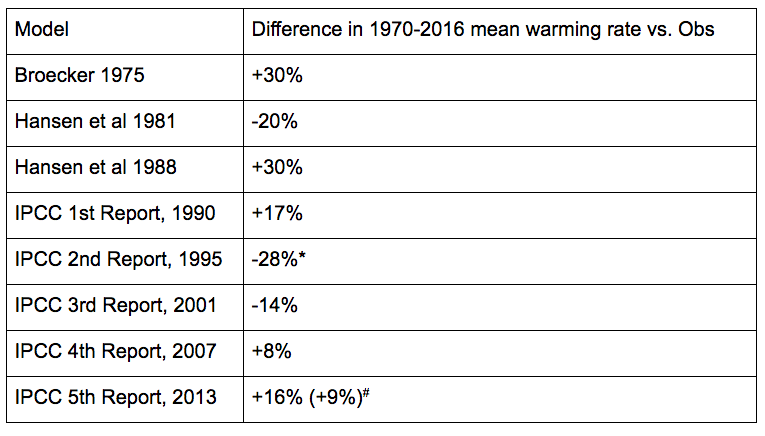
And regarding the accuracy of the models, there have always been uncertainties so the models are never expected to be 100% accurate, but when the various models are analysed carefully with observed measurements of both land and ocean heat content, they have proven to be pretty accurate over all. The observed temperature increases have been slightly lower than the predictions in AR5 but the differences can be accounted for by elements that were not modeled like the declining solar output and a number of small volcanic eruptions.
There are lots of potential positive feedbacks that are not included in the climate models at all, and there is cause for concern over historical evidence showing that climate shifts can happen over the course of a few decades once a tipping point is reached. While these are by no means certain, and there is an awful lot of debate about how likely this is, these are relatively low probability High impact events and it would be very irresponsible to ignore the risk on the basis of optimism rather than a proper analysis of the dangers.https://www.skepticalscience.com/how-well-have-models-predicted-gw.html We need to support the scientific community to improve their modelling. They require resources to allow them to increase the resolution of their modelling systems, and to include things like ice sheet collapse, better precipitation models, better cloud models etchttps://www.ipcc.ch/pdf/assessment-report/ar5/wg1/WG1AR5_Chapter09_FINAL.pdf
Roger_007 wrote: » I am no expert on climate but I often worry about the claims that 97% of climate scientists are of one mind on the subject. Some of these people have made silly predictions in the past which have proved very wide of the mark. Example: article published in 2007, which made big headlines at the time, predicting that the Arctic would be ice-free in summer by 2013.http://news.bbc.co.uk/2/hi/science/nature/7139797.stm There was also the prime minister of the Maldives who made a speech to the UN in 2012 that he had been advised by his climate experts that the Maldives would be under water in 5 years, i.e. 2017. None of the above predictions came to pass but I assume those scaremongers responsible for those predictions are part of the 97%. This is what worries me.
M.T. Cranium wrote: » The word "disingenuous" implies a deliberate distortion of facts. I am not the one doing that. I am quite sure that the 97-3 ratio is contrived and based on poorly worded survey questions combined with peer pressure.
Akrasia wrote: » All the talk of global temperatures not rising completely ignored the rise in ocean heat content, and as you yourself say below, warmer water can hold less co2 so rising ocean temperatures now could just be a stop gap before we see a large increase in the rate of atmospheric warming.
“Our precision is about 0.2 ºC (0.4 ºF) now, and the warming of the past 50 years is only about 0.1 ºC,” he said, adding that advanced equipment can provide more precise measurements, allowing scientists to use this technique to track the current warming trend in the world’s oceans.
NEWS | OCTOBER 6, 2014 NASA Study Finds Earth's Ocean Abyss Has Not Warmed
Update as of 5/30/07: Recent analyses have revealed that results from some of the ocean float and shipboard sensor data used in this study were incorrect.As a result, the study's conclusion that the oceans cooled between 2003 and 2005 can not be substantiated at this time. The study authors are currently working to correct* these data errors and recompute ocean temperature changes.
This accrued heat is "really the memory of past climate change," said Kevin Trenberth, the head of climate analysis at the National Center for Atmospheric Research and co-author of a new paper on ocean warming.
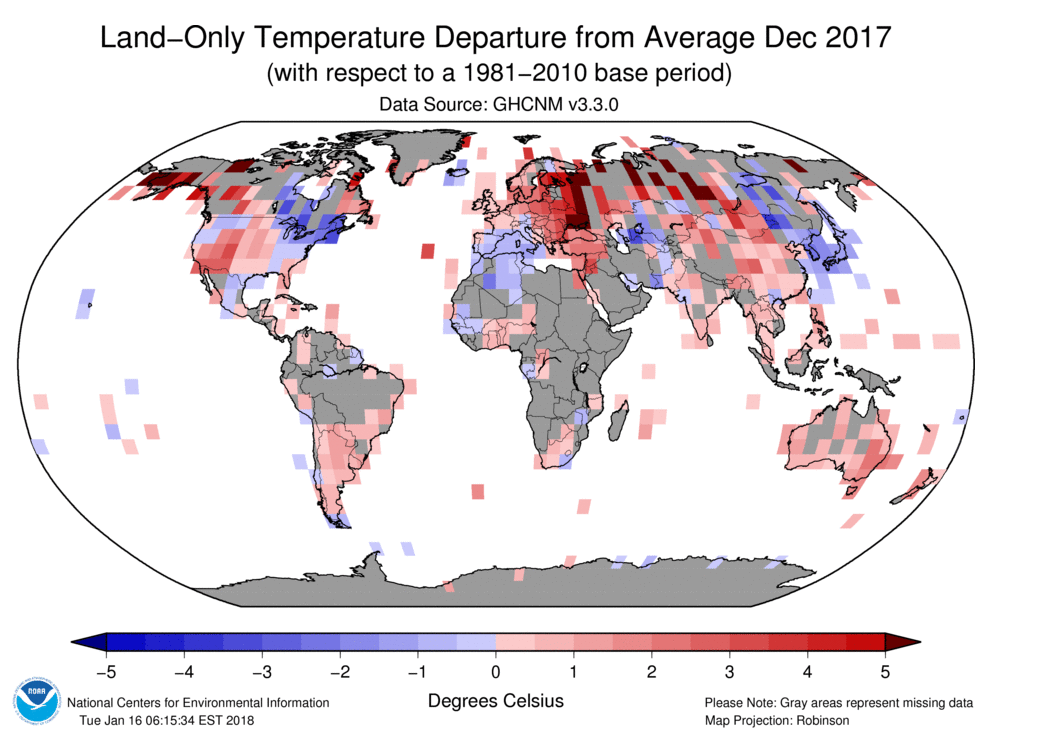
gabeeg wrote: » Well you'll be delighted to hear that those mad fools at NASA have declared 2017 the second hottest year ever, after 2016. But sure what have NASA ever done? Bunch of jokers
piuswal wrote: » What do you think of this;https://www.facebook.com/climatecentral/videos/1551677264919326/?hc_ref=ARSN12y6j75LrYbuSE6ZOlHEx3R_SIQfBKGRpRFfbJxJU6oCI-5dN9EvEBQKVDgKoP4
gabeeg wrote: » See, I happen to think that accuracy is important to Nasa. But then I also believe in the moon landings. It was likely my omission. Sorry.
dense wrote: » Not much to be honest. Here's why: The title mentions 97% of climate scientists. It shouldn't mean anything to anyone actually, because no one has ever surveyed 100% of climate scientists. Therefore no one can claim to have elicited the opinion of 97% of them. If one accepts the above, and one must, one must then also reject the "9 out of ten cats prefer Whiskas" type false construct of "97% of climate scientists" which is deliberately designed to appeal to those who lack the ability to critically analyse such porous claims. I'll just leave this here:
piuswal wrote: » I've only just come on this thread and read the last post by M T Cranium, so I have a lot to catch up on. In the meantime could I ask on what evidence is the statement, "But it seems odd, don't you think, that so many weather enthusiasts are skeptics." based?
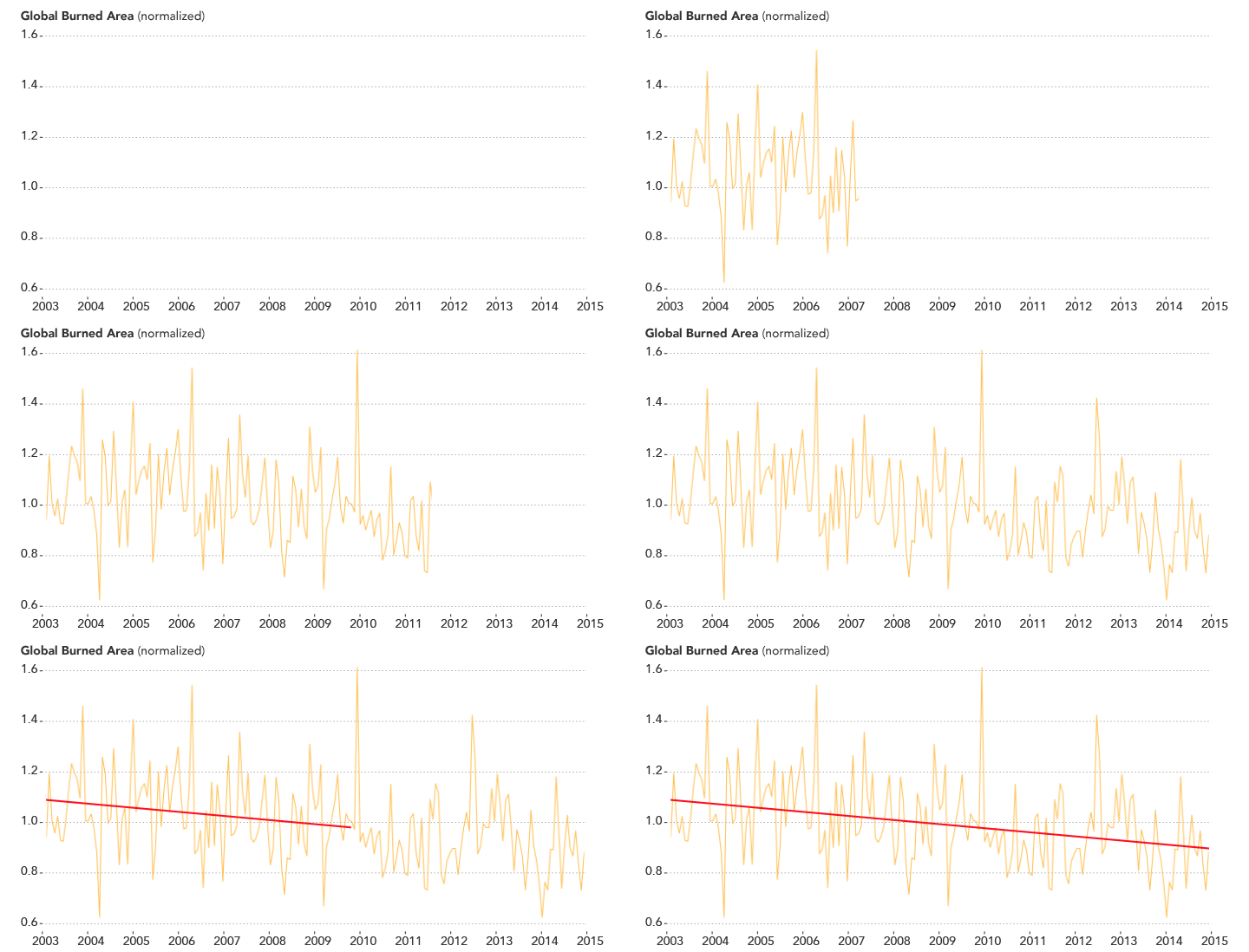
M.T. Cranium wrote: » There is also a related question of exposure of populations to climate stress, where it's not the climate stress that is changing but the amount of exposure to the stress. For example, the "exurban" lifestyle is very appealing in western North America and I would imagine in Australia and other places subject to forest fires. Large numbers of people now live in areas that were formerly sparsely populated, and a preferred setting is "parkland" meaning wide open spaces that have some of the former forest cover still maintained. In recent years it has become increasingly obvious that these are high-risk fire zones. When fires that burn in large tracts of forest come up to the boundaries of these exurban zones, they find an ideal environment for rapid spread. Strong winds are likely to develop both because of the fires and because many of these exurban zones are built on scenic ridges for the view. Thus it may be easy for some to conclude that forest fires are getting worse in a changing climate. What is closer to the truth is that human penetration of fire zones is increasing, and by the very nature of how we settle along these interface zones, we are exacerbating the problem. It's another area where perhaps the first conclusion is not the right one, but just the easiest or most convenient one.
Akrasia wrote: » MT, Can I just ask you about your interpretation of the underlying physics behind global warming? While there is uncertainty about climate sensitivity, (within a likely range of outcomes between 2 degrees nd 4.5 degrees for a doubling of atmospheric CO2) this is entirely because of uncertainty surrounding climate feedbacks, the radiative forcing attached to human emissions of greenhouse gasses is not uncertain at all, it is extremely well understood. There's a great lecture posted on Youtube from Oxford university that explains the basic physics underlying the radiative forcing and why we are certain that it is anthoprogenic.
Great lecture guys. I've shared it and used it to help debate against climate skeptics
There are three main categories of studies estimating climate sensitivity, which are based on: 1) very detailed climate models. 2) combining recent climate measurements with simpler climate models. 3) measurements of past climate changes. Most studies have been very consistent in estimating that surface temperatures will warm between 2 and 4.5°C (3.6 to 8.1°F) in response to a doubling of atmospheric carbon dioxide, most likely 3°C (5.4°F).
piuswal wrote: » Just for information: Scott Pruitt insincerely asked what's Earth's ideal temperature. Scientists answer In short, from a practical standpoint, "as little additional warming as possible" Civilization developed in a stable climate Texas Tech’s Katharine Hayhoe agreed, noting that human civilization has developed in the relatively stable climate of the past 10,000 years. There is no one perfect temperature for the earth, but there is for us humans, and that’s the temperature we’ve had over the last few thousands of years when we built our civilization, agriculture, economy, and infrastructure. Global average temperature over the last few millennia has fluctuated by a few tenths of degrees; today, it’s risen by nearly 1°C and counting. Why do we care? Because we are perfectly adapted to our current conditions. Two-thirds of the world’s largest cities are located within a metre of sea level. What happens when sea level rises a metre or more, as it’s likely to this century? We can’t pick up Shanghai or London or New York and move them. Most of our arable land is already carefully allocated and farmed. What happens when we can no longer grow the crops we used to, as climate shifts and water becomes more scarce in many subtropical areas? We can’t just take over new land: someone else already owns it. What happens when our water resources diminish or even run out? We can’t take over someone else’s water rights without a war. We care about a changing climate because it exacerbates the risks we face today, and threatens the resources we depend on for our future.
dense wrote: » And only scientists that are toeing the UNIPCC line are to be listened to, respected, encouraged and supported in their sainted endeavours. What is made of Ray Bates here I'd love to know. Needs to be silenced too probably.https://www.irishtimes.com/news/environment/warning-of-over-alarmist-stance-on-climate-risk-1.1792370https://cliscep.com/2016/05/12/new-paper-on-climate-sensitivity-supports-low-%E2%89%881c-estimates/http://onlinelibrary.wiley.com/doi/10.1002/2015EA000154/full Actually, I already know...given that Ireland's environmental policy looks like it's being single handedly steered by a lead author of the UNIPCC, a retired geography professor, who isn't Ray Bates.
Gaoth Laidir wrote: » Good luck with that. Look a few months back and you'll see that the Bates paper was ignored here and instead a character-assassination took place. One or two current posters refused to discuss his findings.