Shedbebreezy wrote: » And what's your point?
Say my name wrote: » No point just the article. Carbon dioxide (carbon) came from the earth or molten lava and it will return to the earth again. Whether the earth will return to a lava ball again or even a frozen ball is anybody's guess. It's interesting that there was 5 times more carbon dioxide in the atmosphere during the time of the dinasours that is all. No argument.
MJohnston wrote: » Not being in any way a part of the company running it, I'm not sure why you would expect me to be privy to the financial ins and outs of the it, but I think it's rather irrelevant. I also have no idea what the Ploughing Championships have to do with anything, but anyway. My thinking is that it's great to see a science-positive resource that is clearly targeted at school-age children and school groups.
Shedbebreezy wrote: » I can't actually believe we have so many man made climate change deniers on here. Over 97% of climate scientists agree its real. ...... IMO its just pure ignorance and stupidly to deny it.
Gaoth Laidir wrote: » Since when did anyone deny mmcc? I certainly didn't. I do have a problem with hyperbole and exaggeration, though, and with the attribution of every weather event to mmcc. Observations are not following the most pessimistic scenarios of the IPCC, yet these are invariably the only ones that are quoted and if you point that out you're a "denier". I reckon you need to familiarise yourself a bit deeper with the actual facts and figures and how the observation curve is fitting the projections curves and less on pasting paragraph after paragraph of the basic theory.
Gaoth Laidir wrote: » I'm also all for promoting science to children, but the "science" that appears to be on display (from reading the website) seems to be exaggerated and dramatised.
Yes, make it engaging, but the idea that you transport them to their town only 30 years from now and it's "very different to the town they know today" is laughable and just inaccurate.
I don't think it's irrelevant to ask where the entrance money is going when there is a long list of corporate sponsors.
Shedbebreezy wrote: » I didn't mention your name don't be paranoid. I'm quoting Scientists who conducted studies in to it Gaoth. People who know more about the subject than you or me. Imagine that. And I think you should brush up on your knowledge on the impacts of climate change, especially for developing countries instead of downplaying it as a bit of nothing. Tell them it's hyperbole. I'm sure it'll be comforting to them.
MJohnston wrote: » If you think that, try not to just make glib put downs of the whole thing - explain what exactly you think is exaggerated and dramatised. Otherwise you're essentially just "vaguebooking"
If you actually read the blurb about this 2050 thing, it's talking about issues regarding "transport, waste & energy" - if you don't think that'll look very different in 32 years time, you're very wrong.
Well it's a charity running it, so you can easily find out for yourself: https://charitiesregister.ie/org/b8b8d0a2-76f6-47ab-8002-b6f4fea5ca74/centre-for-climate-change
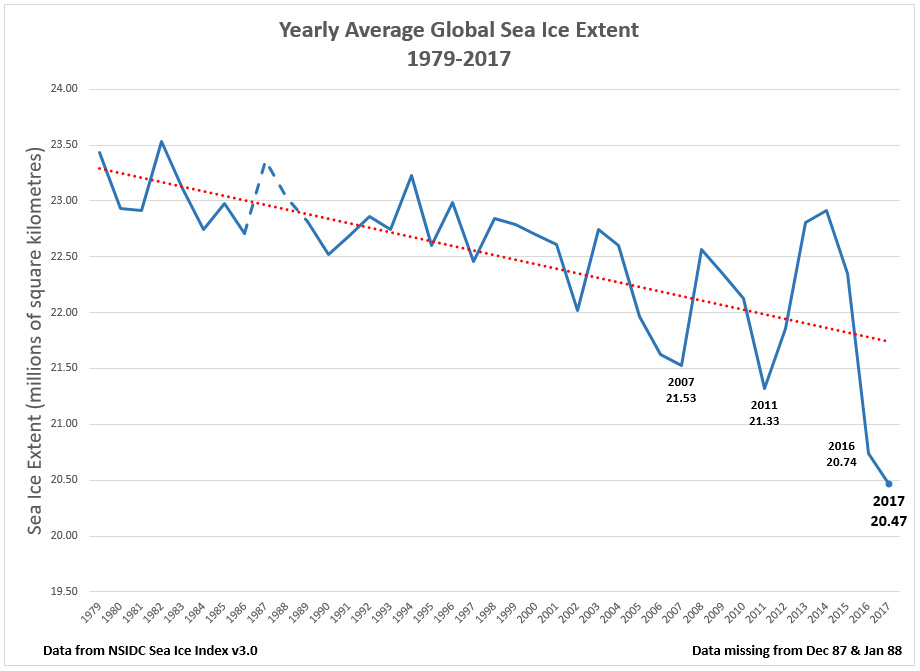
Gaoth Laidir wrote: » I'm well aware of the "impacts" that are alleged to be already happening. It's hard not to when every weather event is being attributed to mmcc. It's being rammed down our throats and we're not meant to question it. Most of it is hyperbole that hasn't come to pass yet. Ice-free Arctic, inundated countries, etc. No sign of many of the impacts that a while back were being warned in the most dramatic of terms. Increased CO2 does affect global temperature, but just not to the extent that was once believed by the 97%. Observations and new research are showing that to be the case. Science moves on as new evidence comes to light. Move with it.
ABC101 wrote: » Well the points I raised are not my own, in fact it was explained by a scientist that with regards climate change, this is what they have been doing, going back through every and any records. So for example if something of interest was written by a Irish Monk, they would look for that evidence elsewhere as well, to see if the observation was also seen across Europe for example, is it replicated in tree trunk rings etc. It’s a bit like forensics, they can work backwards etc
Shedbebreezy wrote: » What observations? Sixteen of the 17 warmest years in the 136-year record all have occurred since 2001. Www.climate.nasa.gov/vital-signs/global-temperature/
You're being hyperbolic now, it was never mainstream opinion that the Arctic would be ice free by 2018. Please supply all this new evidence that is coming to light. You seem angry about climate change, stating facts is ramming it down our throats apparently.
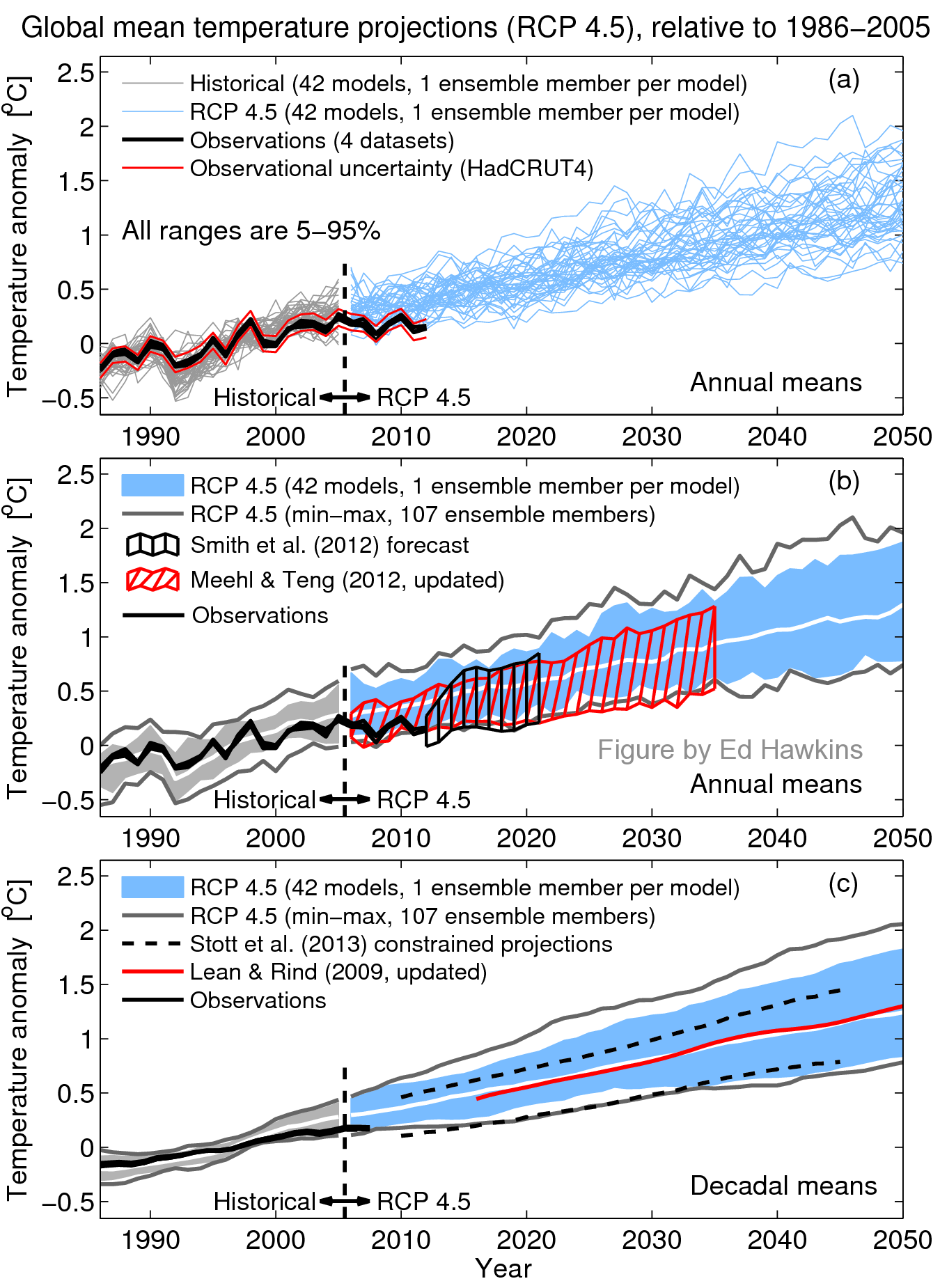
Gaoth Laidir wrote: » That's a dead link. But here's a chart for you (albeit missing the last few years), showing that observations are not even keeping up with RPC4.5, which would suggest that this particular forecast (the second lowest of the four) may not be reflective of reality. Of course the highest RPC (8.5) is the one that invariably gets quoted on here and elsewhere when speaking of the likely future climate. That's what I mean by exaggeration and hyperbole.
I never said 2018, but 2020 was a widely-stated estimation some 10 years or so back. Of course that's now been moved out and out, but I still hear people speak of ice-free in the next decade or so, yet there is no scientific evidence of it.
Gaoth Laidir wrote: » That's a dead link. But here's a chart for you (albeit missing the last few years), showing that observations are not even keeping up with RPC4.5, which would suggest that this particular forecast (the second lowest of the four) may not be reflective of reality. Of course the highest RPC (8.5) is the one that invariably gets quoted on here and elsewhere when speaking of the likely future climate. That's what I mean by exaggeration and hyperbole. I never said 2018, but 2020 was a widely-stated estimation some 10 years or so back. Of course that's now been moved out and out, but I still hear people speak of ice-free in the next decade or so, yet there is no scientific evidence of it. I'm not angry about climate change, so I don't know where you got that. I don't like tabloid exaggeration, whatever the topic. The facts you speak of have become inflated and hijacked as a one-size-fits-all scapegoat for everything and anything. I heard talk that Ophelia was due to global warming, yet a week after it passed a paper was published stating it was not. Didn't matter, there are still some who are telling us to expect more of the same, more severe and more often. Scientific evidence actually shows that the number of high-end tropical systems has been DEcreasing, contrary to previously thought. We need to get off fossil fuels. We need to use renewable energy. Everyone should have a solar panel on their roof. Aircraft wings should have them on the upper surface. We should have more wind farms. But not because the Maldives is going under, or Florida gets hurricanes, but because the energy is there, and whatever small contribution we are to warming will be mitigated.
Gaoth Laidir wrote: » Ah, to pay the salaries of the 1-9 employees. There's the problem. True charities should be run voluntarily.
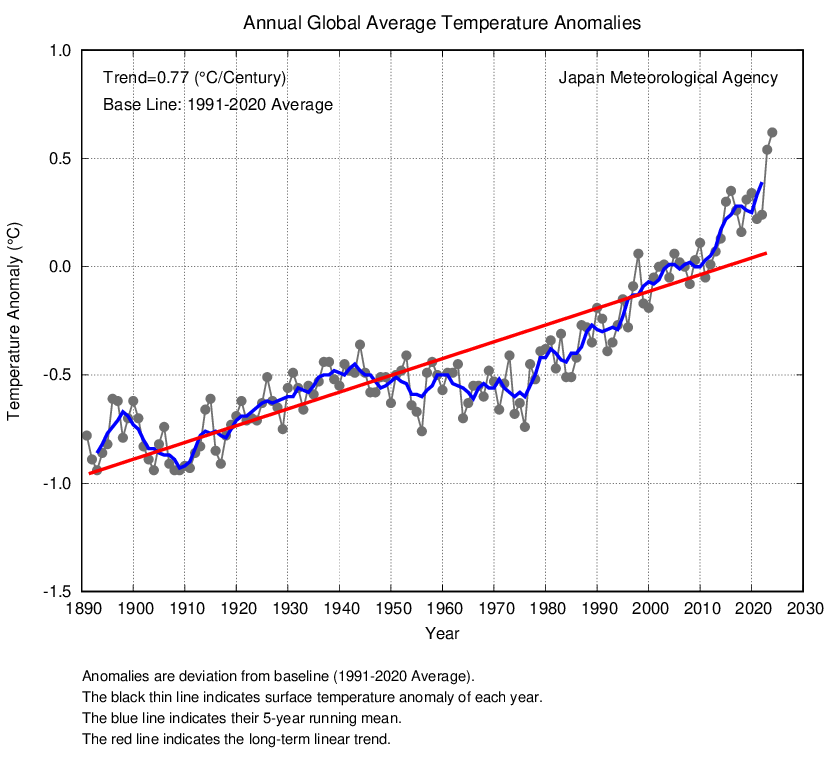
Akrasia wrote: » MT, you say that global average temperatures have flatlined, but 16 of the last 17 hottest recorded years happened this century, and the last 4 years have been dramatically warmer still .
Gaoth Laidir wrote: » On an increasing long-term background trend it's no surprise that recent years have been warmer than earlier ones. I think MT was referring to the flat line from the start of this century.
M.T. Cranium wrote: » By the way, if you want to say that evidence of climate change is irrefutable, then why are all of the following things true? -- the worst hurricane season on record in the North Atlantic was 1780. -- the most severe outbreak of tornadoes in the U.S. (by numbers of F-4 or F-5, not by death toll, although that was the highest) was in 1925. -- the most severe heat waves were in 1934 and 1936. 1911 ranks third. -- in Britain, over 360 years, the warmest January was 1916 and the warmest February was 1779. The warmest winter was 1868-69. It is only the December warmth in 2015 that comes from the modern winter period. None of these fairly significant indicators can be used to support the most frequently heard argument for climate change, namely, that "we" are causing severe or unusual weather events. It doesn't stand up to analysis. Apparently, our unsuspecting grandparents or further back generations were doing this, or perhaps it's just natural variability. As to 97% of climate scientists agreeing with the notion of climate change, first of all we need to break that down by what kind of climate change. I might not qualify as part of the sample, or maybe I do, but I would agree that there is climate change simply on the basis that there is always climate change. Our climates have long-term variability. They always have had, and sometimes much larger variations than we've seen. This isn't even the warmest time since the last glacial, that came about five thousand years ago. So I would like to know, is that 97% like 90% who are concerned about human caused variation and 7% only natural, or is it 40-47 or what is it? And who are these 3% that don't believe in climate change, they must believe in a steady-state climate, but I suspect the 3% is like what the Russians used to report as opposition to the party in state elections, it sounded worse if you said 0%. Now if it's maybe 60% who are concerned about human modification and 37% only natural (I don't think there are any other horses in this race) then okay, how many of those 60% feel no peer or workplace pressure and have no reservations? The reason I doubt these numbers apply to human-induced change is simple, on weather forums where meteorologists participate, the discussion quite often seems more balanced than 97-3, more like 50-50. I know for a fact that a lot of AMS members whose jobs are in local forecasting are skeptics. One reason why a local forecaster is more likely to be a skeptic is that today's record highs (and lows) flash before your eyes once a day, and it's sobering to notice after five minutes of the news guy waffling on about "extreme weather" that today's warmish high fell five degrees short of 1890 or even 1942. I hope there will be a more flexible poll taken with more than two options, to some extent the question asked now is a "do you beat your wife?" question, especially if your boss at the institute happens to be listening in.
Longing wrote: » https://www.youtube.com/watch?v=4LkMweOVOOI Dr Easterbrook on Global warming Hoax and facts.
Akrasia wrote: » But that increasing long term background trend is the global warming, it is the greenhouse effect...
Regarding the temperatures, it's good that you acknowledged that the graph is out of date. What do you think it would show if the previous 4 years of data were included? The last 4 years have shown a staggering surge in temperatures so that unless there is a dramatic cooling in the next few years, we may have already arrived at the 1 degrees above pre-industrial levels that weren't projected to be reached until around 2030 under the RCP 4.5 scenario, and we're well ahead of even the RCP 8.5 scenario, which would indicate that climate sensitivity is higher than we have modelled to.
Gaoth Laidir wrote: » Since the late 1800s the temperature has shown a rising trend. The population then was around 1.5 billion. The population today is 5 times that, yet the rate of warming is similar to that of 100 years ago. Certainly not proportional to the increased emissions from a population almost 5 times as big. There is no runaway warming like there