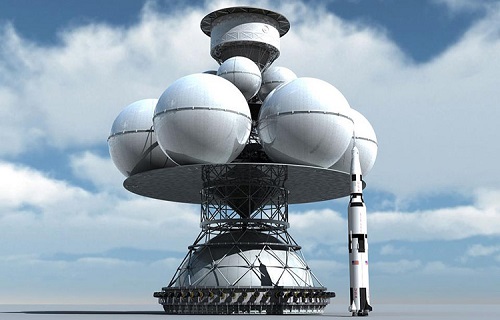
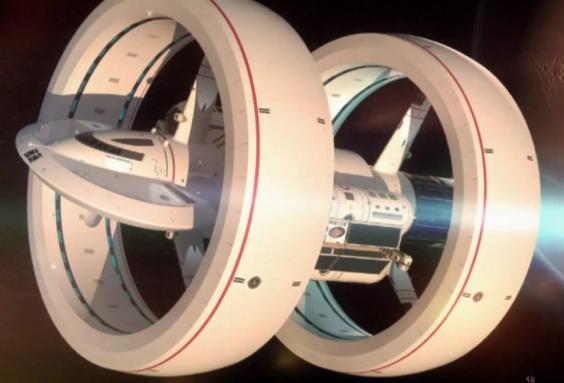
Fathom wrote: » Worldship? Too small for thousands.
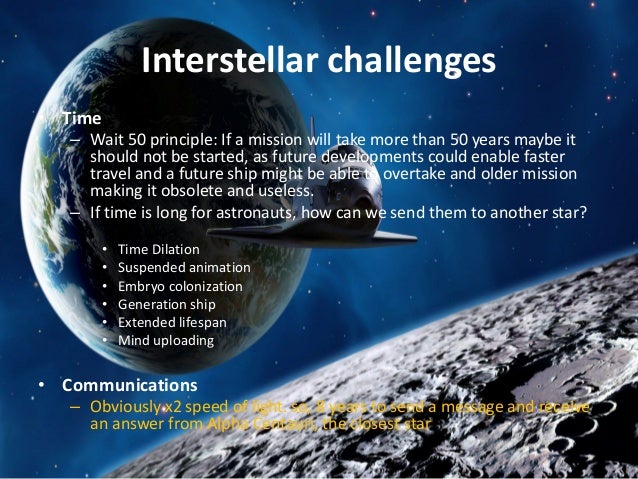
Rubecula wrote: » if a mission will take longer than the lifespan of the crew then perhaps we should only go by proxy.
Capt'n Midnight wrote: » Mammals are bad at that. Most other animals can be stored as eggs. Crows and Squid ?
ED E wrote: » I've always thought that will be the jumping off point. Build a "drone" producing facility in earth/lunar/martian orbit. Find way to feed it supplies effectively (anything we can get from space dust/asteroids we do). Produce drones at send them out like buckshot. Proceed like this for x years until we have a large range comms net with sensor data trickling back about loads of stellar bodies. When thats done start pushing out drones with re-entry shields to land and get surface readings on interesting bodies. From there: terraforming. By the time we send any humans anywhere there should be a veritable army of automated units preparing for them.
Fathom wrote: » A plausible space exploration policy. Funding is problematic. Profits from expanding space exploration? Perhaps mine and ship rare minerals with high return on investment?
sophiewilson wrote: » I do think it is far from reality. But if we can just find another Earth it can be done slowly. We already found another galaxy so finding a new Earth is possible.
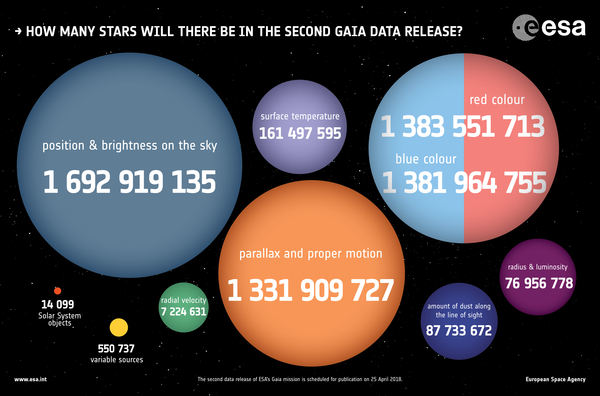
The much awaited second release of Gaia data will contain the position and brightness on the sky of 1 692 919 135 stars, as well as measurements of the parallax and proper motion of 1 331 909 727 stars. ... The second Gaia data release will also include a wide range of additional information: the colours of 1.38 billion stars [1]; the radial velocities of 7 224 631 stars; information about 550 737 variable sources; an estimate of the surface temperature for 161 497 595 stars, the extinction – a measure of the amount of dust along the line of sight – for 87 733 672 stars, and the radius and luminosity of 76 956 778 stars. Closer to home, the new data set will contain the position of 14 099 known Solar System objects – mostly asteroids – based on more than 1.5 million observations.
sophiewilson wrote: » We already found another galaxy so finding a new Earth is possible.
Rubecula wrote: » if the universe is infinite then the earth and every person who has ever lived is also infinite, as are/is every possible outcome.
Black Swan wrote: » Using the Drake Equation, it has been estimated that life exists from 1 (only Earth) to billions of chances elsewhere.
Rubecula wrote: » http://ichef.bbci.co.uk/wwfeatures/wm/live/1280_720/images/live/p0/64/ld/p064ld85.jpg a little off topic but not starting a new thread for one post.
Rubecula wrote: » fuel tanks made from kitchen foil (almost) wonderful memories. I wonder why Ireland with it's Atlantic coast does not partner UK in this project.
Capt'n Midnight wrote: » Because you get 1,000kmph by flying eastwards due to the Earth's rotation. Israel launches it's satellites Eastwards because of the neighbours, so they have to go a wee bit faster to get to orbit. Down in New Zealand there's less shipping and less neighbours so more launching directions for different orbits. For equatorial orbits French Guiana is ideally placed as it's very close to the equator so maximum boost.
Rubecula wrote: » https://en.wikipedia.org/wiki/Reaction_Engines_A2https://en.wikipedia.org/wiki/Skylon_(spacecraft)
Capt'n Midnight wrote: » Materials technology is now at the stage where we could consider space elevators for the Moon and Mars so we could build colony vessels there and not have to worry about this gravity well for the heavy stuff, and use asteroids for the really heavy stuff.





![Photo of [Deleted User]](https://wf.vanillicon.com/v2/fc7d50eddf86fd2a7872c6ffac511c39.svg)