Generic Dreadhead wrote: » Is that speculation of are there figures? Would have thought loot boxes were brining in more moolah
J. Marston wrote: » It really is puzzling. Witcher 3 made stupid amounts of money and at the same time, untold amounts of goodwill from gamers because CDPR didn't take the piss. 16 free pieces of DLC when the game came out blew my mind. Those Triss, Yenn and Ciri alternative outfits for instance, any other company and those outfits would have been €1.99 each. Then the excellent expansions which were brilliant value for money. If Cyberpunk 2077 has lootboxes and microtransactions, it will be the biggest heel turn in gaming.
gizmo wrote: » What needs to be considered though is that said profit is off the back of nearly four years of work for a team of around 200 people on the development side alone and was based on an existing and highly acclaimed franchise whose previous games had already sold 15m combined since the release of the original game in 2007. It's these kinds of figures which show why funding any of these kinds of big budget games can be incredibly risky.
gizmo wrote: » There's an important line in that article you linked. "That’s because advertising is critical to getting a game in the top ten rankings." As discussed earlier, these big budget games need to see big sales in order to earn their development costs back and one of the primary means of doing that is to get as many eyes on them as possible. Word of mouth will only get you so far and the percentage of the potential audience who read games magazines, peruse gaming sites and, even moreso nowadays, use Youtube for news is only a fraction of what these big games sell.
Mark Hamill wrote: » Destiny 2, Forza 7 (is it 7?), Battlefront 2 (4 really) and Shadow of War are all sequels of popular gaming franchises. The Witcher example shows how word of mouth with reasonable advertising will get you big sales and will make you millions of profit if you actually make good games. Instead of what is happening now, making bad* games with exploitative gambling mechanics in order to catch whales and dolphins.
Mark Hamill wrote: » That article about EAs budget came from 2009, when Modern Warfare 2 came out. MW2s production budget was ~$50 million. Its marketing budget was $200 million! That means MW2 needed to sell 5 times as many copies to break even. That means it had a 5-fold increase in risk. It is the marketing that is driving the budget to unreasonable limits and it's the marketing that bring that huge risk.
gizmo wrote: » That's about in line with what most publishers spend on larger titles with the exception of EA and Activision.
gizmo wrote: » generally speaking if you're going to sink ~$80m into a project over that period of time, you're going to need a hell of a return to be able to just start all over again on your next release.
gizmo wrote: » Just because EA and Activision try to go full Minority Report with their ad campaigns and their associated price tags, doesn't really negate this point.
Mark Hamill wrote: » How much of a return will you need if you sink €300 or 400 million into a project? The Witcher shows us that putting $81 million into a game, including marketing, gets you well over that in profit (you need to check your numbers, CD project red made $90 mil profit in 2015 when Witcher 3 came out, and then ~$64 mil profit in 2016 when it's free DLC came out). So maybe game companies should conservatively be expecting a return of 100% profit over the production costs of games of equal quality.
Mark Hamill wrote: » Companies like EA and Activision seem to think that increasing the marketing 8 fold (going from 1/2 production cost to 4 times production cost) will get you an equivalent return in profit. That they are now relying on exploitative gambling mechanics in micro-transactions shows that that is not the case.
Mark Hamill wrote: » The point is that all games carrying massive financial risk. But there is a difference between the risk in a $90 million game and a $300 million one, and if the only reason $300million one isn't costing only $90million is because of the marketing, then it's the marketing that is creating the extra risk which supposedly justifies loot boxes and micro-transactions.
Daniel Zeichner, Labour MP for Cambridge, has submitted two written questions on my behalf: To ask the Secretary of State for Digital, Culture, Media and Sport, what steps she plans to take to help protect vulnerable adults and children from illegal gambling, in-game gambling and loot boxes within computer games. To ask the Secretary of State for Digital, Culture, Media and Sport, what assessment the Government has made of the effectiveness of the Isle of Man's enhanced protections against illegal and in-game gambling and loot boxes; and what discussions she has had with Cabinet colleagues on adopting such protections in the UK.
Grumpypants wrote: » I'm starting a protest outside the Dail about how lucky bags are getting kids into gambling if you want to sign up.
Grumpypants wrote: » Gaming is the only entertainment medium where the price to consumer has come down.
Notorious wrote: » Not having a go, or trying to go off-topic, but I don’t agree with you here. In the last five to seven years the prices of console games have definitely gone up. With the removal of a lot of companies from the Irish market (Game, HMV), and the introduction of the current generation consoles, the price of a new release was bumped by €20. .
wes wrote: » Yeah, the games industry are under the radar, with the in game gambling right now. Only a matter of time, before they attract government attention and end up regulated the same way as any other gambling.
Quake Champions Instant Game Access 50 Shards 100 Platinum 2000 Favor Ranger Champion BJ Champion
gizmo wrote: » Depends on whether you want your next game to be bigger than your previous one I guess. If you aim for 100% profit over production costs then unless you have another stream of income your project is only going to have a similarly sized budget at best.
gizmo wrote: » I'd still consider the $100m+ area for a budget to be astronomical, a good example of the rising development costs we've been talking about here and an understandable candidate for the kinds of micro-transactions we're seeing.
Mark Hamill wrote: » Why would it only be similar sized at best? These companies must have gotten investment before making their first games, and they are making 100% profit after paying back those investers. It should be easy then to get at least the same investment for the next game and then add their own investment to significantly bulk up the budget. e.g. 100m invested for game. Game sales - 100m paid back to investers and 100m in profit for makers. Next game gets 120m invested, plus 50m from makers. So 2nd game has budget of 170m (nearly twice) and makers keep 50m profit from previous game.
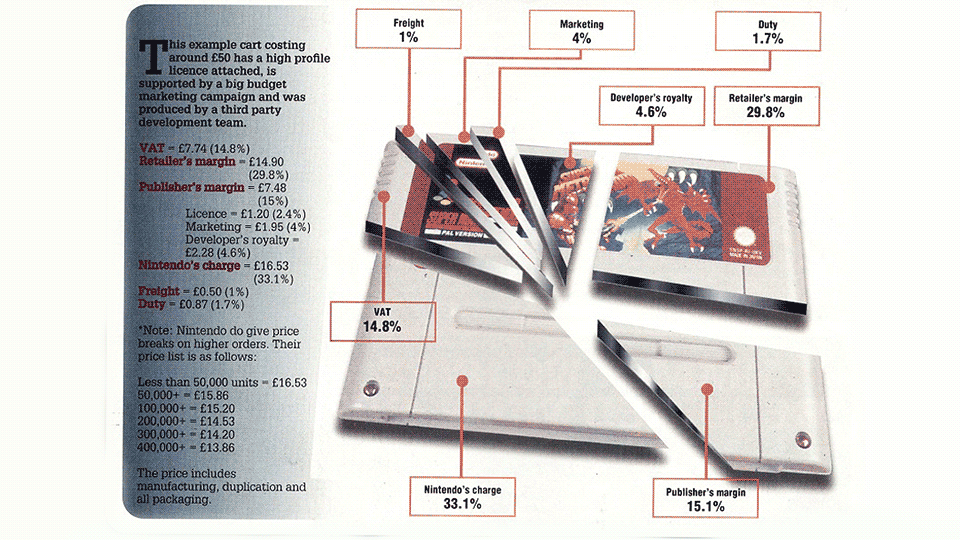
Mark Hamill wrote: » Is €100m astronolical though? What were the production costs of games in the 8/16 bit eras? I don't know how accurate this is, but I found <image>
Mark Hamill wrote: » I think the price of classic games are presented in these discussions as if a) those prices actually represented production costs and b) those costs represented the same things now as then.
gizmo wrote: » That's not really how it works. Publishers don't get investment per title, they use their own funds for development. It's not like the movie industry whose funding model more closely represents what you've described.
gizmo wrote: » Also bear in mind the financials of the larger publishers are publicly available so you get a good idea of the flow of money in and out.
gizmo wrote: » That table really doesn't look correct, at least at the upper end, although I don't think I've ever seen any accurate figures from the earliest generation of consoles. Look at it this way though, Super Mario World had a team of about 10 people working on it for a little under two years, I highly doubt its development budget could eclipse the likes of GTA V with its multiple studios and headcount running into the hundreds over an even longer period.
Mark Hamill wrote: » Change investors for publishers and has my point changed? Developers make game with 100m of publishers money and it makes 200m in revenue. 100m pays back publishers and 100m is profit (which, lets face it, goes to the publisher). Next game is then made with 100m of publishers money plus e.g. 50% of that profit. The circle continues, game budgets and profits grow.
Mark Hamill wrote: » Well, looking at EAs and Activisions financials and it seems like their gross profits have been on the up for a number of years, all before our current talk of gambling-mechanic loot boxes. Their costs have also been going down each year (the jump for Activision in 2016 might be from them buying King).
Mark Hamill wrote: » It has a good few holes and I would like to see other data if people have them but the table tries to take account of the cost of the physical cartridges, which it puts at $15 (I have seen $10 quoted elsewhere too). So even if the software development costs were minimal, the 15 million cartridges for Super Mario World could have cost in the region of $150m to produce (and that's not corrected for inflation). That overhead hasn't existed for a long time in gaming (although, while googling for sources, I saw more than a few articles discussing the Nintendo Switch's reliance on cartridges being the reason multiplatform games are more expensive on it).
[Deleted User] wrote: » Not implemented Activision say but I'll leave it here https://charlieintel.com/2017/10/17/patent-reveals-activision-uses-matchmaking-encourage-players-buy-microtransactions/
EoinHef wrote: » My god thats disgusting,every single game they release that has MP needs to be checked to make sure it doesnt have this. Matchmaking based on microtransactions rather than skill,ive really heard it all now.
gizmo wrote: » Nope, but the same flaw is still present in your argument. That initial $100m made on the game isn't just there to be used to cover production costs on the next game, it will have be used, amongst other things, to cover the operating costs for the studio for the previous two years work, the work that cost $100m which was either their own capital or investment which needs to be repaid. Therefore, when you begin development on the next game, you really only have the $100m profit to work from.
gizmo wrote: » Yup and if you look at the breakdown of the figures you'll see there's a hell of a lot of money coming from alternative digital revenue sources. In the case of EA, this used to be Season Passes for their various franchises but that's been completely eclipsed by the Ultimate Team system across their sports titles. This actually came up in the Shadow of Mordor thread before and I replied here with respect to their FY16 numbers.
gizmo wrote: » Oh for sure, physical costs now are but a fraction of what they used to be. Hell, Nintendo dropped the ball on this big time and arguably opened the door for Sony to steam roll them back in the Playstation days as they took advantage of lower royalties charged as well as the lower cost-per-unit that CDs brought. That being said, with platform holder royalties now around the 11.5% mark that represents a change of a little under 20% on the retail cost of a current physical copy, so what, a tenner extra to the publisher? I don't really think that would do much to make up for the current development budget differences as well as the other ancillary costs required to get a game onto retail shelves.
gizmo wrote: » On a related note, the UK Government have responded to the petition regarding the regulation of in-game gambling. As I kind of expected, it really comes down to the monetary value of the things you're getting and whether they can be sold or traded on afterwards.Government response to loot box concern is predictably non-committal
The government response is, unsurprisingly, evasive and appears to be ill-informed on the issue - citing the prosecution of two third-party gambling websites despite questions asking about in-game gambling.
Nody wrote: » Already been ruled on by the gambling commission in the USA as not being gambling as you're guaranteed to get something from the lootbox; in China also cleared as long as they state the percent chance of getting a specific tier of item (which is why we found out about the percentages for Overwatch for example).
M!Ck^ wrote: » I'm sure gizmo will find a reason for it to be ok :pac:
Given that emotions tend to run high in this debate I feel the need to preface my reply with saying I'm not defending this stuff, I'm simply pointing out the reasoning behind it and who it generally appeals to rather than grabbing the closest pitchfork.
Mark Hamill wrote: » I'm not saying the initial $100m made is for the next game, it is specifically to cover all costs for making the first game. The next game is funded from the same source as the first $100m came from (be it loans or publisher cash reserves from profit from other works). If the previous game made a profit, then some of that profit can be used to increase the budget of the 2nd game, to hopefully make an even greater profit.
Mark Hamill wrote: » You are saying "alternative digital revenue sources" as if they are from some separate department to their game development departments. They are revenue directly from and tied into the making and selling of the games that use them. And we can see from their financials that EA were making increasing profits every year, whilst reducing costs at the same time. These companies might want more money, but their financials, at least since season passes were invented, put the lie to their claim that games are costing them more to make and they are loosing profits. It proves that micro-transactions, especially gambling mechanic ones, are pure greed.
Mark Hamill wrote: » 20% goes a long way. Then add in the profit from Season passes and DLCs. While they may sell fewer units that original game, modern Season Passes and DLC are almost entirely digitally sold (so no physical costs) and each unit produces more profit relative to the original game. We can see the effects from this in the reduction in development costs over the last years within EA and Activisions financials.
Mark Hamill wrote: » It more comes down to the UK government not even understand the question, from the article you provided:


![Photo of [Deleted User]](https://wd.vanillicon.com/v2/d3e92925f7bde702415f91ea088d4f7a.svg)
![Photo of [Deleted User]](https://w8.vanillicon.com/v2/892f365931e5cb4ba5c9d4ce2c7da299.svg)
![Photo of [Deleted User]](https://w2.vanillicon.com/v2/26b068742f9f8d6966cd56c45527e149.svg)

