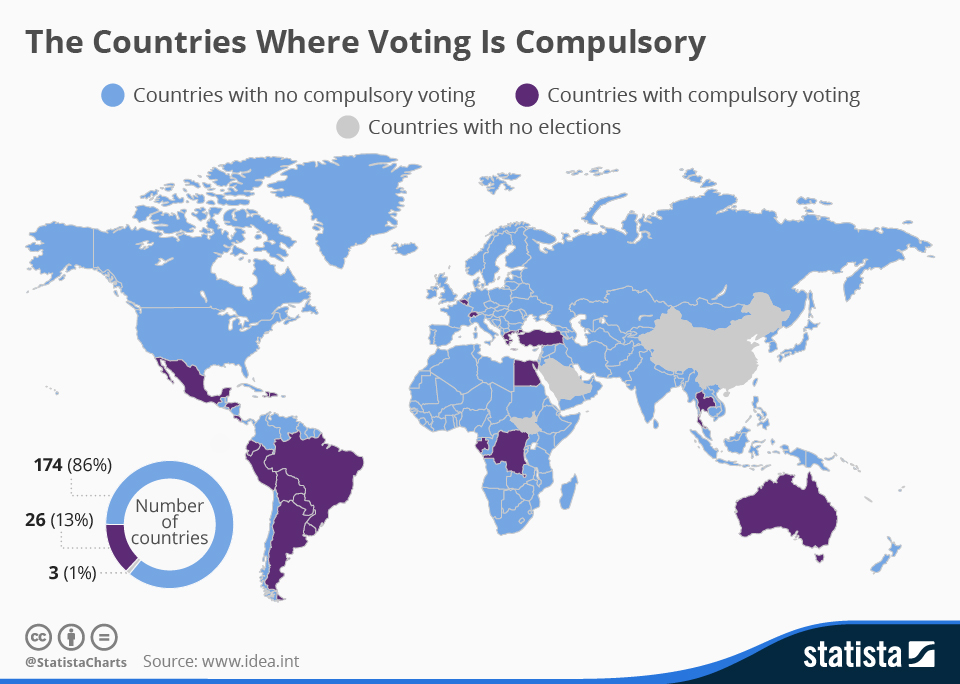
Whether or not society would be better of with compulsory voting has been a longstanding debate among scholars. Jason Brennan and Lisa Hill’s book
Compulsory Voting: For and Against offers two opposing arguments on the matter. Hill argues for compulsory voting, while Brennan argues against it.
A very brief summary of their arguments are as follows. Hill believes that compulsory voting will strengthen democracy by allowing for marginalised groups in society to be part of the voting process. This means that politicians will pay heed to the problems faced by the less well off in society. As things stand, politicians usually only look after their voter base (mostly middle classes) safe in the knowledge that neglecting disadvantaged areas will not impact them negatively in elections, because a high percentage of people in disadvantaged areas do not vote.
Brennan is against state coercion of any kind, hence opposes compulsory voting. He believes there is no evidence to suggest that everybody voting would lead to a more democratic and inclusive outcome. Instead, he believes, a "voting lottery" would be a less coercive and democratic method of voting....
“In a voting lottery, all citizens have the same equal fundamental political status. While in universal suffrage every citizen has one equal vote, in a voting lottery every citizen has equal eligibility to vote. Elections proceed normally, with candidates working to gain support from voting-lottery-eligible citizens. Shortly before the election, the system selects a predetermined number of citizens at random. These citizens – and these citizens only – become electors, imbued with the power to vote. To ensure turnout, the government pays each elector a substantial sum to vote.22 They are not forced to vote. We might perhaps ask them to sign a contract committing them to voting (in exchange for the payment) and then allow them to be punished for breach of contract if they renege. This involves compulsion, but only compulsion to which citizens genuinely consent.
For instance, in a U.S. presidential election, we could select 20,000 citizens randomly from all eligible voters. We pay them $1,000 each to vote. They and they alone decide the election. In a local election, we might select a much smaller number of local citizens and pay them significantly less.”
Brennan & Hill (2014)
So, is it more democratic to make voting compulsory in order to try get representation for all groups in society, or is any kind of state coercion a slippery slope, and instead is Brennan's "voting lottery" a more democratic way of doing the same thing?
Thoughts?
Brennan, J., & Hill, L. (2014).
Compulsory voting: For and against. Cambridge University Press.


![Photo of [Deleted User]](https://wf.vanillicon.com/v2/fc7d50eddf86fd2a7872c6ffac511c39.svg)