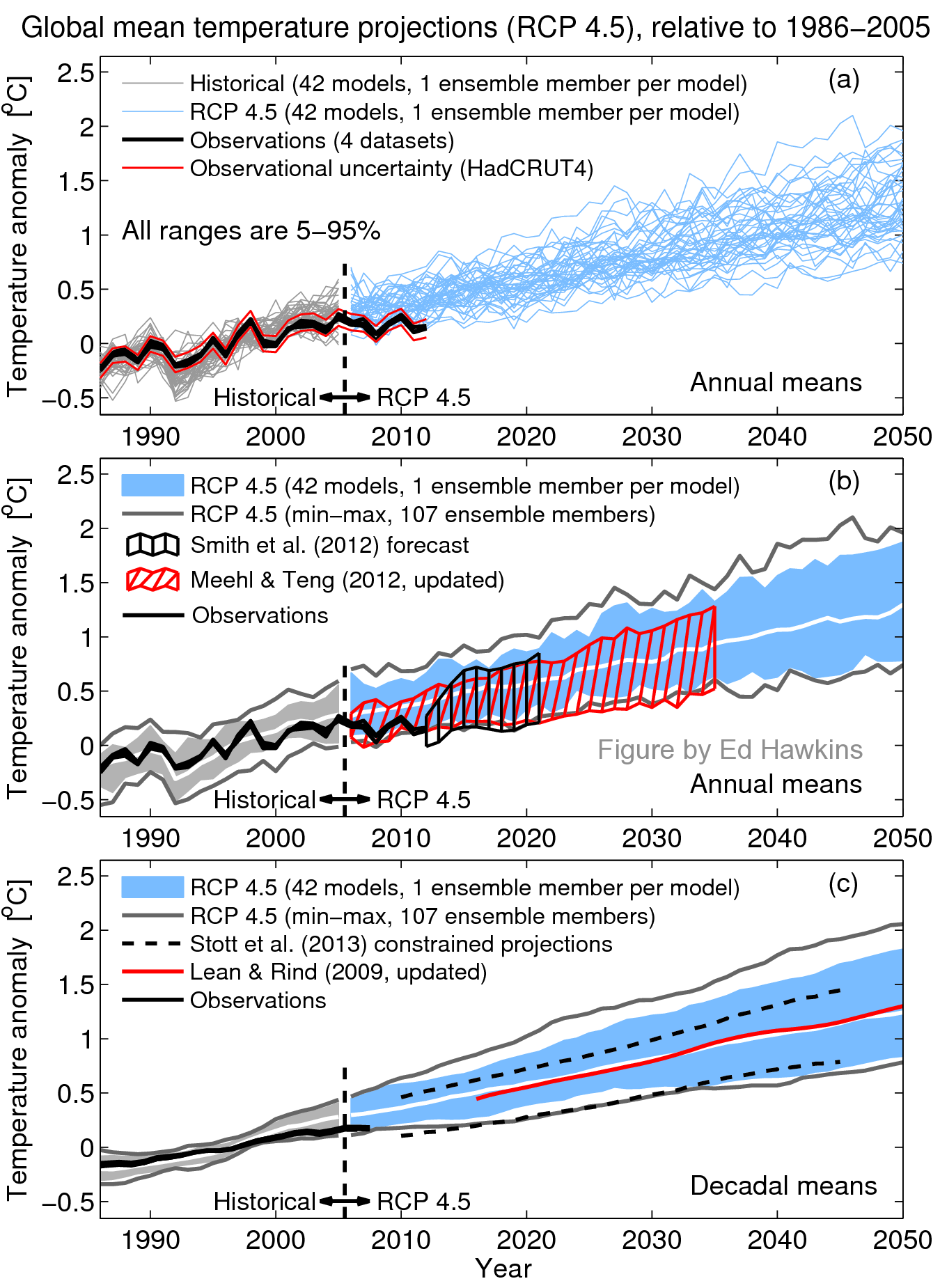
Akrasia wrote: » It's up to you to show that natural warming would lead to such a rapid change during a time when the sun is in an inactive phase According to NASA, naturally it would take 5000 years to warm about 5 degrees. We have already warmed .7 degrees in the past 100 years, that's 10 times faster than natural warming, and are on track to have between 2 and 6 degrees of warming over the next century, which is something that is unprecedented over since humans have existed as a species. Its not just the levels of warming, it's how fast it's happening that are alarming to climate scientists
Gaoth Laidir wrote: » I make it about 0.9 degrees warming in the past 100 years, about 0.35 of which was the natural pre-1940 warming. From AR5...
Akrasia wrote: » You're assuming that pre 1940s warming was all natural. Actually, we had increased the concentration of CO2 by 15ppm by 1940 which would have contributed to .22 of a degree warming out of that .35 observed warming.
Gaoth Laidir wrote: » I'm not assuming anything. It is widely acknowledged, even by the IPCC, that the 1910-40 warming was almost all due to solar activity.
Akrasia wrote: » I was mistaken in my figure of .22 degrees of warming due to co2, the actual figure was probably closer to .15 of a degree due to lag as heat is sequestered in the oceans. Its still between a third and a half of the observed warming and significant warming of the oceans which is the main heat reservoir driving our climate.https://skepticalscience.com/pre-1940-warming-causes-and-logic.html
Oneiric 3 wrote: » June's heatwave in Western Europa directly linked to Climate Change, say scientists:https://www.theguardian.com/environment/2017/jun/30/europes-extreme-june-heat-clearly-linked-to-climate-change-research-shows
Still, the difference between the Risk Ratios derived from observations and most models is sizeable. As we verified that the variability is similar (we rejected a model with too high variability) and as we corrected for biases in the mean, this is mainly due to differing estimates of the effect of anthropogenic emissions on summer temperatures in Europe. This difference is especially large in Tmax in Portugal and Spain. The discrepancy was found for CMIP3 models in southern Europe (van Oldenborgh et al, 2009) and also present for 3-day extremes in the summer of 2015 (Sippel et al, 2016). The cause for the differing trends is unknown. A first possibility is inhomogeneous observations, although the time series for Switzerland and the Netherlands are based on homogenised series. Part of the discrepancy could be due to random weather fluctuations, even though the high value for 2017 that is not included in the trend estimate is evidence against that. There could be decadal or longer time scale variability, but the autocorrelations of the residuals are compatible with white noise after subtracting the trend as a factor times the smoothed global mean temperature (in Belgium there is a step downward around 1950, whilst the CNT and CET show relatively cool weather in the 1970s and 1980s connected to air pollution). Finally, there may be model deficiencies in this area that cause a trend underestimation. However, for the whole SREX MED (Mediterranean) region, observed trends agree well with CMIP5. Maybe all these explanations contribute somewhat.
The impact of ozone-depleting substances on global lower-stratospheric temperature trends is widely recognized. In the tropics, however, understanding lower-stratospheric temperature trends has proven more challenging. While the tropical lower-stratospheric cooling observed from 1979 to 1997 has been linked to tropical ozone decreases, those ozone trends cannot be of chemical origin, as active chlorine is not abundant in the tropical lower stratosphere. The 1979–97 tropical ozone trends are believed to originate from enhanced upwelling, which, it is often stated, would be driven by increasing concentrations of well-mixed greenhouse gases. This study, using simple arguments based on observational evidence after 1997, combined with model integrations with incrementally added single forcings, argues that trends in ozone-depleting substances, not well-mixed greenhouse gases, have been the primary driver of temperature and ozone trends in the tropical lower stratosphere until 1997, and this has occurred because ozone-depleting substances are key drivers of tropical upwelling and, more generally, of the entire Brewer–Dobson circulation.
Akrasia wrote: » I had never heard of Polvani before, I wonder where you came across him? Do you mind if I ask you where you find these papers? I looked him up, he seems to be a reputable character who publishes a lot of research into ozone and it's effects on the atmosphere. He's not a climate skeptic, he uses the climate models that you are critical of, his work is on tweaking them so that they better account for the effects of O3 depletion and to make the models better. The paper you quote looks only at the proposed upwelling of ghgs in the lower stratosphere as a posited explanation for observed lower stratospheric cooling. He has published other papers that show that the ozone hole has had minimal impact on the rising temperatures at the poles because 97% of the radiation is reflected back due to the high albido.http://www.columbia.edu/~lmp/pubs.html At the poles, the greenhouse effect is the driving force of global warming because it traps radiation that would otherwise be reflected out to space. In the rest of the world, the ozone layer is mostly intact so if Ozone depletion was to have a major impact on the current global warming, it would happen at the poles. You have mentioned before that the AR5 is out of date and that there have been big changes to the scientific understanding of climate sensitivity since then, and I should wait until AR6 to see this reflected. I genuinely cannot understand this attitude. The very best science we have is the AR5 report in it's entirety and that paints a picture of a climate emergency with a very high degree of confidence. Waiting 5 more years for the next report is madness when global warming is accelerating as we speakhttp://climatechange.cornell.edu/is-climate-change-slowing-down-2/
Gaoth Laidir wrote: » Again it seems that your first port of call is to look at the credentials of the author before the content itself. Once satisfied that he is not a "climate skeptic" (there's that term again) you then move onto the content. I'm glad you found the time to go through his paper at least. Pity you don't have the time to read Bates' one. Polvani came up in another paper I was reading. These papers are out there in the published world. I'm not sure why you're asking me where I find them. I'm reading the published work since AR5 and I would recommend anyone else do likewise. My comment to you to wait for AR6 was a tongue-in-cheek response to your insistence on looking no more recent than AR5. I said if you want to wait, fine, meanwhile papers are being published weekly. These will all go into the mix for AR6 but if you want to wait then no problem. The point of my post on Polvani was merely that we are constantly refining our understanding of the complex climate system and sometimes what was believed to be the case turns out not to be. That was all.
Akrasia wrote: » Gaoth Laidir wrote: » Again it seems that your first port of call is to look at the credentials of the author before the content itself. Once satisfied that he is not a "climate skeptic" (there's that term again) you then move onto the content. I'm glad you found the time to go through his paper at least. Pity you don't have the time to read Bates' one. Polvani came up in another paper I was reading. These papers are out there in the published world. I'm not sure why you're asking me where I find them. I'm reading the published work since AR5 and I would recommend anyone else do likewise. My comment to you to wait for AR6 was a tongue-in-cheek response to your insistence on looking no more recent than AR5. I said if you want to wait, fine, meanwhile papers are being published weekly. These will all go into the mix for AR6 but if you want to wait then no problem. The point of my post on Polvani was merely that we are constantly refining our understanding of the complex climate system and sometimes what was believed to be the case turns out not to be. That was all. There are dozens of papers published every year in climate science and related fields. There are loads of studies showing that global warming is happening and is worse than previously thought. A large number of studies that question the climate sensitivity or provide additional detail to improve how the models should account for the various feedbacks, and then there are the cranks and propaganda that are published by professional deniers and contrarians and paid PR for the energy industry or other large polluters. It's easy to do a link dump, to google for a paper that supports an argument. I try not to do this by only referring to sources that are trustworthy, in reputable journals and by properly qualified experts in the field. This is why I asked you for where you get your sources. There are so many papers out there that a layperson couldn't read them all, but there are denialist blogs that spread misinformation and only report on papers that are critical of the consensus, so if you think that the most recent evidence is going to overturn AR5's main conclusions, then I wonder if you're maybe reading certain blogs that are pushing that slant?
Gaoth Laidir wrote: » How do you know what's in these papers if you don't have the time to read them? Sometimes it seems like you're treating this like a conspiracy theory in that if anyone writes something you believe to question "the consensus" then they're "crank/skeptic/professional denier". Your second paragraph above illustrates this. You support those papers that say warming is getting worse but anything else is rubbish. Bates - a former IPCC expert reviewer - published a paper detailing possible refinements to the models - something you seem to support - but yet you chose not to read it, instead trying to blacken his name. I note that you still haven't replied with the lobby group who you allege employ him. For the record, I attended an Irish Met Society lecture in which he went through his paper. Is the IMS now a propaganda organisation for hosting him? I read all papers that I can, from all arguments and authors. I have read AR5. I have read some of what has been published since. Am I saying that AR6 will turn AR5 on its head? No, it most likely won't, however you seem to be implying that I do. You say you have no time and are not qualified to read Bates' paper, so how can you have time read all the ones that you do want to read? It seems the cherries are having a bumper season...
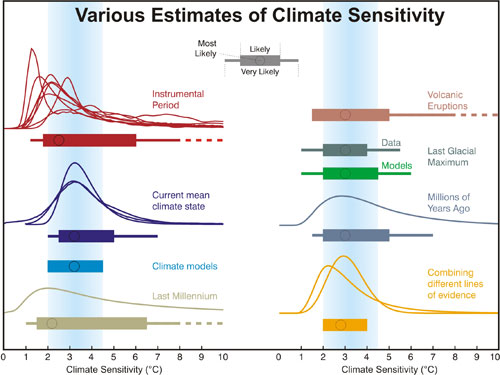
We suggest that the tightening of the ascending branch of the Hadley Circulation is an important process that contributes to the decrease of tropical-mean high cloud fraction. • We find that the high cloud sensitivity to surface temperature is a primary source for the inter-model spread in the longwave radiative feedback and hydrological sensitivity. • However, the “iris effect” is not a dominant factor that contributes to the inter-model spread in climate sensitivity.https://isccp.giss.nasa.gov/Rossow_Symposium/pdf/B1_Su.pdf
Akrasia wrote: » Gaoth Laidir wrote: » How do you know what's in these papers if you don't have the time to read them? Sometimes it seems like you're treating this like a conspiracy theory in that if anyone writes something you believe to question "the consensus" then they're "crank/skeptic/professional denier". Your second paragraph above illustrates this. You support those papers that say warming is getting worse but anything else is rubbish. Bates - a former IPCC expert reviewer - published a paper detailing possible refinements to the models - something you seem to support - but yet you chose not to read it, instead trying to blacken his name. I note that you still haven't replied with the lobby group who you allege employ him. For the record, I attended an Irish Met Society lecture in which he went through his paper. Is the IMS now a propaganda organisation for hosting him? I read all papers that I can, from all arguments and authors. I have read AR5. I have read some of what has been published since. Am I saying that AR6 will turn AR5 on its head? No, it most likely won't, however you seem to be implying that I do. You say you have no time and are not qualified to read Bates' paper, so how can you have time read all the ones that you do want to read? It seems the cherries are having a bumper season... I'm sorry, but I'm having an increasingly harder time taking this Ray Bates guy seriously. I went onto his website where he lists his recent newspaper articles. The top one is a letter he wrote to the Irish Farmers Journal in response to a letter from An Taisce who were outraged that a contrarian article was published that urged no action on limiting co2 pollution. In response, Ray Bates referred back to Richard Lindzen's work on the Iris effect which has very little credibility with it's results challenged in multiple peer reviewed papers (but you probably already know that) so he mentioned a 2015 paper by Mauritsen-Stevens which used models test for an Irish effect and found that some models might suggest that there is an effect, but it is a small one that is an order of magnitude lower than the Lindzen Choi paper suggested, and finally, he mentions another paper by Willie Soon, and two Irish global warming deniers, the Connollys. Willie Soon is one of the least credible scientists out there, he published a paper with Christopher Monkton, a man up there with Ronald McDonald in his scientific integrity. Willie Soon has had his reputation in tatters for a decade following a spate of shamefully bad publications, and revelations that he failed to disclose conflicts of interest in his funding. The Connollys are a father and son who run their own 'research company' and also set up their own 'peer reviewed journal' purely to publish their own research without ever being reviewed by anyone else. Their only other climate change research publications are co-authored by Willie Soon. These guys are total deniers with no credibility in the field of climate science, who think the peer review system is corrupt so they set up their own journal. The fact that Ray Bates chose to use them to support his argument that his own position is credible shows just how little actual academic support his positions must have. I know you're going to say that all of this is just a series of ad hominem attack and that these papers should be taken on their own merits and not dismissed because they've been written by a series of charlatans and paid shills, but give me a break here. When a scientist is prepared to co-author a paper with Christopher feckin Monkton, then there is something seriously wrong, and the Connollys aren't just arguing that climate sensitivity is over stated, they say that there is no greenhouse effect at all. And if Professor Ray Bates wants to be associated with these kinds of people, then it's his choice, but I won't be taking him seriously.
Plain Language Summary The Earth may have a cooling mechanism, so called the iris effect, under green house gas forcing, as if human eyes control the light influx. This feedback process of the tropical cloud to increased sea surface temperature is confirmed using various satellite observation. It is found that the precipitation efficiency increases as the temperature increases and the cirrus decreases as the precipitation efficiency increases in the tropical Western Pacific. This negative relationship suggests the presence of the cooling mechanism (negative feedback). Our climate models also tend to show lower warming rate if the observed negative relationship is properly mimicked, vice versa
Gaoth Laidir wrote: » So which is the lobby group that employs him? Have you read his 2016 paper? Not NEWSpaper, his actual scientific paper.
<!DOCTYPE html PUBLIC "-//W3C//DTD XHTML 1.0 Strict//EN" "http://www.w3.org/TR/xhtml1/DTD/xhtml1-strict.dtd"> <html xmlns="http://www.w3.org/1999/xhtml" xml:lang="en" lang="en"><head><script type="text/javascript" src="/dtagent_ICAp_6000500171012.js" data-dtconfig="rid=RID_1638479746|rpid=314518628|domain=wiley.com|lab=1|reportUrl=dynaTraceMonitor|agentUri=/dtagent_ICAp_6000500171012.js"></script><script type="text/javascript" xml:space="preserve"> //<