New Home wrote: » Quick question about the plague - hasn't it been recently discovered that it was in fact an air-borne disease? I seem to remember that some bodies were found recently during some underground work in London, and when they were examined and analysed and what have you they realised the plague wasn't transmitted by fleas after all. Is that correct, or did I imagine it?
New Home wrote: » So did I!!! Well, good to know, I guess...
Esel wrote: » If a flea from a rat will bite a human, surely it will bite a cat as well? Cats coming into contact with infested rats would carry the fleas to humans... KILL THE CATS! Btw, I have seen rabbits and hedgehogs teeming with fleas. Are there any fleas which confine themselves to one type of host?
Candie wrote: » Horrifying to think you could still contract bubonic plague, though of course until antibiotic resistance gets us - and it will, and soon - at least we have treatment for it.
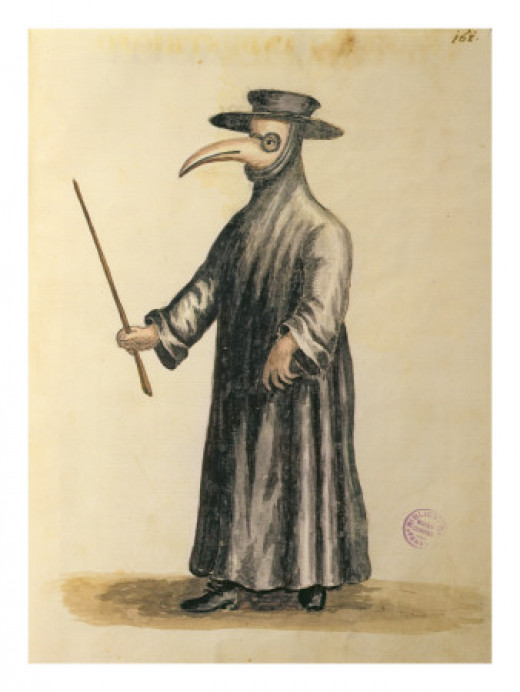
New Home wrote: » I know that hedgehog fleas are 'specialised' (not a technical term, but you get the gist) and wouldn't survive on other hosts, I'm not sure if other types of fleas are the same. Back to the plague - I just checked, and according to Wikipedia (who's never ever wrong :rolleyes:), Yersinia pestis is the bacterium responsible for the plague, and depending on how a person is infected the plague manifests itself in different ways; the bubonic plague and the septicemic plague are likely to be transmitted by insect bites and sometimes by infected food, whereas the pneumonic plague is air-born; the Black Death seems to be a combination of all three. Charming. I know gondolas in Venice are black supposedly as the fulfilment of a vow made to Our Lady to stop the plague, and that the mask of the plague doctor has such a long beak/nose because it would be stuffed with herbs and other things to act as a filter against air borne diseases, including the black death (I'm not sure as to how reliable the masks were, but I'm sure it was better than nothing), so the 'miasma' theory wasn't that far off, after all.
osarusan wrote: » Eh...no. Eh...yes.
Skylinehead wrote: » Qantas have never had a fatal accident right?
retalivity wrote: » Building a palace of ice so turkmen could learn to ice skate - turkmenistan is 70% desert.
cdeb wrote: » He banned make-up as his nation's women were beautiful enough already. When Kazakhstan became independent, one of the first things they did was ring the US and say that they appeared to be the third biggest nuclear power in the world, and could the US advise how they could get of the stuff? The USSR used Kazakhstan for its nuclear testing. Kazakhstan went from having 1400 nukes to having none in the space of four years
Cookie_Monster wrote: » Turkmenistan has a hole in the ground that's been on fire for 4 decades!
According to Turkmen geologist Anatoly Bushmakin, the site was identified by Soviet engineers in 1971. It was originally thought to be a substantial oil field site. The engineers set up a drilling rig and operations to assess the quantity of oil available at the site. Soon after the preliminary survey found a natural gas pocket, the ground beneath the drilling rig and camp collapsed into a wide crater and was buried. Expecting dangerous releases of poisonous gases from the cavern into nearby towns, the engineers thought it best to burn the gas off. It was estimated that the gas would burn out within a few weeks, but it has instead continued to burn for more than four decades. The years of the crater's history are uncertain. Local geologists say the collapse into a crater happened in the 1960s, and the gases weren't set on fire until the 1980s. There are however no records available for any version of the events.
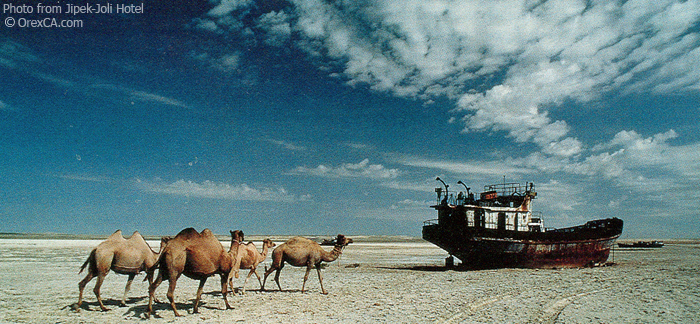
In the 1960s, the Soviet Union undertook a major water diversion project on the arid plains of Kazakhstan, Uzbekistan, and Turkmenistan. The region’s two major rivers, fed by snowmelt and precipitation in faraway mountains, were used to transform the desert into farms for cotton and other crops. Before the project, the Syr Darya and the Amu Darya rivers flowed down from the mountains, cut northwest through the Kyzylkum Desert, and finally pooled together in the lowest part of the basin. The lake they made, the Aral Sea, was once the fourth largest in the world. Although irrigation made the desert bloom, it devastated the Aral Sea. This series of images from the Moderate Resolution Imaging Spectroradiometer (MODIS) on NASA’s Terra satellite documents the changes. At the start of the series in 2000, the lake was already a fraction of its 1960 extent (yellow line). The Northern Aral Sea (sometimes called the Small Aral Sea) had separated from the Southern (Large) Aral Sea. The Southern Aral Sea had split into eastern and western lobes that remained tenuously connected at both ends. By 2001, the southern connection had been severed, and the shallower eastern part retreated rapidly over the next several years. Especially large retreats in the eastern lobe of the Southern Sea appear to have occurred between 2005 and 2009, when drought limited and then cut off the flow of the Amu Darya. Water levels then fluctuated annually between 2009 and 2016 in alternately dry and wet years. In 2014, the Southern Sea’s eastern lobe completely disappeared. As the Aral Sea has dried up, fisheries and the communities that depended on them collapsed. The increasingly salty water became polluted with fertilizer and pesticides. The blowing dust from the exposed lakebed, contaminated with agricultural chemicals, became a public health hazard. The salty dust blew off the lakebed and settled onto fields, degrading the soil. Croplands had to be flushed with larger and larger volumes of river water. The loss of the moderating influence of such a large body of water made winters colder and summers hotter and drier. In a last-ditch effort to save some of the lake, Kazakhstan built a dam between the northern and southern parts of the Aral Sea. Completed in 2005, the dam was basically a death sentence for the southern Aral Sea, which was judged to be beyond saving. All of the water flowing into the desert basin from the Syr Darya now stays in the Northern Aral Sea. Between 2005 and 2006, the water levels in that part of the lake rebounded significantly and very small increases are visible throughout the rest of the time period. The differences in water color are due to changes in sediment. Link: https://earthobservatory.nasa.gov/Features/WorldOfChange/aral_sea.php
Capt'n Midnight wrote: » Antarctica is mostly desert too.
Skylinehead wrote: » 4th biggest actually - Ukraine had 5,000 after the breakup of the USSR. That amount of nuclear warheads is mind boggling.
retalivity wrote: » Ah yeah...i meant warm sandy desert!
Capt'n Midnight wrote: » The UK defence nuclear deterrent was based on being able to destroy 75-80% of Moscow. So didn't need the US or USSR levels of overkill South Africa is the only country to get rid of it's atomic bomb making capacity. The UK is the only country to abandon the ability to launch satellites.
368100 wrote: » Didn't the Queen announce an agenda for launching satellites as part of opening parliament this week?


![Photo of [Deleted User]](https://wb.vanillicon.com/v2/bb1b435feca4d036f6db42bb67252c40.svg)