Wanderer78 wrote: » ive only started looking into his work, comes across as being a little arrogant but certainly is no fool working fine for me
Wanderer78 wrote: » ive only started looking into his work, comes across as being a little arrogant but certainly is no fool
catbear wrote: » His last summation is concise, any Trump stimulus will not be enough to counter Chinese falling demand.
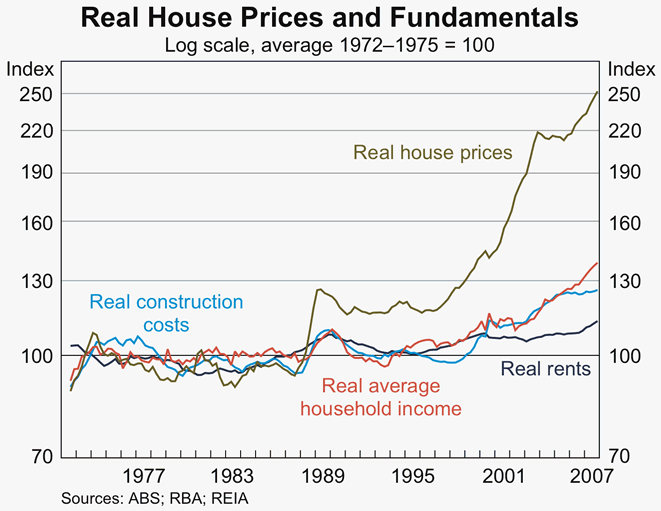
catbear wrote: » 1992. That's a couple of generations who've never known a recession. There was a dip in 08 when the global markets tanked but then Australia took the ascendent chinese commodities escalator whilst everywhere else went down. Before that happened though the Australia government did up the deposit guarantee to a quarter of a million dollars so there were jitters already about their finance sector. This reduced risk pushed money into bank deposits and then banks lent that back into the property market and with low interest rates property funds looked more attractive etc.....basically slapping a turbo on it and filling the car with airplane fuel. Added to that this is the beginning of the babyboomer retirees who'll want to sell up their negatively geared investment properties once they can no longer avail of that income tax break.
Wanderer78 wrote: » i would imagine that would have negative implications for us?
cnocbui wrote: » Ironically, it was in the mid '90s that I bought my first house in Perth with a roughly 60% deposit and paid off the mortgage within a year. Tough times.
catbear wrote: » Weren't average house prices roughly only twice twice the average wage then? A lot has happened since!
"The year to 2012, 56,000 people came to WA from other countries and 14,000 from the rest of Australia," he said. The housing affordability debate is increasingly becoming the home of wacky ideas ranging from dangerous to disastrous, writes Michael Janda. "But in 2015-16, only 14,000 people came to WA from other countries and we actually lost almost 10,000 people to other parts of Australia.
Lifeline financial counsellor Jenny Cecil said they were servicing a new group of clients - those struggling as a result of the economy collapsing. Many had been high income earners. She said a lot of clients were now using credit cards to maintain mortgage payments, electricity bills and council rates, making their financial positions even harder. During the product resources boom in WA incomes doubled, and Bankwest chief economist Alan Langford told 7.30 households were not getting the income growth today they were during the boom. It's a very different story in Perth compared to Melbourne and Sydney. "They say in the top end of Perth on a quiet day you can hear the property values falling," Mr Hegney said. "And property values at the top end of the market have probably dropped 30 per cent from where they were at the peak of the market in 2009."
catbear wrote: » I looked up the block I used to rent near the city centre and average rent appears to be 2/3 of what we were paying in 2014!
catbear wrote: » Always found Keen extremely dry to listen to but he's not wrong in what he's saying.
res ipsa wrote: » Like David McWilliams, he will be right one day.
"For the first time Westpac [WBC] disclosed its exposure to interest-only (IO) lending, which contributes 50% of its mortgage book and 46% of 1H17 flows," Mott writes in a note to clients. "This compares to ~40% for the system.
res ipsa wrote: » We,ve just had the budget. No cut to negative gearing. Nothing to stem the price rise tide. The only thing that can turn the Oz house price cruiser round is a rapid rise in interest rates. There was an ozzie bank transaction tax but i think it will take us inflation rises & usa interest rate rises to force the reserve bank to raise rates in Oz.
The weakness in spending over Q1 is somewhat surprising given that household wealth grew further over H2'16 given the rise in residential property prices
niva*sis wrote: » Forecast for the dollar to hit the .50cent mark for the euro next year. Pretty frightening for those planning on moving home.




![Photo of [Deleted User]](https://w0.vanillicon.com/v2/05bfdb0bc9f81b358ccf2f55186422bb.svg)


