sondagefaux wrote: » A French Departement is roughly the equivalent of an Irish county...
Deedsie wrote: » Trying to add my Eircode on Motortax.ie and I keep getting an error message. Anyone else having this problem? Reply from motortax.ie "Dear Sir, If the Eircode is not accepted by the on-line system, it has not updated to our system from Eircom, this office cannot force it through. Just enter the address minus the eircode." Not sure what Eircom have to do with it.
sondagefaux wrote: » Human makes mistake =/= system has failed. Suggestion: contact them with your correct Eircode.
NikoTopps wrote: » It was a hardly a critique of the eircode system moreso an observation.
Sam Russell wrote: » No, it is a system feature that such a mistake can be made, that is not good - is it? If the code was not random, then such a mistake would be less likely. That is a poor system. If my postcade was D04 ABCD, and it is expected my neighbours was D04 ABCE then such a mistake is obvious. If my postcode is D04 AT6J, and my neighbours is D04 P7MK, how is anyone going to spot that either one or both are wrong? It is the random nature of the code that gives rise to such inability to check if they are correct or not. If you get the right postcode, it might save costs, but get it wrong, and savings go out the window.
Dave_Dublin wrote: » I'm having a problem with deliveries since the Eircodes were introduced. I added the Eircode to my address instead of "Dublin 7" since the code starts "D07" and I've been waited nearly 4 weeks for something that should've been here in 4 days! The order was in 4 identical boxes with the same exact address on each in the same position on each box. Box #1 arrived in 4 days; box #2 arrived the following day but box #3 took THREE WEEKS to arrive and when it did, it had"IMPORTANT : Delay caused by incorrect postal address" labels all over it -- one would've sufficed.The final box has still not arrived. I contacted An Post via their website on Wednesday last but I have not yet received a response.My address is in the format : XXX Road Name Dublin D07 XXXX --- Previously it would've been always : XXX Road Name Dublin 7
Impetus wrote: » In Ireland each apartment, and anything else has its own eircode. but po boxes have no eircode - ie you can use the eircode of the An Post delivery office if you are enthusiastic, as An Post have advised.
The entire system is dumb, does not comply with European address formats...
...and while one hates to say this and it smells of low IQ and other things.
[font=Lato, sans-serif]The correct Spanish address format is:[/font][font=Lato, sans-serif][font=Lato, sans-serif]Type of street Street name building number floor number door number[/font] [font=Lato, sans-serif]Postal code city[/font] [font=Lato, sans-serif]province (optional, especially if the address is in a big city)[/font][/font][font=Lato, sans-serif]Example Spanish address[/font][font=Lato, sans-serif]C/ Santa Maria 45, 3 , 2 28012 Madrid[/font][font=Lato, sans-serif]The 3 means tercer[font=Lato, sans-serif]o[/font] (tercer piso) or third floor. The 2 means segunda puert[font=Lato, sans-serif]a[/font] or second door.[/font][font=Lato, sans-serif]Speaking this address out loud you would say Calle Santa Marie cuarenta y cinco tercero, segunda .[/font]
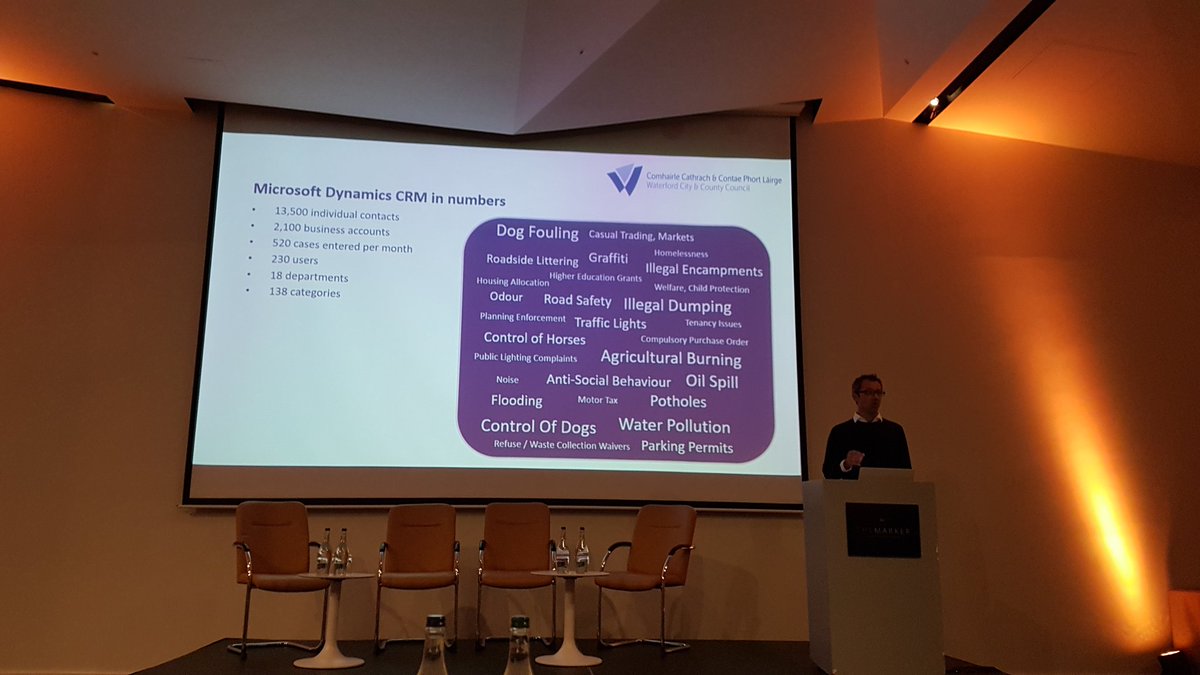
Conference Programme:8:30 Registration and Light Breakfast9:00 Session 1John Tuohy, Nightline Group: Nightline Delivers Innovation with EircodesFeargal O Neill, Gamma: Eircodes in Insurance - The Power of PrecisionDavid Nagle, Microsoft: Digital Transformation 10:30 Session 2Jon Hawkins, Waterford City & County Council: Locate the Case: Using Autoaddress and Eircodes in Dynamics CRMPaul Spring, Student Universal Support Ireland: Hitting the Objective Targets with Eircodes 2 Practical ApplicationsWilliam Kennedy, Bonkers Money Ltd: How Ireland s Favourite Price Comparison Website Fell in Love with Autoaddress 11:40 Session 3Caoimhin Blake, Autoaddress: How to Get the Best out of AutoaddressLiam Duggan, Eircode: Eircode - The State of the Nation Usage UpdateDenis Naughten, T.D., Minister for Communications, Energy and Natural Resources: Closing Address
Sam Russell wrote: » NikoTopps wrote: » It was a hardly a critique of the eircode system moreso an observation. No, it is a system feature that such a mistake can be made, that is not good - is it? If the code was not random, then such a mistake would be less likely. That is a poor system. If my postcade was D04 ABCD, and it is expected my neighbours was D04 ABCE then such a mistake is obvious. If my postcode is D04 AT6J, and my neighbours is D04 P7MK, how is anyone going to spot that either one or both are wrong? It is the random nature of the code that gives rise to such inability to check if they are correct or not. If you get the right postcode, it might save costs, but get it wrong, and savings go out the window.
oscarBravo wrote: » So... PO boxes have no Eircode, apart from the Eircode of the DSU where they are located. Which is a bit like saying that the mailbox on the pillar outside my house has no Eircode, but if I was feeling really enthusiastic I could use the Eircode of my house instead.
byrnefm wrote: » If an Apartment can have an Eircode to help with addressing.. why not PO Boxes, to aid with address verification?
GreenFolder2 wrote: » Surely you could just have a PO BOX like PO BOX 2345 Cork T23 XXXX
antoinolachtnai wrote: » Well, for me, in Dublin 2, a house that has a similar eircode (one digit different) is just around the corner, maybe 200m away as the crow flies. There are plenty of these. Another example (not my house) is D02 C656 and D02 C653.
There are similar-ish things in rural areas. Just from a quick look H12 PK30 and H12 PK03 are both in issue and are not a terribly long distance from each other.
What we have is a code that is highly granular, but that is not known to be particularly accurate.
sondagefaux wrote: » And finally, how Waterford Council is implementing Eircodes: ... 8o-90% of cases reported to the council have a location component.
clewbays wrote: » Are you saying 80% to 90% of cases reported included an Eircode or do you mean things like a street name, or a park name etc. because it is very hard to understand how even 80% of incidents would be directly linked to a postal address?
antoinolachtnai wrote: » Well, for me, in Dublin 2, a house that has a similar eircode (one digit different) is just around the corner, maybe 200m away as the crow flies. There are plenty of these. Another example (not my house) is D02 C656 and D02 C653. There are similar-ish things in rural areas. Just from a quick look H12 PK30 and H12 PK03 are both in issue and are not a terribly long distance from each other. H12 PK30, H12 PK31, H12 PK37 and H12 PK38 are all in issue. Perhaps there is a meanness about letter-use in the Cavan area? (That was unfair.) In a rural setting, there is no quality assurance done (that I know of) to ensure that the correct eircode has been delivered to the correct house. There is a very high probability indeed that over 16000 houses have not received their eircode or have received the wrong one, or multiple eircodes. What we have is a code that is highly granular, but that is not known to be particularly accurate. This is easy to see from Google Maps. (Now that these codes are going to be publicly available, largely for free on Google Maps, it is hard to understand why Eircode doesn't just publish the file. )
There is a very high probability indeed that over 16000 houses have not received their eircode or have received the wrong one, or multiple eircodes.
GJG wrote: » You are precisely incorrect with this. Let's leave aside the impossibility of keeping a system sequential (and dealing with the inevitable confusion caused by a partially sequential system). Stressed communications are prone to error, and stark differences are important to avoid this. If your address was only one or two characters different to your neighbour, (remember that 40 per cent of people have an identical address to their neighbours, and most of the rest have only a single character difference). then the potential for undetected error is very high. You can never prevent all errors, the point is to make sure that errors are evident. 999 operators are trained to then ask first for the code, then for the address, even though they can see it on their screen once they enter the code. If the code is wrongly communicated, redundancy means a 99 per cent chance that it will be immediately evident, and the operator can ask for clarification. But if you give an incorrect Eircode that, by chance, is the correct Eircode for somewhere else, that will be instantly evident when you state your address. This happens because, contrary to you umpteenth restatement of the false claim that Eircode is random, it isn't. It is designed to make sure that no two addresses which are identical or even similar (even if they aren't physically close) have even remotely similar Eircodes. Under your suggested system, a small communication error could give a nearly-correct code, which resolved to an address, say 100m away, around a corner.
PDVerse wrote: » 80% to 90% of cases reported are related to a location, a subset of those relate to houses or activities outside houses. The ECAD database contains spatial information (centre point and bounding boxes) for Streets, Townlands, etc. so this information about an address is useful to Waterford even if an actual Eircode isn't available or suitable.