Advertisement
If you have a new account but are having problems posting or verifying your account, please email us on hello@boards.ie for help. Thanks :)
Hello all! Please ensure that you are posting a new thread or question in the appropriate forum. The Feedback forum is overwhelmed with questions that are having to be moved elsewhere. If you need help to verify your account contact hello@boards.ie
Hi all! We have been experiencing an issue on site where threads have been missing the latest postings. The platform host Vanilla are working on this issue. A workaround that has been used by some is to navigate back from 1 to 10+ pages to re-sync the thread and this will then show the latest posts. Thanks, Mike.
Hi there,
There is an issue with role permissions that is being worked on at the moment.
If you are having trouble with access or permissions on regional forums please post here to get access: https://www.boards.ie/discussion/2058365403/you-do-not-have-permission-for-that#latest
There is an issue with role permissions that is being worked on at the moment.
If you are having trouble with access or permissions on regional forums please post here to get access: https://www.boards.ie/discussion/2058365403/you-do-not-have-permission-for-that#latest
New Age Atheism and The Image of Science in Public.
-
12-10-2010 2:59pm#1[I posted this in A&A, but I thought I'd also post it here to hopefully get a wider viewpoints]
There can be no denying that there is a growing public mistrust and fear of science and the scientific method. Time and again, various groups with various agenda's do their utmost to subvert the scientific method just so that their ideological views can be viewed as science. But this isn't the topic of this thread, well party isn't. There is also some criticism being directed at so called New Age Atheists for helping drive the wedge between Science and Public mistrust even deeper. In your opinion do you think such criticisms are valid?
My opinion is that they are not, and more should be done to promote science and understanding not pathetic strawmans of ignorance. But is that opinion ideological, or practical? Scientists, are an minority, atheists are an even bigger minority, so what exactly, in your opinion is the best way to combat growing illiteracy in science? I'm afraid to say I haven't quite worked out one yet. 0
0
Comments
-
Can you give examples of this mistrust of science? Do you mean things like the scare stories generated in the media eg MMR vaccine, or maybe the Green agenda and the realisation that some technologies may have caused planetary damage?
Or are you talking about the Dawkins / Hitchkins types who seem to have said some pretty daft stuff re the papal visit to London among other OTT statements in the recent past, and whose views were pretty much ignored?
Dawkins writes beautiful science books, I don't think they're necessarily tarnished by his aggressive atheism (in fact, that might appeal to some people though I've always found it boorish myself).
As regards promoting science, did you catch the article in New Scientist 11th September edition "The Most Unlikely Ideas in Science...and why we can't live without them today"? My nephew has just started on Complex Numbers - it was great to show him that article and the explanation of why there could be no iPods without iota! This kind of writing is great - short, succinct and meaningful, showing the link between abstruse science and modern living.
So, what exactly is at the heart of the question for you?0 -
Can you give examples of this mistrust of science? Do you mean things like the scare stories generated in the media eg MMR vaccine, or maybe the Green agenda and the realisation that some technologies may have caused planetary damage?
Or are you talking about the Dawkins / Hitchkins types who seem to have said some pretty daft stuff re the papal visit to London among other OTT statements in the recent past, and whose views were pretty much ignored?
Dawkins writes beautiful science books, I don't think they're necessarily tarnished by his aggressive atheism (in fact, that might appeal to some people though I've always found it boorish myself).
As regards promoting science, did you catch the article in New Scientist 11th September edition "The Most Unlikely Ideas in Science...and why we can't live without them today"? My nephew has just started on Complex Numbers - it was great to show him that article and the explanation of why there could be no iPods without iota! This kind of writing is great - short, succinct and meaningful, showing the link between abstruse science and modern living.
So, what exactly is at the heart of the question for you?
You hit the nail on the head. Any agenda or scare story to be honest. Creationism, Intelligent Design, Green Movement, Anti Green Movement, "Natural" Movements (e.g Nature knows best fallacies), Anti Vaccinations, Scare stories of future tech, etc. Generally speaking the disconnect between what the public thinks science says and what scientists actually say. Then there are problems with getting folks to understand statistics, logical fallacies and terrible media based advertising scientific claims.
Yeah Dawkins writes lovely science books, but I can't help but fear that because of his "aggressive atheist" label many people will avoid such books. I know personal experience isn't much to count on, but in my personal experience folks have used that as an excuse to avoid reading his books.
The heart of my question is whether New Atheists portraying science as in conflict with religion is a good idea for promoting science.
With regards to the NS article, yes I did, it was brilliant.But NS is mainly preaching to the converted.0 -
There can be no denying that there is a growing public mistrust and fear of science and the scientific method.
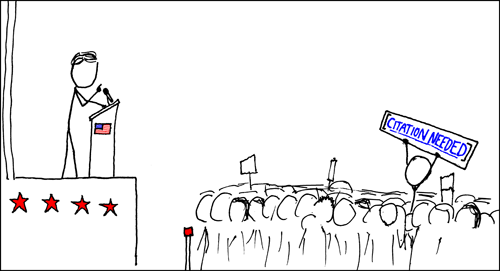
The world is more interconnected than ever before. There seems to be a trend for anti-scientific advocates to organise and use certain tactics now. However, I think what you're seeing is mostly a small, reactionary minority who are vocal and effective. These people always existed, but in the past, they'd have been loners on soap boxes or handing out pamphlets on a street corner, ignored by most. My father recalls people asking the ESB men if the new electricity stuff would leak out of the sockets and kill them all.
The problem, as I see it, is a public which is largely ignorant of the tactics of these people (most noticeably, appeals to ignorance and a pseudo-scientific approach followed by claiming controversy where there is little or none) and of the source of science's authority - its methodology and its track record.
I really wish people would pause a moment when they hear these people speak, and ask themselves, "What is this guy selling?" Whether it's a pill or an EMF shield or a religion, there's usually something. Not every time, but more often than not.
Does Dawkins' public image hurt? Or Hitchens'? Sure, a little. But Hawkings' public image is probably more favourable and sympathetic than he has earned (not to do him down - he's a top class physicist, but if not for the disability and its iconic trappings, he'd be a nobody in the public eye), and Cox's handsome, passionate public image is extremely good PR. Do they cancel out? Maybe we come out ahead? I don't know, but I doubt it's the key issue.0 -
Scientists, are an minority, atheists are an even bigger minority, so what exactly, in your opinion is the best way to combat growing illiteracy in science?
Quite simply I think two things need to be done, though both are so essentially intertwined that they are two sides of the one coin. Anyone who has watched the same talks as I have on the net will probably recognise that I am paraphrasing this from another persons words. 10 points to the person who first guesses who!
First we need more Carl Sagans and Stephen J Goulds and Sir David Attenboroughs. Scientists are notoriously bad communicators. They have one of the best jobs in the world, they get to walk into a lab and ask themselves “What will I discover today?”. They have little reason to worry about communicating with the public. They just get on with it.
Secondly however scientists themselves need to reward more the ambassadors for science who actually do this. It is not generally known but Sagan and Gould were actually looked down on and derided by many of their peers as a fellow peer would a noble who “consorts with the common folk”. Scientists effectively look down upon popularises of science. People looked down at Gould for example because they considered themselves “more serious” evolutionary scientists while Gould simply wrote for the public. Writing popular science is looked down upon as being some sort of “low brow” version of being a scientist.
Some moves are indeed made in this direction, such as the creation of the “Charles Simoni chair for the public understanding of Science”. But this is simply not enough, much more needs to be done.
The only thing I would add is that a massive change is required in our own attitudes as people. It is seen as “admitting defeat” often to say “I do not know” and a problem with science often is that people will act like they know what they are talking about when they patently do not and they will churn out the most egregious nonsense calling it “science”. Those who dare to correct them are seen as arrogant and rude.
Yet on this very site for example, I had one person get angry at me for suggesting most people do not know what gravity actually is or where it comes from. How dare I say such a thing when surely “everyone knows” that we have gravity because “the earth is spinning”.
We have gravity because the earth is spinning? This is the most obscene nonsense I have ever read yet I was seen as the bad guy when I corrected the person in this and for suggesting most people actually do not understand the first thing about gravity.0 -
There are reasons to be skeptical at the "edges" of the more complex areas. For instance nutrition cause/effect can be poorly understood even within the medical profession , plus throw in the phama industy who can make sure studies tell them what they want to hear. Did you know for instance that the US food Pyramid is run by the US dept of Agriculture. Their outputs will be labelled as "science" but there is likely to be corruption or bending to special interests.
A belief in gender identity involves a level of faith as there is nothing tangible to prove its existence which, as something divorced from the physical body, is similar to the idea of a soul. - Colette Colfer
0 -
Advertisement
-
You hit the nail on the head. Any agenda or scare story to be honest. Creationism, Intelligent Design, Green Movement, Anti Green Movement, "Natural" Movements (e.g Nature knows best fallacies), Anti Vaccinations, Scare stories of future tech, etc. Generally speaking the disconnect between what the public thinks science says and what scientists actually say. Then there are problems with getting folks to understand statistics, logical fallacies and terrible media based advertising scientific claims.
Hi Malty, You might or might not like this:
I recently bought a book called "Dr Johnson's Dictionary of Modern Life" where the author writes up definitions of modern-day living as might have the deeply cynical Samuel Johnson. The stuff on Alternative Medicine is hilarious (if, like me, you're deeply cynical about most of the claims made for these techniques). For example:
"Acupuntcure - n.
The stabbing treatment that can cure any ill save Gullibility or the Fear of Needles.
"Homeopathy - n.
medicine of proportion where smaller Dose is greater Cure; a theory of which the more I Read the less I Believe.
"Hot Stone Therapy - n.
practiced in Persia, a barbaric method of Execution;
practiced in an English spa, a method of Relaxation.
"Reiki - n.
A practice whereby manual manipulation of Energy Force does relieve a patient's Purse if not his Disease."0 -
You hit the nail on the head. Any agenda or scare story to be honest. Creationism, Intelligent Design, Green Movement, Anti Green Movement, "Natural" Movements (e.g Nature knows best fallacies), Anti Vaccinations, Scare stories of future tech, etc. Generally speaking the disconnect between what the public thinks science says and what scientists actually say. Then there are problems with getting folks to understand statistics, logical fallacies and terrible media based advertising scientific claims.
I will just repost the answer I gave on the A&A forum:
Practical solution: Pretty much completely overhall the education system, putting emphasis on an understanding of the scientific method & peer review (just give people an understand of what they mean and why they are done), maths & statistics (get across the difference bewteen correlation and causation, explain what makes a good statistic study) and informal debating (make people think about things, teach them to recognise common logical fallacies and the importance of empirical evidence over emotive rhetoric). IMO, going for the kids is the best way, most people over 25 are no hopers.
Imparactical solution: Take away everything science has given them, until they learn how to properly appreciate it and be skeptical in the proper way.The heart of my question is whether New Atheists portraying science as in conflict with religion is a good idea for promoting science.
If it is true, though, I dont think there's much of a choice. I dont know about anyone else, but I wouldn't be happy if science started pulling away with confronting unscientific assertions simply for PR reasons.0 -
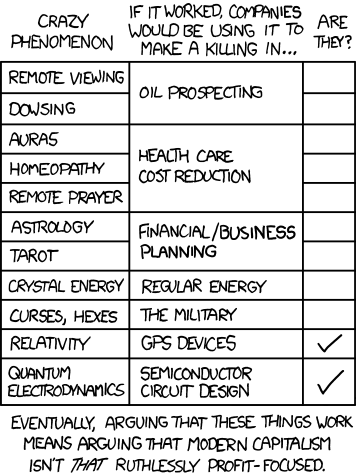
I was going to post up that xkcd cartoon, but someone has beaten me to it.
First off, what do you mean by 'an even bigger minority'? Does that mean there are more or less of them?Scientists, are an minority, atheists are an even bigger minority,
I find it quite harder to reason about whether there are more atheists or scientists. I think that'd be quite an interesting discussion in itself.so what exactly, in your opinion is the best way to combat growing illiteracy in science?
I'm not sure there is a growing 'illiteracy in science' at all.
I reckon more people understand and know about the scientific method than ever before. Higher education is available to many more people than in the past.
I would be optimistic, and think that we are seeing more criticism of science, in different quarters, because more people are engaging with science than ever before.
Science is accessible and available to more people than ever before. Its not something a bunch of people in lab coats, over there, do.
This is one of my favourite xkcd cartoons: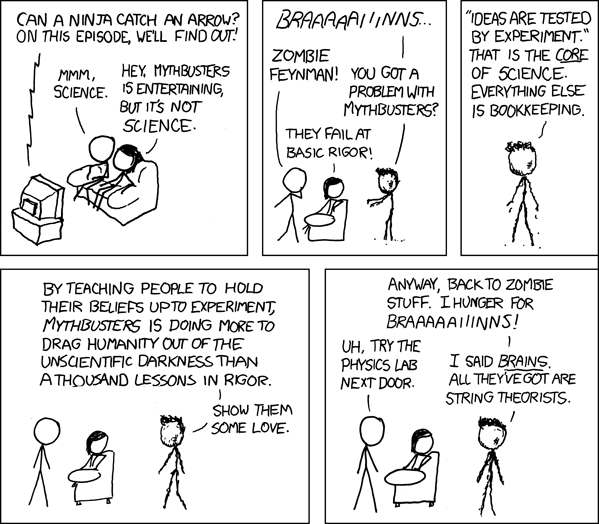
My solution though?
Don't teach more science in school.
Instead, philosophy should be a required junior cert subject.
Teach people rational enquiry, and logical thought.
Science will naturally come later from that - and they'll have an appreciate of its limitations, too.
It would be nice, as others have said, if popular science authors were more regarded than they are, by the scientific community. Not as scientists, but as popularisers.
One caveat might be that some popular science writing, and discussion, sometimes isn't very scientific. Sometimes people just take popular science writing on faith because the person who wrote it is respected; some writing doesn't provide much argument for why we should believe the world views that it is putting to us - in part because its trying to give an overview.Mark Hamill wrote: »I will just repost the answer I gave on the A&A forum:
Practical solution: Pretty much completely overhall the education system, putting emphasis on an understanding of the scientific method & peer review (just give people an understand of what they mean and why they are done), maths & statistics (get across the difference bewteen correlation and causation, explain what makes a good statistic study) and informal debating (make people think about things, teach them to recognise common logical fallacies and the importance of empirical evidence over emotive rhetoric). IMO, going for the kids is the best way, most people over 25 are no hopers.
You know, I really don't like that 'over 25 are no hopers' sentiment. I think a cornerstone of science is a belief that rational argument appeals to all of us, eventually - at least if its put to us in the right way.
There's an implicit belief that our experiments are repeatable, by other rational humans, and that the conclusions we draw, from the evidence we see, will appeal to other people.
Now, in practice, its very difficult to have a conversation with some people, but I really don't like the idea of writing anyone off as a 'no hoper'; thats going too far.
What is the proper way to be sceptical, if you'll pardon my scepticism? Maybe I'm picking up too much on how this is phrased, and missing the point, but that just strikes me as a scary way of thinking about things.Mark Hamill wrote: »Imparactical solution: Take away everything science has given them, until they learn how to properly appreciate it and be skeptical in the proper way.Mark Hamill wrote: »If it is true, though, I dont think there's much of a choice. I dont know about anyone else, but I wouldn't be happy if science started pulling away with confronting unscientific assertions simply for PR reasons.0 -
You know, I really don't like that 'over 25 are no hopers' sentiment.
Ok, "over 25s are no hopers" is a little strong, but, unfortunately, the older they get, the more difficult it is for someone to be argued out of a position they are used to believing in. You see I've had plenty of arguments about things with older siblings or my parents, where they have wheeled out some correlation between two subjects and expressed it as a causation. I try to point out that correlation =/= causation, but even if I can get that idea across, they wont apply it to their own reasoning. People past a certain age just haven't encountered these ideas and are resistant to understanding them and so you have two hurdles in debating with them, teaching them the concept and then showing how it applies to what they are talking about. At least in school, you can get them to learn the concept early, hopefully meaning they will apply it before they even enter the debate.I think a cornerstone of science is a belief that rational argument appeals to all of us, eventually - at least if its put to us in the right way.
There's an implicit belief that our experiments are repeatable, by other rational humans, and that the conclusions we draw, from the evidence we see, will appeal to other people.
Rational arguments only appeal to rational people and not everyone is rational in every subject (just see any creationism v evolution discussion)Now, in practice, its very difficult to have a conversation with some people, but I really don't like the idea of writing anyone off as a 'no hoper'; thats going too far.
Look in the creationism thread in the christianity forum and tell me J C isn't a no hoper.What is the proper way to be sceptical, if you'll pardon my scepticism?
I answered a similar question in another thread, so I will just post it here again:
There is good skepticism and bad skepticism though. Questioning an assertion because you have yet to see valid evidence is good skepticism, as you are are being skeptical because you have yet to be convinced (see what happens whenever someone claims to have made a perpetual motion or a cold fusion machine - lots of skepticism with calls for empirical evidence over anecdotal evidence). Questioning an assertion simply because it disagrees with your idealogical world view is bad skepticism, as you are being skeptical simply because an answer isn't nice for you (see what happens when people are told that no, in fact mmr doesn't cause autism - lots of skepticism, because some ex-playboy model says it does).
Basically, some people seem to think skepticism is just disagreeing with something.Maybe I'm picking up too much on how this is phrased, and missing the point, but that just strikes me as a scary way of thinking about things.
Why is it scary? People are all hugs and kisses for science when it comes to their ipods and mobile phones and life saving medicine, but when you question some idea they like, people who have never even heard the phrase "falsifiabilty" are disgreeing with what is being represented to them. Some people just think that there is a difference between the science that gives them their toys and cars and porn, and the science that shows that global warming is happening or that the MMR vaccine is safe. I dont mind people being skeptical of something, even something well defined and accepted, but people throwing out whole droves of scientific research, whole fields even, simply because they dont like the results is not proper skepticism and I honestly think that if they cant appreciate something, they shouldn't get the benefits of it.0 -
Yeah, thats a fair point. I agree with what you are saying there.Mark Hamill wrote: »I answered a similar question in another thread, so I will just post it here again:
There is good skepticism and bad skepticism though. Questioning an assertion because you have yet to see valid evidence is good skepticism, as you are are being skeptical because you have yet to be convinced (see what happens whenever someone claims to have made a perpetual motion or a cold fusion machine - lots of skepticism with calls for empirical evidence over anecdotal evidence). Questioning an assertion simply because it disagrees with your idealogical world view is bad skepticism, as you are being skeptical simply because an answer isn't nice for you (see what happens when people are told that no, in fact mmr doesn't cause autism - lots of skepticism, because some ex-playboy model says it does).
Basically, some people seem to think skepticism is just disagreeing with something.Mark Hamill wrote: »Why is it scary? People are all hugs and kisses for science when it comes to their ipods and mobile phones and life saving medicine, but when you question some idea they like, people who have never even heard the phrase "falsifiabilty" are disgreeing with what is being represented to them. Some people just think that there is a difference between the science that gives them their toys and cars and porn, and the science that shows that global warming is happening or that the MMR vaccine is safe.
I dont mind people being skeptical of something, even something well defined and accepted, but people throwing out whole droves of scientific research, whole fields even, simply because they dont like the results is not proper skepticism and I honestly think that if they cant appreciate something, they shouldn't get the benefits of it.
I still disagree with this specific part of your thinking though, I think this is too harsh.
First off, I think your worldview of science and unscientificness is too polarised.
You can drive your car around, and be glad you have one, even while not understanding, or not believing in, the principles that were required to design or manufacture it. Such a stance might be silly, but I don't think its *bad* as such.
I don't like the idea that people that reject the science underlying something like a mobile phone should be denied the use of the mobile phone.
This is gunboat diplomacy, and is close to the idea of the thought police. "We've made something useful, but unless you accept our worldview, you can't use it."
I wouldn't like if an artist that made a movie told me that I couldn't watch the movie unless I accepted her theory of aesthetic principals that were using to script the scenes.
It reminds me of a mission that requires people to join the religion if they want to mission to feed them, etc - its just fundamentally not cool.0 -
Advertisement
-
Yeah, thats a fair point. I agree with what you are saying there..
Thanks I still disagree with this specific part of your thinking though, I think this is too harsh.
First off, I think your worldview of science and unscientificness is too polarised.
You can drive your car around, and be glad you have one, even while not understanding, or not believing in, the principles that were required to design or manufacture it. Such a stance might be silly, but I don't think its *bad* as such.
I don't like the idea that people that reject the science underlying something like a mobile phone should be denied the use of the mobile phone.
This is gunboat diplomacy, and is close to the idea of the thought police. "We've made something useful, but unless you accept our worldview, you can't use it."
I wouldn't like if an artist that made a movie told me that I couldn't watch the movie unless I accepted her theory of aesthetic principals that were using to script the scenes.
It reminds me of a mission that requires people to join the religion if they want to mission to feed them, etc - its just fundamentally not cool.
I suppose what I said can be taken to mean that, but I dont really mean it in that harsh of a way. I would be less "you dont get your food back until you accept all science" and more "you shouldn't want your food back because the stuff you keep saying doesn't work in things like mmr study or evolution (eg statistical or biological principles), were used in largely the same way by whoever made (and tested) the food, and if mmr and evolution is fundamentally flawed, then so is your food". My unpractical solution is a little tongue-in-cheek idea that occured to me after I realised (and saw) that just pointing out this cognitive dissonance to most people rarely even garners a response.0 -
Moderators, Recreation & Hobbies Moderators, Science, Health & Environment Moderators, Technology & Internet Moderators Posts: 92,489 Mod ✭✭✭✭
 Join Date:Posts: 90727


Advertisement