Advertisement
Help Keep Boards Alive. Support us by going ad free today. See here: https://subscriptions.boards.ie/.
https://www.boards.ie/group/1878-subscribers-forum

Private Group for paid up members of Boards.ie. Join the club.
Hi all, please see this major site announcement: https://www.boards.ie/discussion/2058427594/boards-ie-2026

How much is this all going to cost and who will pay for it ?

13334363839

Comments

  • Registered Users, Registered Users 2 Posts: 2,314 ✭✭✭KyussB


    No you don't, you roll over debts forever and let GDP growth erode them over time (public finances do not work like personal finances) - and interest rates on the current stock of debt do not change - and interest rates don't rise until the whole of the EU reaches full economic recovery and inflation kicks in.


  • Registered Users, Registered Users 2 Posts: 3,227 ✭✭✭Sweet.Science


    KyussB wrote: »
    No you don't, you roll over debts forever and let GDP growth erode them over time (public finances do not work like personal finances) - and interest rates on the current stock of debt do not change - and interest rates don't rise until the whole of the EU reaches full economic recovery and inflation kicks in.

    You roll over debt when repaying it isn't an issue . I'd love your optimism . Covid, Brexit , CT. We are in for a huge shock .


  • Registered Users, Registered Users 2 Posts: 7,748 ✭✭✭timmyntc


    KyussB wrote: »
    No you don't, you roll over debts forever and let GDP growth erode them over time (public finances do not work like personal finances) - and interest rates on the current stock of debt do not change - and interest rates don't rise until the whole of the EU reaches full economic recovery and inflation kicks in.

    Irish GDP is massively distorted due to MNCs and off-shoring off assets into this country.

    "Real" Irish GDP is magnitudes lower. Our Finance Ministers know this, hence why McGrath has announced a tightening of belts on govt spending across multiple departments. The Covid spending of borrowed money has to end - we need to start living within our means


  • Registered Users, Registered Users 2 Posts: 2,314 ✭✭✭KyussB


    You roll over debt when repaying it isn't an issue . I'd love your optimism . Covid, Brexit , CT. We are in for a huge shock .
    No, debts are rolled over forever. Practically all countries show a faithful permanent rise in the stock of Public Debt (not vs GDP, the stock). Surpluses are extremely rare.


  • Registered Users, Registered Users 2 Posts: 2,314 ✭✭✭KyussB


    timmyntc wrote: »
    Irish GDP is massively distorted due to MNCs and off-shoring off assets into this country. Irish GDP is magnitudes lower. Our Finance Ministers know this, hence why McGrath has announced a tightening of belts on govt spending across multiple departments. The Covid spending of borrowed money has to end - we need to start living within our means
    GDP, GNI, GNI* - the measure doesn't matter, economic growth is used to erode away Public Debt vs GDP/GNI/GNI* - and the stock of Public Debt is allowed to rise, permanently.

    Living within our means is based on maximizing economic output and employment - we are absolutely living way BELOW our means, every day we leave people unemployed and not doing useful work, when we have all of the labour, physical resources, money, and useful work to do, to hire ALL of the unemployed.


  • Advertisement
  • Registered Users, Registered Users 2 Posts: 7,748 ✭✭✭timmyntc


    KyussB wrote: »
    GDP, GNI, GNI* - the measure doesn't matter, economic growth is used to erode away Public Debt - and the stock of Public Debt is allowed to rise, permanently.

    Living within our means is based on maximizing economic output and employment - we are absolutely living way BELOW our means, every day we leave people unemployed and not doing useful work, when we have all of the labour, physical resources, money, and useful work to do.

    The stock of public debt rises alongside the ability to repay - you dont actually have to repay I agree, you just refinance and the total debt increases.
    But you cannot borrow yourself out of a hole - if public debt was of no consequence then countries would just borrow massively forever and live on credit.

    We can only borrow as much as it appears we can repay or refinance - our GNI* to debt ratio shows that we cannot keep borrowing as we have before.


  • Registered Users, Registered Users 2 Posts: 4,885 ✭✭✭Arthur Daley


    kippy wrote: »
    Well it never really ends does it. Just cycles through.
    Never too good for the head to think about it all too much

    I know what ya mean. Like Ole Man River, The Magic Money Tree theory keeps rolling along.


  • Registered Users, Registered Users 2 Posts: 3,227 ✭✭✭Sweet.Science


    KyussB wrote: »
    No, debts are rolled over forever. Practically all countries show a faithful permanent rise in the stock of Public Debt (not vs GDP, the stock). Surpluses are extremely rare.

    You're stating the best case scenario . Our ability to repay is going to plummet compared to pre covid and pre brexit . Spending will be cut and taxes will increase


  • Registered Users, Registered Users 2 Posts: 2,314 ✭✭✭KyussB


    timmyntc wrote: »
    The stock of public debt rises alongside the ability to repay - you dont actually have to repay I agree, you just refinance and the total debt increases.
    But you cannot borrow yourself out of a hole - if public debt was of no consequence then countries would just borrow massively forever and live on credit.

    We can only borrow as much as it appears we can repay or refinance - our GNI* to debt ratio shows that we cannot keep borrowing as we have before.
    The ability to service (service, not repay...) the stock of debt is backed by GDP/GNI/GNI* - and if you are below maximum GDP/GNI/GNI* (which is the same as being below Full Employment), then borrowing to keep GDP/GNI/GNI* at Full Output and the economy at Full Employment - bolsters the whole economy and the ability to service the debt.

    The stock of debt is meaningless as well. It is the cost of servicing the debt that matters.

    Right now interest rates are negative - which means we actually gain money, by taking on more debt - i.e. it's inherently more sustainable to take on more debt right now.

    Countries do borrow forever - they never repay the stock of debt! It permanently increases, forever...

    Stop treating government finances like personal/household finances.


  • Registered Users, Registered Users 2 Posts: 2,314 ✭✭✭KyussB


    You're stating the best case scenario . Our ability to repay is going to plummet compared to pre covid and pre brexit . Spending will be cut and taxes will increase
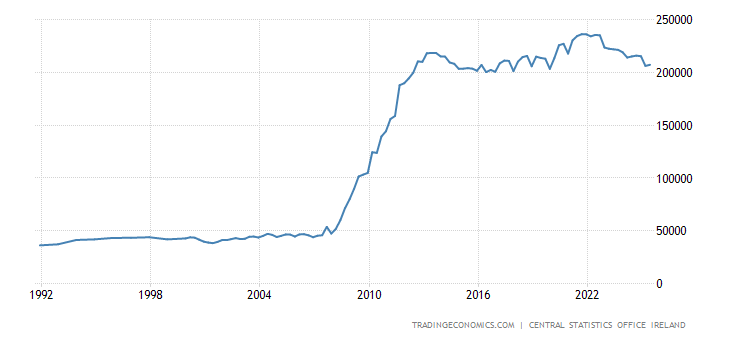
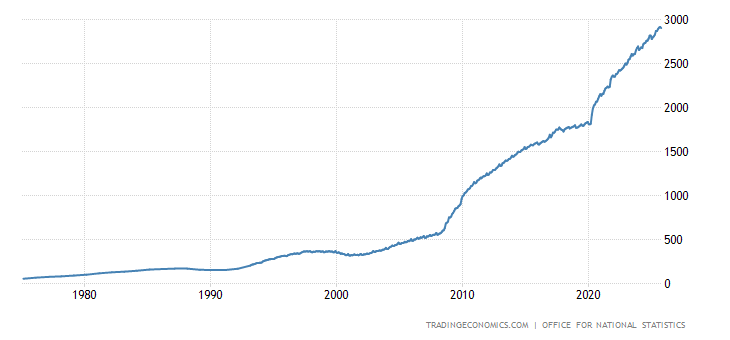
    No, I'm stating a fact - the stock of debt increases forever

    Ireland:
    ireland-government-debt.png?s=irelandgovdeb&v=202104232315V20200908&d1=19210521
    UK:
    united-kingdom-government-debt.png?s=unitedkingovdeb&v=202104241010V20200908&d1=19210521
    US:
    https://d3fy651gv2fhd3.cloudfront.net/charts/united-states-government-debt.png?s=unitedstagovdeb&v=202104232315V20200908&d1=19210521


  • Advertisement
  • Registered Users, Registered Users 2 Posts: 7,748 ✭✭✭timmyntc


    KyussB wrote: »
    The ability to service (service, not repay...) the stock of debt is backed by GDP/GNI/GNI* - and if you are below maximum GDP/GNI/GNI* (which is the same as being below Full Employment), then borrowing to keep GDP/GNI/GNI* at Full Output and the economy at Full Employment - bolsters the whole economy and the ability to service the debt.

    The stock of debt is meaningless as well. It is the cost of servicing the debt that matters.

    Right now interest rates are negative - which means we actually gain money, by taking on more debt - i.e. it's inherently more sustainable to take on more debt right now.

    Countries do borrow forever - they never repay the stock of debt! It permanently increases, forever...

    Stop treating government finances like personal/household finances.

    Yes but countries do not borrow as much as they like indefinitely - its related to your ability to pay interest payments & refinance the debt - which is linked to the countries revenue & GDP.

    The likes of San Marino cannot borrow as much as Germany - because their ability to borrow is related to their ability to service said debts.

    Same applies to Ireland - our ability to service our debts is much lower than our inflated GDP suggests.
    Despite low interest rates, Ireland’s repayments on its debt are relatively high. In 2018, Ireland’s interest
    payments were 6.4% of government revenue. This was the fourth highest in the EU.

    EU fiscal rules also state that any debt to GDP over 60% needs to be reduced at a certain rate per annum. The bottom line is - we cannot borrow indefinitely or continually deficit spend. Pre covid the Dept of Finance had planned to reduce Irelands debt to GNI* ratio down to 85% (currently >100%). Why would they have planned to do that if there are no consequences to indefinite borrowing?


  • Registered Users, Registered Users 2 Posts: 26,242 ✭✭✭✭Eric Cartman


    The only real solution here is to cut government spending , theres no way around this


  • Registered Users, Registered Users 2 Posts: 2,314 ✭✭✭KyussB


    With QE and their negative interest rate policy, the ECB dictates countries ability to repay and finance debts - and the ECB's policy is, in turn, determined based on EU-wide inflation rates, which in turn are determined based on EU-wide economic recovery (with significant inflation not kicking in, until there has been an EU-wide economic recovery).

    It follows a fairly straight-forward economic cycle:
    Economic downturn > reduced GDP, employment and inflation rates > ECB reduces interest rates > increased borrowing/spending under low interest rates > increasing GDP, employment and inflation rates > full economic recovery > ECB increases interest rates > borrowing/spending levels off.

    You borrow and spend until you reach full economic recovery, then you stop - until the next economic downturn. You never pay down the stock of debt. You don't stop spending until GDP and employment are maximized.


  • Registered Users, Registered Users 2 Posts: 7,748 ✭✭✭timmyntc


    KyussB wrote: »
    With QE and their negative interest rate policy, the ECB dictates countries ability to repay and finance debts - and the ECB's policy is, in turn, determined based on EU-wide inflation rates, which in turn are determined based on EU-wide economic recovery (with significant inflation not kicking in, until there has been an EU-wide economic recovery).

    It follows a fairly straight-forward economic cycle:
    Economic downturn > reduced GDP, employment and inflation rates > ECB reduces interest rates > increased borrowing/spending under low interest rates > increasing GDP, employment and inflation rates > full economic recovery > ECB increases interest rates > borrowing/spending levels off.

    You borrow and spend until you reach full economic recovery, then you stop - until the next economic downturn. You never pay down the stock of debt. You don't stop spending until GDP and employment are maximized.

    Yes but not all EU countries have the same Debt to GDP ratios.

    Greece and Italy cant borrow as much as Germany or France for example.
    Ireland is in the same boat there - we have one of the highest debt to GDP ratios in the Union and we do not have nearly as much scope to borrow further. If we keep on borrowing at this rate then confidence in Ireland's ability to repay will begin to drop and then the credit taps are turned off.


  • Registered Users, Registered Users 2 Posts: 3,227 ✭✭✭Sweet.Science


    The only real solution here is to cut government spending , theres no way around this

    Back to the Troika days as per the front page of the Examiner


  • Posts: 107 ✭✭ [Deleted User]


    saabsaab wrote: »
    Mass air travel is largely responsible for the spread of this. How about we slap a tax on air travel to help pay or at least put an excise on the fuel. Why on earth is it exempt anyhow? I don't think any other sector is and it would be a tax on carbon usage.

    Why on earth would you suggest a tax on air travel? You live on a small island. Tourism has had an appalling 2020 and 2021, and an air travel tax is the last thing that sector needs. Wouldn't go down too well with the MNCs that do business here either. MNCs that your economy depends on badly.
    KyussB wrote: »
    No you don't, you roll over debts forever and let GDP growth erode them over time (public finances do not work like personal finances) - and interest rates on the current stock of debt do not change - and interest rates don't rise until the whole of the EU reaches full economic recovery and inflation kicks in.

    That is a very risky strategy. As of now you can roll on debts forever but that may not be the case in twenty years time. History would suggest that it is not a good approach. I can see the attraction in the short term, for sure, but are you not concerned about the possibility of long term pain?
    The only real solution here is to cut government spending , theres no way around this

    Pandemic or no pandemic government spending needs to be cut here. That is not going to happen until people vote in politicians and parties that are willing to do do. You don't have any parties that are willing to do that, which is shocking, and dangerous. Another visit from the Troika will be needed to get the ball rolling on this.


  • Registered Users, Registered Users 2 Posts: 26,242 ✭✭✭✭Eric Cartman


    Back to the Troika days as per the front page of the Examiner

    “Austerity” the “evil” word we used for sinply explaining “cutting spending” didnt go far enough here.


  • Registered Users, Registered Users 2 Posts: 2,314 ✭✭✭KyussB


    timmyntc wrote: »
    Yes but not all EU countries have the same Debt to GDP ratios.

    Greece and Italy cant borrow as much as Germany or France for example.
    Ireland is in the same boat there - we have one of the highest debt to GDP ratios in the Union and we do not have nearly as much scope to borrow further. If we keep on borrowing at this rate then confidence in Ireland's ability to repay will begin to drop and then the credit taps are turned off.
    Ireland has one of the lowest Public Debt to GDP figures - and a Public Debt to GNI* figure well below what we successfully dealt with after the GFC, and at much higher interest rates back then compared to now.

    ECB "whatever it takes" QE and negative rate policies mean that we aren't subject to 'market confidence fairies' anymore - our interest rate is set by the ECB, hovering fairly close to that point, and that's that.

    We have pretty much the opposite economic conditions to what you're basing this scaremongering on.


  • Registered Users, Registered Users 2 Posts: 2,314 ✭✭✭KyussB


    tara2k wrote: »
    That is a very risky strategy. As of now you can roll on debts forever but that may not be the case in twenty years time. History would suggest that it is not a good approach. I can see the attraction in the short term, for sure, but are you not concerned about the possibility of long term pain?
    History shows it is the approach every economy on the planet has taken, as far back into history as sovereign currencies go. Find any graph of the stock of Public Debt (not vs GDP, the stock), throughout any countries full history.


  • Registered Users, Registered Users 2 Posts: 7,748 ✭✭✭timmyntc


    KyussB wrote: »
    Ireland has one of the lowest Public Debt to GDP figures - and a Public Debt to GNI* figure well below what we successfully dealt with after the GFC, and at much higher interest rates back then compared to now.

    ECB "whatever it takes" QE and negative rate policies mean that we aren't subject to 'market confidence fairies' anymore - our interest rate is set by the ECB, hovering fairly close to that point, and that's that.

    We have pretty much the opposite economic conditions to what you're basing this scaremongering on.

    Debt to GDP is not a valid indicator for Ireland.
    From the Irish Parliamentary Budgetary Office: link
    Ireland’s debt-to-GDP ratio is
    currently 59%. This is below the EU average and the 60% threshold set by the Stability and Growth Pact. However,
    using a more appropriate measure of economic activity for Ireland (GNI*), the debt-to-GNI* ratio is 100.2%,
    significantly higher than the EU average.

    That link goes into detail of our pre-covid debt standing, well above the EU average.
    I agree it was worse in 2010, and when the latest stats come out at end of this year, it will be much worse than it was in 2019 too. Its trending in the wrong direction and the solution is not to keep on deficit spending.

    With the threat of global tax reforms and the US commitment to taxing corporations foreign earnings, projections state Ireland will see a drop in revenue between 2bn - 6bn euro. That, coupled with the fact that post covid our debt to GNI* is forecast to be around 120% - advocated continued deficit spending is incredibly reckless in the face of this.


  • Advertisement
  • Registered Users, Registered Users 2 Posts: 4,885 ✭✭✭Arthur Daley


    timmyntc wrote: »
    I agree it was worse in 2010, and when the latest stats come out at end of this year, it will be much worse than it was in 2019 too. Its trending in the wrong direction and the solution is not to keep on deficit spending.

    The debt level isn't actually worse than 2010 though. Because debt keeps on rising (as we've been told repeatedly). And kept rising up to around 2015 when they eventually had to try to be seen to balance the books.

    At least the UK got it's 2010 loan back recently, because they need it as the debt in the UK isn't an awful lot better than Ireland.

    That's a sobering thought some folks should be open to. Ireland was more indebted pre Covid in Euro billion terms than it was in 2010 when its debt problems were worldwide news.


  • Registered Users, Registered Users 2 Posts: 2,305 ✭✭✭Jizique


    KyussB wrote: »
    No you don't, you roll over debts forever and let GDP growth erode them over time (public finances do not work like personal finances) - and interest rates on the current stock of debt do not change - and interests rates don't rise until the whole of the EU reaches full economic recovery and inflation kicks in.

    What is this desire for inflation to kick in?
    Inflation destroys wealth and is a disaster for the poor, the low paid, pensioners etc.
    The last thing we need is a return of inflation


  • Registered Users, Registered Users 2 Posts: 7,748 ✭✭✭timmyntc


    The debt level isn't actually worse than 2010 though. Because debt keeps on rising (as we've been told repeatedly). And kept rising up to around 2015 when they eventually had to try to be seen to balance the books.

    At least the UK got it's 2010 loan back recently, because they need it as the debt in the UK isn't an awful lot better than Ireland.

    That's a sobering thought some folks should be open to. Ireland was more indebted pre Covid in Euro billion terms than it was in 2010 when its debt problems were worldwide news.

    Worse *in* 2010 not worse *than* 2010.
    I never said our current debt situation was worse than 2010.

    In 2010 we peaked at Debt to GNI* of 160% or so.
    Post covid forecast is for ~120%, possibly a bit lower. We were last around 120% debt to GNI* in 2015, but the trend was much better then.


  • Registered Users, Registered Users 2 Posts: 2,314 ✭✭✭KyussB


    You made a factually false claim that Ireland has one of the highest Debt to GDP figures. GDP and GNI* are not interchangeable, so refer to the correct figure.

    The only thing that matters is the cost of servicing the debt. Debt vs GDP/GNI* is a meaningless figure. A 50% value for that can be more expensive to service than a 100% value - because it depends on the interest rates.

    Since interest rates are negative right now - and for the foreseeable future - there is nothing that presents any kind of a challenge for servicing the debt.


  • Registered Users, Registered Users 2 Posts: 7,748 ✭✭✭timmyntc


    KyussB wrote: »
    You made a factually false claim that Ireland has one of the highest Debt to GDP figures. GDP and GNI* are not interchangeable, so refer to the correct figure.

    The only thing that matters is the cost of servicing the debt. Debt vs GDP/GNI* is a meaningless figure. A 50% value for that can be more expensive to service than a 100% value - because it depends on the interest rates.

    Since interest rates are negative right now - and for the foreseeable future - there is nothing that presents any kind of a challenge for servicing the debt.

    Ignoring this point from earlier then:
    Despite low interest rates, Ireland’s repayments on its debt are relatively high. In 2018, Ireland’s interest
    payments were 6.4% of government revenue. This was the fourth highest in the EU

    We are already heavily indebted in absolute terms and in terms of cost to service our debt. 4th highest in the EU in 2018. Even at low interest rates, we are already starting off with a high yearly interest payment. Why add to that?

    As for claims that interest rates are negative for the foreseeable future - why then are most investment funds shorting debts of some of Europes most indebted? It looks like ECB may be starting to wind up the stimulus packages from Q3 this year into next year, after which govts bonds including Irelands will no longer have 1% or lower yields. The cost of borrowing is only going one way from here, and that is up


  • Registered Users, Registered Users 2 Posts: 2,314 ✭✭✭KyussB


    Jizique wrote: »
    What is this desire for inflation to kick in?
    Inflation destroys wealth and is a disaster for the poor, the low paid, pensioners etc.
    The last thing we need is a return of inflation
    Inflation is just what happens after an economy has fully recovered and is at capacity.


  • Registered Users, Registered Users 2 Posts: 2,314 ✭✭✭KyussB


    timmyntc wrote: »
    Ignoring this point from earlier then:


    We are already heavily indebted in absolute terms and in terms of cost to service our debt. 4th highest in the EU in 2018. Even at low interest rates, we are already starting off with a high yarly interest payment. Why add to that?
    We reduce the cost of that repayment by taking on more debt right now - because interest rates are negative - and we are paid to take on more debt...

    Have you not gotten your head around the fact that negative rates = we get paid interest, instead of paying it out...


  • Registered Users, Registered Users 2 Posts: 4,885 ✭✭✭Arthur Daley


    Jizique wrote: »
    What is this desire for inflation to kick in?
    Inflation destroys wealth and is a disaster for the poor, the low paid, pensioners etc.
    The last thing we need is a return of inflation

    I suspect at times there is a generational thing with some people behind the scenes. A sense that the pensioners can fund this and suffer inflation, because some might have got wealthy off the back of rising asset prices.

    Hopefully the pensioner groups we saw out on the streets in Ireland in 2010 have not lost any of their Zazz since.


  • Registered Users, Registered Users 2 Posts: 2,924 ✭✭✭Nermal


    That's a sobering thought some folks should be open to. Ireland was more indebted pre Covid in Euro billion terms than it was in 2010 when its debt problems were worldwide news.

    What did we get for it?

    High-speed rail, a metro network or fixed link to the UK?

    Energy generation or transmission capability?

    Did we use it to buy foreign assets, build up a sovereign wealth fund?

    We spent it paying people to do nothing.

    It's not just a sobering thought, it's a gut punch.


  • Advertisement
  • Registered Users, Registered Users 2 Posts: 6,985 ✭✭✭brickster69


    timmyntc wrote: »
    Ignoring this point from earlier then:


    As for claims that interest rates are negative for the foreseeable future - why then are most investment funds shorting debts of some of Europes most indebted? It looks like ECB may be starting to wind up the stimulus packages from Q3 this year into next year, after which govts bonds including Irelands will no longer have 1% or lower yields. The cost of borrowing is only going one way from here, and that is up

    ECB cannot wind up anything because they are the only ones keeping everything low. That's why people are offloading and shorting, because it is artificially priced and can't go any lower.

    If they stop, everyone is sat holding a load of toxic waste that no one wants.

    “Wars begin when you want them to, but they don’t end when you ask them to.”- Niccolò Machiavelli


Advertisement